The so-called 'God's thoughts' refer to a web of correlations
There is no direct link between the local and global The 3-D projection(s) of the global mode of spacetime are The cosmic vacuum/quantum aether, called here More on the errors in GR literature here. The current GW detectors are manifestly blind and deaf to
SRP originates from the idea that the macroscopic world, at the length scale of tables and chairs, is located around the middle section from of the horizontal red line (four asymptotic sections) in the drawing above. In this macro-world reference frame, the space is 'finite' and the structure of space is FAPP 'local', which provides exact distinction between Large vs Small and left vs right. The latter begin to conflate and "penetrate" each other along the horizontal red line, in a hypothetical global mode of spacetime. An observer placed at the macro-world reference frame (horizontal red line) will evaluate volumes of space toward S as "small", and volumes of space toward L as "large", and will face the conundrum of differential calculus. The four asymptotic sections along the vertical black lines refer to 'the universe as ONE' and its dual image, as viewed along the direction toward S , and along the opposite one toward L . The intersection point of the red lines is considered unobservable in principle; it only separates the consecutive "flashes" of physical reality (local mode of spacetime) along the Arrow of Space. Details on SRP and its possible applications will be presented (Deo volente) in Munich on 25.11.2015.
LIGO tunnels should be converted to wine cellars. Any other ideas? Latest entries:
Panta rei conditio sine qua non est
We haven't the money, so we've got to think! Lord Rutherford, 1962 Brunel Lecture, 14 February 1962 Overfunded research is like heroin: It makes one addicted, weakens the mind and furthers prostitution. Johann A. Makowsky, The Jerusalem Post 19.4.85 Regarding Quantum Mechanics (QM), the aim is to avoid the incomprehensible paradoxes and artifacts in it (watch the double slit experiment here), which originate from its textbook interpretation (Niels Borh's belief that quantum world can only be "seen" through classical "glasses"). We can indeed understand the quantum world (but not the current QM textbooks; cf. Richard Feynman), by changing the "glasses" through which we "see" and construe the quantum world: the universe modeled as a brain. Regarding the artifacts in QM, we may be in a situation similar to an Eskimo trying very hard to comprehend the notion of "trunk". In our case, we encounter an incomprehensible wave-particle complementarity, which could be just an artifact from our wrong thinking, like the "nose-arm complementarity" in the case of the Eskimo observing elephant's trunk. Surely 'the quantum system' doesn't live in any relativistic space, so one should expect all sorts of headaches and artifacts (e.g., "diese verdammte Quantenspringerei", Erwin Schrödinger) from imposing wrong "glasses" onto the quantum world 'out there'. (A typical example is Franco Selleri's quest for detecting de Broglie waves.) The prerequisites for the interpretation of QM suggested here originate from Schrödinger. Back in 1935, Erwin Schrödinger stressed the following: "The rejection of realism has logical consequences. In general, a variable has no definite value before I measure it; then measuring it does not mean ascertaining the value that it has." And in a letter to Einstein dated 18 November 1950 (quoted after J. Bub, p. 115), he wrote (emphasis added): “It seems to me that the concept of probability is terribly mishandled these days. Probability surely has as its substance a statement as to whether something is or is not the case — an uncertain statement, to be sure. But nevertheless it has meaning only if one is indeed convinced that the something in question quite definitely is or is not the case. A probabilistic assertion presupposes the full reality of its subject.” We are obviously dealing with a new form of reality: a probabilistic assertion, and the Hilbert space itself, cannot accommodate the Kochen-Specker case in which "the something in question" is beyond an unequivocal "is or is not" state (cf. "an unequivocal true-false value" in Isham and Butterfield, p. 3; emphasis added):
Going back to Ernst Specker's tripod, if there are states of the tripod in which one of its legs has UNdecidable color, then not just this particular leg, but the whole tripod will be UNdecidable. It's a package. The phrase "an incomplete Kochen-Specker colouring" (Helena Granström, p. 2) has no meaning whatsoever; it is the result from imposing wrong "glasses" onto the quantum world. And if you subscribe to the modern quantum mysticism -- "the quantum state is not a physical object, it is a representation of our state of knowledge, or belief" (Itamar Pitowsky, p. 28) -- your brain will wind up in a schizophrenic state of, say, 68% "knowledge" of the quantum state, and 32% of "[what da heck is that uncolored KS sphere?]". No mental concepts, such as 'knowledge' or 'imagination', are admissible in the ontology of quantum reality. We must never mix apples with oranges (Res Extensa and Res Cogitans). Karl Svozil refers to this UNdecidable faculty of the quantum world as "ambiguity" (p. 4), and stressed: "This ambiguity gets worse as the number of particles increases." If you think about the quantum world with classical concepts, it will get from bad to worse, until you end up with the (old) cosmological "constant" problem (more on that from Alan Guth). As Erwin Schrödinger might have said in 1935, the same "variable" that has had no definite value before you measured it will continue to keep its UNdecidable nature after you "measure" it as well. And you can't fit it in any Hilbert space, of course (what is the dim(H) for 32% "uncolored" and 68% colored KS sphere?). Let's give it a name: potential reality. In the quantum realm, it (i) offers its context-dependent explications (a.k.a. "observables"), (ii) keeps the sameness (Genidentität, Kurt Lewin) of particles of the same type, which MTW regard as "a central mystery of physics" (p. 1215), and (iii) facilitates the ultimate quantum phenomenon: entanglement. It may be difficult to grasp, but is much simpler to the juggling with the possible implications from Bell's inequality and their loopholes (e.g., Ghim and Zhang). As to quantum gravity (notice the opinion of an expert here), the 'potential reality' is introduced to revive the physical objectivity of spacetime "points", by making the spacetime manifold itself an emergent phenomenon: "The requirement of general covariance takes away from space and time the last remnant of physical objectivity" (A. Einstein, Grundlage der allgemeinen Relativitätstheorie, Annalen der Physik 49 (1916) 769-822). The current formulation of GR can only determine "the mutual relations that exist between the gravitational field and the matter fields (i.e. the value the gravitational field takes where the matter field takes such and such value)", but not "the proper time between spacetime points" (Wiki; more from Butterfield and Isham), and the field equations "cannot even uniquely determine the topology of a manifold" (Alan Macdonald, Einstein's Hole Argument, p. 4). How can we fix these problems? By introducing two connections, geometric (local mode) and torsion (global mode of spacetime). The torsion connection is completely vanished (Hehl and Obukhov) in the local mode, hence its effect are considered "dark" (see Alex Murphy). In the case of a human brain (not mind or consciousness), the UNspeakable potential reality can be explicated with, for example, three (and many more) sayings, which produce "measurements" (if you prefer QM jargon) on it: 1. All are not hunters that blow the horn. None of these "measurements" can "collapse" the potential reality (Platonic idea) explicated with these sayings. And if our brain can work with 'potential reality', so can the universe modeled as a brain. Regarding the brain above your neck: its 'potential reality' is to its human self what EM radiation is to your subjective experience of 'color' -- no direct action of the human self on its brain is allowed in science. Hence it may be conceivable that the potential reality entwined with the human brain could be bridged to that of the quantum vacuum (BCCP). All you may need is an arrow of spacetime. (Notice, however, the 'two rules of success' here.) Forget about "energy conservation in GR". It's an oxymoron (details from Denisov and Logunov). What kind of "time" is implied in the non-linear dynamical cancellation of the two "fluxes" (Merced Montesinos), such that the ether would not "come back"? Can your wristwatch read it? The sole "explanation" of this ultimate puzzle of GR, offered by Chris Isham, was that, "after all, general relativity does seem to work well as a theory, and yet I can certainly read the time on my wrist watch!" But your wristwatch should not be able to read more than one instant from this (global) non-linear "time". Complex problems have simple, easy-to-understand wrong answers (Murphy's Law No. 15). We need quantum gravity, to uncover "the proper time [tau] along spacetime trajectories" (Carlo Rovelli; drawings here) and the genuine 'time variable' associated with the expansion of space due to DDE. Once we achieve this formidable task, we will (hopefully) find out what -- if anything -- might remain unchanged/conserved in this particular (global mode of) time. In the current 'GR without DDE', the dynamics is "entirely generated by constraints. The dynamical data do not explicitly include a time variable" (Karel Kuchar), and one can only hope that "the energy momentum tensor which is the source of gravity" might be conserved "due to the Bianchi identities" (E. Guendelman, p. 9). Such hopes are (i) utterly murky even in the textbook GR, because any observable of the gravitational field is "necessarily quasi-local" (Laszlo Szabados) and (ii) not applicable to the new dynamics of GR due to DDE. For example, Noether's Theorem holds only for flat spacetime, and the Bianchi identities are applicable only for 'GR without DDE'. At this point, I got an emotional response from Eduardo Guendelman, saying that the Bianchi identity is a mathematical theorem, so there is no ambiguity involved here. Well, I'm just a psychologist, so let me quote Matt Visser, p. 3: "... the Einstein equations of general relativity are local equations, relating some aspects (notice the poetry -- D.C.) of the spacetime curvature at a point to the presence of stress-energy at that point. Additionally, one also has local chronology protection, inherited from the fact (Sic! -- D.C.) that the spacetime is locally Minkowski (the Einstein Equivalence Principle), and so “in the small” (that's the sole application of those 'twice-contracted Bianchi identities', cf. George F R Ellis and Henk van Elst, Eq. 2 -- D.C.) general relativity respects all of the causality constraints of special relativity. Which is precisely the missing element needed to address the 'global properties of spacetime' in the presence of DDE. As R. Rakhi and K. Indulekha acknowledged (p. 5): "Because this energy is a property of space itself, it would not be diluted as space expands. As more space comes into existence (the same phrase was used by Sean Carroll -- D.C.), more of this energy-of-space would appear. (...) So the mystery continues." And so does the confusion about it -- click here. The intrinsic dynamics of the phenomenon of 'more space comes into existence' could only be detected in a reference frame from which this phenomenon is excluded, like 'not acting there'. But because DDE acts on the whole 3-D space en bloc, without any irregularities, there is no place in the universe in which we could install a clock and say -- look, this clock does read the (global mode of) time pertaining to the omnipresent phenomenon of 'more space comes into existence'. It is the theory of relativity itself, which cannot "detect" it. Which is why some people call it "dark". Although the mathematical meaning of the phrase "more space comes into existence" is not clear, I don't think Kurt Gödel would have called the ultimate source of spacetime points "dark". Once we move from physics to geometry, it's a whole new world there. Pity Mike Turner called it "dark"; that's so wrong! One cannot insert the "dark" energy of X into its consequence -- accelerated expansion of space. The source X does not belong, and cannot be fitted into the same 3-D space (Cauchy hypersurface) which is being created by X . You can do this only in GR textbooks that deal with 'GR without DDE'. Capiche? Notice also that Matt Visser (see above) considers the metaphysical assumption that the spacetime were "locally Minkowski (the Einstein Equivalence Principle)" to represent a fact. But we only have a mathematical fact that locally , "over" a point, one can indeed eliminate the gravitational "field" by hand (Hermann Weyl). But because nobody has so far explained the resulting quasi-local nature of the gravitational field's observables (see Laszlo Szabados above), nor the origin and the mechanism of inertial reaction "forces", I think we should be very cautious and open-minded in interpreting such mathematical facts and theorems, like the above-mentioned Bianchi identity. If you are looking for a genuine quantum-gravitational measuring device, your wristwatch (as well as the one of Kip Thorne) fits the bill, because it reads an already-linearized (see the explanation of 'already' below) time variable obtained from the "the proper time [tau] along spacetime trajectories" (Carlo Rovelli) and the (global mode of) time associated with the expansion of space due to DDE. This is to me the ultimate puzzle in present-day GR. The sole "explanation" of Chris Isham was that, "after all, general relativity does seem to work well as a theory, and yet I can certainly read the time on my wrist watch!" I will desist to comment on C. Isham's observation, and will instead take the liberty of being (again) deadly boring, by explaining the difference between 'GR without DDE' vs 'GR with DDE'. First, a simple example from STR, with a trajectory of a Frisbee, on the fixed background of Minkowski spacetime: we can calculate the instantaneous state of the Frisbee at each point from the trajectory, and attach to this dimensionless point a well-defined vector. My teenage daughter couldn't understanding how it is possible to attach a vector to a "point", and I explained the puzzle by saying that the information from a finite interval from the history of this infinitesimal "point" is encapsulated in it -- we instruct this interval to shrink asymptotically toward zero -- so the vector is indeed well-defined. All this is possible under the premise of the fixed "grid" in STR. But once we move to 'GR without DDE', the "grid" is gone (Emilio Elizalde): at each and every "point" from the trajectory, the non-linear mutual determination of matter and space (John Wheeler) takes place. But in what time (see Chris Isham's wrist watch above)? There is no background grid or "ether" w.r.t.w. one can define the dynamics of 'GR without DDE'. Yet people don't ask such questions and prefer to just do calculations with the linearized approximation of 'GR without DDE'. As another expert explained to his undergraduates, "one begins by introducing the notion of a tangent vector to describe an infinitesimal displacement about a point p " (Bob Wald, p. 4). But again, in order to recover the true dynamics of 'GR without DDE', you need some "ether" or rather 'reference fluid' w.r.t.w. one can describe the fundamental phenomenon of transience (Abner Shimony): see the so-called Aristotelian Connection here. At this point, the 'GR with DDE' comes to rescue the Hamiltonian formulationof 'GR without DDE': we have a brand new, global degree of freedom of spacetime en bloc, hence can recover the transience of spacetime, as driven by the source of DDE, along the arrow of spacetime -- see above. To identify this same source in the quantum realm (called 'potential reality'), let's go back to the interpretation of QM here. In a nutshell, the so-called PR2 interpretation of QM offers a solution to the non-unitary "collapse" by replacing the alleged "U" and "R" processes with a new (at least to people like Ed Witten, Steven Weinberg and Gerardus 't Hooft) form of reality, known since Plato, called here 'potential reality'. Its quantum presentation is ubiquitous and has zero entropy; hence the familiar notion of time, which pertains to monotonic increase of entropy "in time", is not applicable to 'potential reality'. It may produce "shadows" in terms of 'quantum observables', yet these "shadows" cannot be traced back, to reveal any evidence of such events (or "quantum information") ever having emerged from 'potential reality'. It may act, yet not experience any backaction from its "shadows". Hence it is the ultimate "background" for QM and GR. It evolves along the arrow of spacetime (resembling the "memory" of the universe), by unfolding from 'the ideal monad without windows'. In the local mode of spacetime, every "point" is filled with an already explicated value of its 'potential reality', and as the latter evolves and becomes enriched, the "number" of its localized explications increases accordingly: more and more things come into existence in the universe. As John Wheeler put it, "Time is Nature's way to keep everything from happening all at once". Only with 'potential reality' there is no need nor place for any 'unitary dynamics' in the local mode of spacetime. This is the metaphysics of 'the universe modeled as a brain', viz. the interpretation of 'expansion of space' along the arrow of spacetime. From this perspective, if we follow the deflation time arrow in the local mode of spacetime, things will gradually fade away in a strictly non-unitary fashion, but will only approach asymptotically The Beginning, because it is logically impossible to reach It from/within the local mode of spacetime (cf. the paradox here). The solution is 'dual age cosmology'. The current situation with inflationary cosmology was presented by Alan H. Guth, the winner of the 2009 Isaac Newton medal, on 13 October 2009. He speculated that our galaxy could be an amplified "quantum fluctuation" (Part 2, 3:30 - 6:16),
... and then confessed his "Nightmare of Dark Energy" (Part 2, 11:36), on which the "eureka" of inflationary cosmology is grounded.
Let's go back to QM. Think of a trajectory of a Frisbee: at each "point" from the trajectory (the latter could be a perfect continuum of such "points"), the state of the Frisbee is a perfectly well defined fact, with a 'carpe diem' unit probability. I use this simple idea to introduce a new kind of cancellation mechanism, pertinent to 'potential reality', for removing the non-unitary "R" process (historical account from October 2002 here); hence the motto of this web site, since July 1997: Dead matter makes quantum jumps; the living-and-quantum matter is smarter. Notice that not only the "R" process is being removed (as did Hugh Everett III in his relative state interpretation of QM), but the alleged "U" process and Hilbert space as well. The established theoretical physics community, particularly Niels Bohr, ridiculed Everett's interpretation to the extent to which Hugh Everett left physics (and became millionaire). NB: Notice that if the PR2 interpretation of QM is correct, then all tentative solutions proposed for the measurement problem and the classical limit of QM, based on either probabilistic or "toposification" (Chris Isham), ‘neo-realist’ interpretation of QM (Cecilia Flori, p. 211), will necessarily be wrong. The next step is to elaborate on the continuum of such explicated quantum states (local mode of spacetime), which emerges from the back bone of the whole physical world (global mode). Here we enter quantum gravity, particularly the emergence of time and space from "something else" (Isham and Butterfield): check out the arrow of spacetime here, and think of 'the whole universe' as a huge brain which self-determines its consecutive quantum-gravitational states in line with the Bootstrap Principle of Geoffrey Chew. Also, the alleged quantum "fluctuations" are interpreted as flexibility of 'the quantum state' to offer potential states, one of which to be chosen (one by one) by 'everything else in the universe'. Hence the speculation about some "spacetime foam" and the insoluble problems from it (how do you tell apart spacelike from timelike at Planck scale?) are avoided from the outset. Possible practical implications are outlined here. "You do not know enough theoretical physics to help with any research in that area." To the best of my knowledge, nobody has so far offered some new cancellation mechanism as a joint solution to the measurement problem of QM and the cosmological "constant" problems. Such cancellation mechanism is built in the UNdecidable quantum state (quantum presentation of Platonic ideas) from the outset: instead of dealing with some |alive cat> & |dead cat> from the "U" process, we encounter an UNdecidable 'cat per se', so if we happen to observe an 'alive cat' as a fact, with unit probability, the 'dead cat' will happily live undisturbed in 'the UNdecidable quantum state'. No "collapse" nor dead cat doppelgänger à la Everett are needed.
To understand the origin of this whole mess, read the second sentence from the excerpt below (R.I.G. Hughes, The structure and interpretation of quantum mechanics, p. 77):
All these problems are resolved in the PR2 interpretation of QM from the outset. Moreover, the new cancellation mechanism is introduced to explain the ongoing, as-we-speak mechanism of 'the flatness problem' (asymptotically flat spacetime conjecture), producing an extremely precise balance between the two tug-of-war effects, CDM & DDE, of the geometry of spacetime at cosmological scales. Otherwise we have to inject up to 96% "dark stuff" (with all sorts of "ghosts") into the current theoretical physics, as calculated under the assumption that 'potential reality' doesn't exist. As Evalyn Gates put it (p. 196), the detection of DDE was "like finding an elephant on top of a table impeccably set with the finest china and silver (...). We stare in shock at the uninvited guest and demand to know where the elephant came from -- and how it got into (the) room." Regarding the arrow of spacetime: notice that the Frisbee-like sequence of explicated facts (local mode of spacetime) is inherently background-free, because the background (the reference fluid of GR and the UNdecidable quantum state) is 'not there', being placed ]between[ the "points" of the continuum of the local mode of spacetime. In other words, the "dark gaps" of the global mode are not like the real gaps between the tiles in R. Penrose's bathroom: regardless of how small tiles you choose, if you decrease the size of the tiles in a Fibonacci sequence, you will never ever reach the "gaps" from/within the local mode of spacetime (more on Fibonacci here). This proposal makes the local mode of spacetime a perfect 3-D continuum with dynamical topology of 'asymptotically flat spacetime'. The "dark" gaps of the postulated global mode of spacetime are completely sealed off by the arrow of spacetime -- the mechanism by which the "dark" gaps of the global mode are made nonexistent in the local mode is the same that makes the "speed" of light a fundamental constant (and also hides the mirror tachyonic world). This renders the Schlaefli conjecture (L. Schlaefli, Ann. di Mat. 5 (1873) 170), as well as all "branes" and other multidimensional superstitions in GR and string hypotheses (Lisa Randall; see also A. Vilenkin below) redundant, to say the least. In the context of GR, the global mode of spacetime is located "within" each and every point from spacelike hypersurfaces, as it "lives" exclusively on null hypersurfaces. (Unlike the geometry of spacelike hypersurfaces, the geometry of null hypersurfaces is not metric (D. C. Robinson), which leaves a challenging opportunity to introduce an additional, to the Christoffel connection, global torsion connection.) To be precise, the "duration" of the global mode, recorded with a physical clock (local mode), matches the "duration" of the atemporal "handshaking" transaction in Cramer's interpretation of QM: it has been already completed at each and every instant we "look" at it (see below). Hence in the local mode of spacetime, the dimensionless GW amplitude is zero, nonexistent, zilch. (Another case of reining a dimensionless amplitude, the mythical "quantum computing", is examined here.) Notice also that the hypothetical global mode of spacetime cannot be read by a physical clock (it will "stand still"). It is introduced to replace the "external time parameter" in H.-D. Zeh (p. 13) and the “auxiliary internal time” (cf. Macias and Quevedo, p. 8) by 'the reference fluid of GR'. The latter can "act" upon matter without being affected in turn by matter. In this unphysical "absolute" reference frame, an electromagnetic radiation field can indeed "stand still" (recall that EM radiation field cannot stand still with respect to any physical observer, Bahram Mashhoon, p. 14). The next metaphysical idea is straightforward: 'time' does not originate from 'change in space' but from 'change of space'. Only if you have the latter (global mode), you may introduce the former, as 'time read by a clock' (local mode). Why? Because one cannot insert the "dark" energy of X into its consequence: accelerated expansion of space. The dynamics of 'the change of space' is defined relative to the "omnipresent ether X " (global mode of spacetime). The latter is located "within" each and every point from the local mode of spacetime, and is wrapping the local mode by two (in fact, one) 'numerically finite but physically unattainable Aristotelian boundaries'. All we can physically observe is that the local mode of spacetime is being 'acting upon itself'. Such self-action will of course look "dark" to all local sub-systems (see Alex Murphy). Hence we can bridge QM and GR, and understand the origin of quantum and gravitational "waves": EPR-like correlations (global mode) will inevitably induce wave-like holomovement of physical stuff along the arrow of spacetime. Such wave-generation effects can be found in our brains and in many living organisms. Perhaps it determines the inertial reaction "forces" as well (don't bother to ask Criss Angel, he knows nothing about it). Recall what William Kingdon Clifford claimed in his paper ‘On the Space-Theory of Matter’, presented to the Cambridge Philosophical Society on February 21, 1870 (quoted after Domenico Giulini, p. 2):
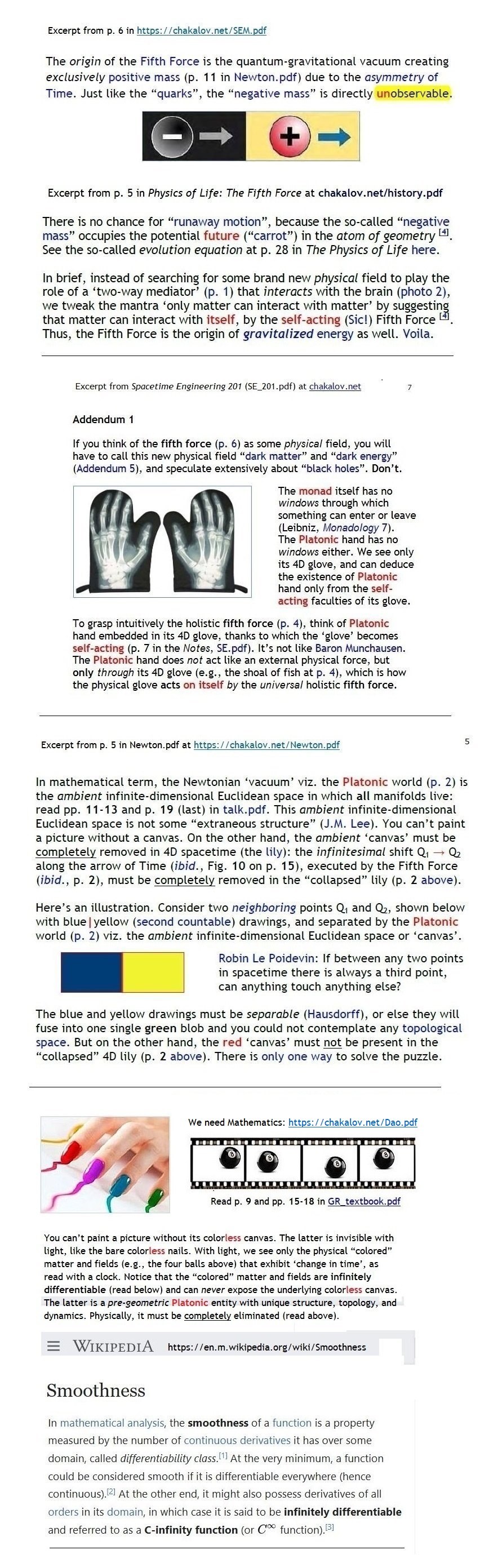
Hence the space itself is endowed with dynamics, but then we need some ether w.r.t.w. such 'global dynamics of 3-D space' can be formulated. Then the only possibility -- trust me, there is no other option -- is to place the omnipresent ether, as 'the source of the "dark" energy', in the global mode of spacetime. Otherwise you will have to define the dynamics of space w.r.t. itself, and will look like Baron Munchausen. That's why we need an arrow of spacetime, in my opinion (but notice the opinion of Chris Isham above). NB: If this is the case chosen by Nature, then any approach to quantum gravity, based on the "splitting" of spacetime (Brett Bolen), will necessarily be wrong. Perhaps we may have to develop new mathematical theory of 'potential reality', such that the "state space" of Margenau's Onta (quantum presentation of Platonic ideas) would match the structure of cognitive concepts; notice that in the "cheating on 20 questions" the answer 'cloud' was explicated by a Baeysian learning rule (not the Born rule). For comparison, the categorification of Feynman diagrams requires "black boxes with many wires going in and many wires going out" (Baez and Lauda, p. 16), while in our case all wires are "instantaneously" (global mode of spacetime; see the Escher drawing below) keeping track of all virtual 'black boxes' as well (relational ontology), in order to dynamically adjust to the changing context of the game, until they jointly select the final, explicated 'black box': 'cloud' (see also the four dice here). NB: In the local mode of spacetime, the "duration" of the total negotiation with 'everything else in the universe' (relational ontology) is zero. Hence a wave pattern is being created, without any source of these "waves" being present in the local mode, and a new form of retarded causality (biocausality; see below) can be postulated -- a revitalization of Leibnitz' harmonia praestabilita, Jung's Synchronicity, and Einstein's Überkausalität. We definitely need mathematical theory of 'potential reality'. The task is highly non-trivial, but once we unravel the correct mathematical theory, the astonishing effectiveness of mathematics (Eugene Wigner) may drive us closer to the true quantum gravity of He Who Does Not Play Dice -- the world is not deterministic but flexible, and the 'chooser' of one possibility (one at a time) amongst infinitely many is 'the whole universe' in its state of ONE. All I've been getting so far is either dark silence or insults (some of them really harsh). Perhaps the situation will improve in 2010, after the sixth consecutive failure of LIGO Scientific Collaboration (LSC) to detect GWs with the so-called "enhanced LIGO". GW energy transfer is fundamentally non-linear phenomenon (Hermann Bondi), but is wiped out with the "linearized approximation" adopted by LSC. Also, GW energy is intrinsically quasi-local, in the sense that GWs do not propagate exclusively "in one direction only" (“when the waves are all moving in the same direction”, cf. P.A.M. Dirac, Ch. 33, p. 64), as they also have a holistic global component (atemporal "handshake"), which covers the whole 3-D space en bloc. Is it possible to detect some 'elementary shift' of the expanding metric -- the "intrinsic time interval associated to any timelike displacement", T. Jacobson, pp. 18-19 -- due to the omnipresent and perfectly smooth DDE? In what reference frame? Notice that you're dealing with some "fluid" that "has zero inertial mass! It can be accelerated with no cost, no effort" (B. Schutz, p. 255) and "provides an all-pervading energy density and negative pressure that are the same to all observers, at all places, and at all times in the history of any universe model, even the expanding ones." (p. 257) Similar rhetoric questions apply to the dynamics of the metric, producing inflationary gravitational waves on the 3-D "balloon" hypersurface. It's a bundle.
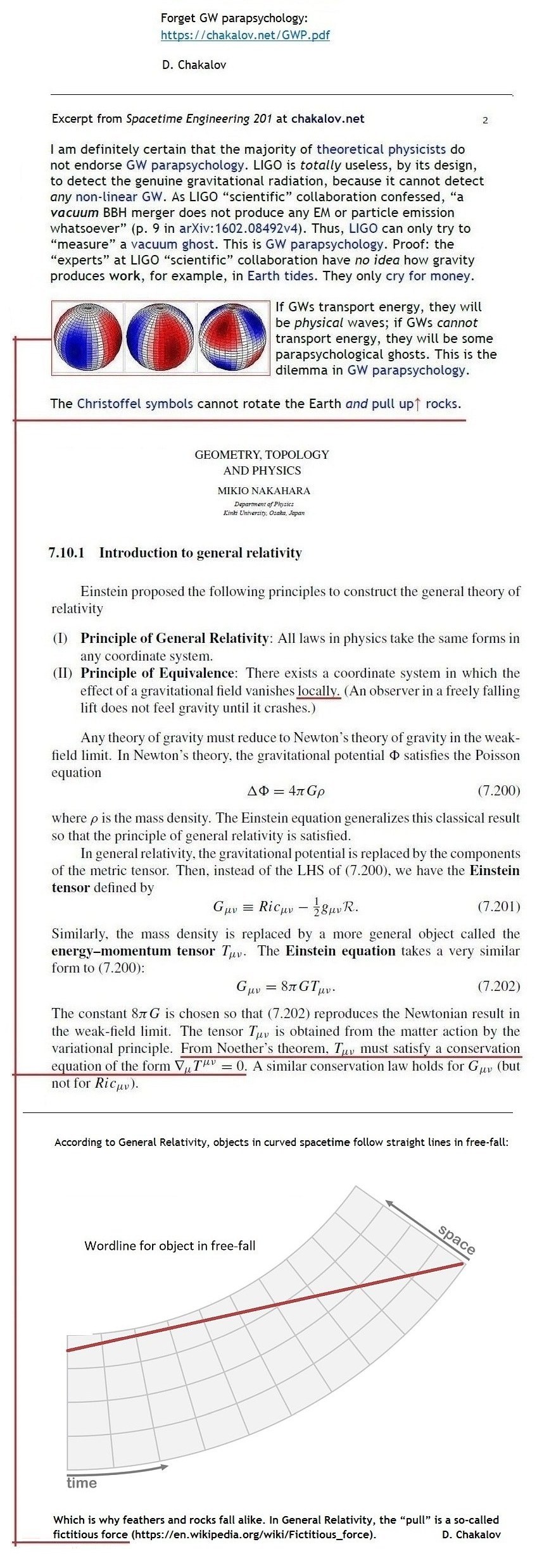
Forget it. There is no need for "precise calibration" of a dead turkey. The insane efforts of LSC remind me of the old joke about a drunken man, who has lost his key somewhere in the dark, but is searching for it under the street lamp, simply because it is brighter there. Only LSC's "key" costs billions. Which is why I accused LSC members of aggressive professional negligence, and offered them to review my White Paper. They responded with dark silence, as usual.
To explain "already", let me quote from Thomas E. Phipps, Should Mach's Principle be taken seriously? Speculations in Science and Technology, 1(5) 499-508 (1978), p. 504:
From this perspective, detecting GW effects requires "online" access to the global mode of spacetime, in which the dynamical determination of spacelike and timelike directions (hence Lorentzian metric) is being produced -- one-at-a-time, along the arrow of spacetime. In simple words, this means that the proper GW detectors must be endowed with the self-acting faculty of the human brain, to match the "interaction of spacetime with itself" (C. Kiefer, p. 2; cf. also J. G. Pereira et al., arXiv:0909.4408v1 [gr-qc], p. 10, Eq. 7.2). As of today, nobody cares. Nobody. I can take it. I'm psychologist, and don't need quantum gravity to practice PHI. Why would a fish need a bicycle?
[click the image to enter the web site]
Hopefully, if we join our efforts and knowledge (included at the level of our collective unconsciousness, cf. Jungian Kollektives Unbewusstes), some day we may succeed. Meanwhile, please keep in mind the prediction of Robert Millikan, Nobel Prize in Physics (1923): "There is no likelihood man can ever tap the power of the atom." This web site is my feedback to all people, who are helping me, one way or another, with improving the theory. Feel free to download it (app. 11.8MB) from http://www.god-does-not-play-dice.net/PHI_info.zip By unzipping PHI_info.zip, a new folder, !Einstein_PHI , will be created on your hard drive. Find there START.html.lnk and open it (it is linked to this front page (index.html) in the website folder). If, for some reason, you believe we don't need new approach to quantum gravity, try to understand Sean Carroll's speculations (448 pages, January 2010): "... wavefunctions appear to collapse in one direction of time but not the other is not an explanation for the arrow of time, but in fact a consequence of it. The low-entropy early universe was in something close to a pure state, which enabled countless "branchings" as it evolved into the future." Yet he acknowledged: "we can't, once again, define a conserved total energy in any reasonable way." Consequently, the main speculation of S. Carroll about some "low-entropy early universe" is just as unclear as is its gravitational energy which would evolve "into the future". (Also, there may be a critical low geometric entropy state of the 'extremely early' universe, which may blur the timelike and spacelike directions themselves, and turn them into some primordial quantum dough from which nothing could possibly "decohere", ever.) As one of his senior colleagues summarized, "the magnitude of the entropy of the universe as a function of time is a very interesting problem for cosmology, but to suggest that a law of physics depends on it is sheer nonsense."
"... when treated in a multiverse framework, fundamental time is directionless and consequently physical laws inherit its time-reversal symmetry. Despite that reversal symmetry is broken for the local time by the bubble nucleation, the bubble still inherits laws of physics at birth from the multiverse, without modification. Thus the emergent time’s arrow in the bubble does not affect the time-reversal symmetry imprinted onto the physical laws that the bubble inherits from birth in the multiverse. (...) An emerging time in the multiverse does not appear plausible since the emergence adds information on the multiverse that wasn’t there prior (... but we face the same kind of emergent non-unitary phenomenon with DDE -- an evolving cosmological "constant" that springs from the quantum vacuum - D.C.)." ... and the obstinate belief of Andrei Linde ($164,179 FQXi Grant): Sure enough, Andrei Linde tried to answer the first off question of how many universes are in the "multiverse" (arXiv:0910.1589v2):
That's how 'potential reality' is being camouflaged in present-day GR, simply because if it were possible to detect the source of DDE as 'gauge invariant observable', the omnipresent and perfectly smooth ether (the source of DDE) will be exposed to direct physical observations, as 'spacetime acting upon itself'. Back in April 1986, Yakov Zel'dovich wrote in a letter the following (private communication): "Long time ago, there was a period of time during which there was still no time at all." Of course he was joking. Yet the 'global mode of time', pertaining to potential reality, cannot be read by any physical clock, because the poor inanimate clock will read it as 'stand still' or "no time at all", as Yakov Zel'dovich put it. Maybe The Beginning, which lives in "no time at all", is always with us (dual age cosmology).
In German, it reads: Der Geist bewegt die Materie. Physically, Der Geist may look like 'the ideal monad without windows'. However, no scientific predictions can be made about it, or else we will conflate religion with science. Thank God, this is impossible.
"Leibniz thought the idea of God as an astronomical maintenance man as absurd. He believed that God had carefully chosen among an infinity of possible worlds, the one He felt the most suitable. So that although we may not have a perfect world, it was the ============================
===================================
Note: The failures to detect GWs were "explained" by Jim Hough with a very misleading statement: "we haven't been able to detect them yet because they are very weak". In fact, GWs are immensely powerful phenomena, but nobody -- Jim Hough and Sheila Rowan included -- can offer a non-linear theory of GWs. All they can do is to imagine that, by the time GWs reach LIGO or LISA, they will be "very weak", such that their spherical-cow approximation to Einstein's GR would be correct. But again, they don't have any non-linear theory of strong GWs, from D.C.
=========================================
"The first question we have to answer is: What are the base states for the system? Now the question has been put incorrectly. There is no such thing as “the” base states, because, of course, the set of base states you may choose is not unique. New sets can always be made out of linear combinations of the old. There are always many choices for the base states, and among them, any choice is equally legitimate. So the question is not what is the base set, but what could a base set be? We can choose any one we wish for our own convenience. It is usually best to start with a base set which is physically the clearest. It may not be the solution to any problem, or may not have any direct importance, but it will generally make it easier to understand what is going on." There is such thing as “the” base state (never in plural) -- the UNdecidable KS state, as explained below. For example, in the case of two spin-half particles, everything you insert in brakets |1> = |++>, |2> = |+->, |3> = |-+>, |4> = |--> ... are just possible physical manifestations of “the” base state, much like the three sayings above, emanating from their UNspeakable potential-reality state of your brain. Thus, the system {“the” base state & |whatever>} evolves along the arrow of spacetime in a strictly quasi-local fashion: see Fig. 1 and Fig. 2 below. Feynman also stressed [Ref. 1, 12-2]: "That’s the question: How do the amplitudes change with time in a particular (fixed) base?" The amplitudes change along the global mode of time: see again Fig. 2 below. Don't be befuddled by the anti-relativistic "time parameter" in the Schrödinger equation, because you need “the” base state to eliminate the measurement "problem" in QM and reconcile QM with STR, as well as solve the puzzle of quantum vacuum and gravitation: “the” base state does not gravitate. It would be nice if Robert Geroch writes up a sequel to his 30-year old book General Relativity from A to B, entitled "General Relativity from A to A+ds", to elucidate the concept of 'interval' in GR -- professionally. But he wouldn't. Trying to discover new math is a tough challenge. The last time I heard from Robert Geroch was eight years ago, only to require his email to be removed from my web site. I will gladly do that, if only he writes a serious paper on GR, or at least reply professionally. Here are two questions: Do you believe that the "points" from the underlying manifold can be connected only and exclusively only by their physical content that is invariant under "active" diffeomorphisms? If your answer is 'no', what could be “the” base state in GR (a.k.a. the reference fluid of GR), which binds the "points" by one single unique bare UNdecidable matrix? If your answer to the first question is 'yes', you are ready to teach GR and enjoy its generic pathologies [Refs 2 and 3]. It is generally believed that (i) one can picture the spacetime in GR as a manifold that can be "locally modeled" on some fictitious flat Minkowski space, but (ii) this picture should break down at short distances of the order of the Planck length. Neither of these ideas are needed, however. There is no need for any limitation in the possible accuracy of localization of spacetime events either. Why is that? Because the so-called Planck length may possess an inner geometrical structure. Ignore it at your peril. D.C.
"The problem of the definition of the concept of singularity in General Relativity is very difficult indeed, as can be appreciated by reading on its historical development (Hawking and Ellis, 1973; Tipler, Clarke and Ellis, 1980). The intuitive ideas are clear: if any physical or geometrical quantity blows up, this signals a singularity. However, there are problems of two kinds: Id., Notes on Differential Geometry, 1, p. 8:
=================================== Subject: The global existence problem in general relativity, ===================================
Re: Positive-mass conjecture in the case of "more and more space appears" ? Thomas Alva Edison, 1889
====================================
Names? They're all at my web site.
The quest for Finite Infinity has a long history, starting from Gunnar Nordström (Über die Möglichkeit, das elektromagnetische Feld und das Gravitationsfeld zu vereiningen, Phys. Z. 15 (1914) 504-506). It is an age-old problem of General Relativity. Nothing could be more important than understanding the topological manifold of the Universe, and its dynamics. Traditionally, experts in GR start with what I hope to derive at the end of this project: asymptotically flat spacetime with quasi-local positive mass. For example, Rick Schoen would presuppose a "smooth manifold", which has already been equipped with a "Lorentz signature metric", "asymptotic flatness", and "appropriate falloff" conditions, and then ask question like: 'why do we see positive mass only' ? A short answer: because we have an Arrow of Space. The detailed answer requires careful analysis of all initial presumptions in Rick Schoen's talk and in present-day GR textbooks.
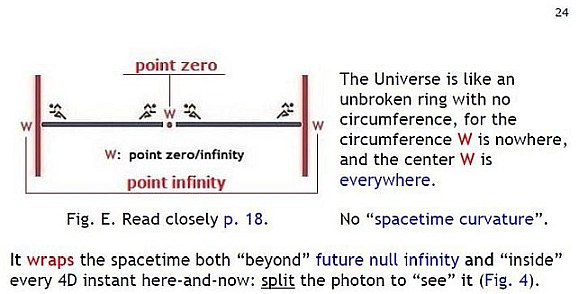
A rigorous definition of 'isolated gravitating system', which would ensure an "asymptotic regime such that all gravitational effects are localized inside of it" (Adam Helfer) and proper boundary conditions, is still an unresolved task: there are no physically motivated boundary conditions in the case of the Einstein equations; for example, "we do not know how to build a mirror for gravitational waves" (A. Rendall), nor can we resolve the paradox of geodesic incompleteness and "black holes". Moreover, how can we define an 'isolated gravitating system' and its (obviously) positive mass if the space itself is endowed with a new, dynamical "dark" energy? The calculating machinery of ADM, suggested half a century ago, doesn't work anymore. Enter the Finite Infinity (FI). In a nutshell, the idea of FI is to suggest a mechanism for obtaining a finite volume of Archimedean 3-D space. The very notion of 'finite 3-D space' implies the existence of two distinguishable volumes of 3-D space, separated by a "trapped" surface (cf. lion's cage below), such that we can always define the notions of 'inside vs outside' (hence "large" vs "small") and 'left vs right'. (In order to eliminate the absolute structure of 'size', we will introduce later the so-called Scale Relativity Principle, SRP.) Now, how can we introduce some process and mechanism by which 'finite space' can be fixed at all length scales, in such way that 'physical space' will never actually reach zero nor infinity but will always remain 'finite' ? We will use an infinite-dimensional Euclidean space and will introduce smooth sphere-torus conversions in it, along a new axis w , such that these sphere-torus conversions snap and fix all Archimedean volumes of 3-D space from both "below" and "above" (cf. Fig. 5). Hence space becomes both "infinite" (local mode of spacetime) and bounded from S and L (global mode of spacetime). The latter is physically unobservable, because we're stuck in the Archimedean 3-D space and don't have access to 'actual infinity'. Only Chuck Norris has been there (twice). As in a good crime novel, all will become crystal clear at the end. Well, eventually. Some history. The notion of 'finite infinity' (Fi) was suggested by George F R Ellis in 1984; please see:
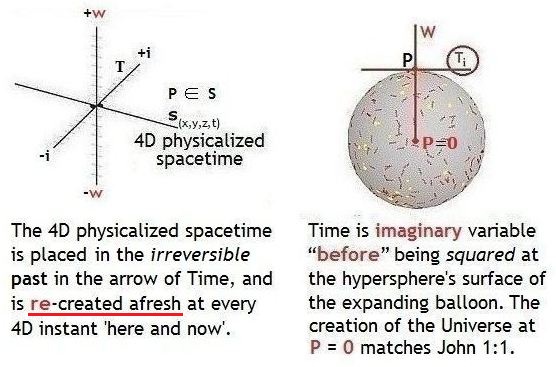
In order to resolve the conundrum of 'ending something', notice that the nature of the local Archimedean mode of spacetime (cf. below) is determined by 'potential infinity': every step toward the Finite Infinity provides the necessary and sufficient condition for the next step, just as in the Thompson's lamp paradox. If we go in the "direction" toward 'the infinitesimal' (S), one can (with some luck) work out a cutoff and end-point, but it will belong, again and always, to the local ("colored") mode of spacetime (see the story about 'John's jackets' below). If we wish to work out a proper Finite Infinity, the obvious choice is to introduce a new 'cutoff and end-point' conjugated with the infinitesimal, S , and to employ the two forms of 'infinity': potential and actual. The latter is 'already completed', in the sense that (i) it does not entail any "dynamics" that can be recorded with a physical clock, and (ii) applies only to the global non-Archimedean mode of spacetime. We begin with postulating an uncountably infinite "number" of points packed in any finite -- arbitrarily "large" or arbitrarily "small" -- line segment, plane, or volume of space in the local (physical) mode of spacetime, in such way that 'there is nothing ]between[ these points'. Then we will "insert" the global mode of spacetime ]between[ the points from the local mode, and will make sure that the global mode is non-existent in the local mode, with the sole exception of the instant 'now' from the Arrow of Space, in which the two modes of spacetime coincide (cf. Fig. 1 below). Notice the crucial difference between the two modes of spacetime: in the local mode, a test particle equipped with a clock reading its proper time will need a finite Archimedean time interval to pass through a finite Archimedean volume of space, even if the test particle travels with the speed of light. It cannot pass through a finite volume of space for 'zero time', even if the volume of space is 'tending asymptotically toward zero', as in the case of the empty set (R). Thus, it will always need 'more Archimedean time' to pass through all uncountably infinite points from the perfectly smooth continuum of the local (physical) mode of spacetime. This is the essence of 'potential infinity', and it is valid only for the local mode of spacetime. Hence the interpretation of 'the infinitesimal' as the empty set (R): in the local mode of spacetime, it is and will always remain a finite entity, tending asymptotically toward zero, being comprised from uncountably infinite points. In the global mode, however, it is a purely geometrical, dimensionless point -- just one single geometrical point (Fig. 1). NB: This one single geometrical point cannot be reach from/within the local (physical) mode of spacetime, for any finite duration of time, as read with a physical clock. Why? Because its physical content (jacket) is UNdecidable, after the Thompson Lamp paradox. Thus, the empty set (R) is endowed with a structure, as hinted in Fig. 1 below, and with 'space inversion' (Fig. 1.1). It is the flashmob for the two modes of spacetime, at which they "coincide". It is also the instant 'now' (now-at-a-distance) from the Arrow of Space. And thanks to the so-called "speed of light", it has zero duration and zero spatial extension. Compared to the local mode, the global mode of spacetime is ontologically different: it is a non-Archimedean realm of 'potential reality' (GPIs), which can traverse any finite -- arbitrarily "large" or arbitrarily "small" -- line segment, plane, or volume of space from the local (physical) mode of spacetime for zero time, as it would have been read by the clock attached to a test particle from the local mode. Namely, the global mode is equipped with 'actual/completed infinity': it can traverse the uncountably infinite points of any finite object for zero time (as it would have been read by the clock attached to the test particle from the local mode), and endows the local mode with a web of "instantaneous" correlations (as they would have been read by an inanimate clock from the local mode). With the Arrow of Space, such kinematics gives rise to a new dynamics resembling a living organism: a 'school of fish'-type bootstrapping of physical systems in their quantum and gravitational regimes, and quasi-local geodesics, in line with the rule 'think globally act locally' (hence one can introduce a background-free, relational reality and Machian quantum gravity). The question of what kind of 'global time' runs in the global mode of spacetime, equipped with "instantaneous" actual infinity, can be answered by explaining its corresponding 'global space' and the non-Archimedean structure of the purely geometrical GPIs in it. In general, the quest for amending Finite Infinity with an Arrow of Space is highly non-trivial, because we should also consider the following tasks: 1. The two modes of spacetime are separated by the fleeting instant 'now' from the Arrow of Space, namely, the global mode is placed in the realm of 'potential reality' (GPIs residing in the potential future in the Arrow of Space), while the local mode refers to the irreversible world of explicated GPIs in terms of facts, placed in the steadily increasing 'irreversible past' from the Arrow of Space. Such 'ever-increasing past' is what makes an 'arrow', due to irreversible 'information gain': every instant 'now' pertains to an explicated physical universe, which contains more information that its immediate predecessor in the 'ever increasing past', and at the same instant 'now' the physical universe is offered an enriched spectrum of potential states to choose from for its next instant 'now', just as in the cognitive cycle of Ulric Neisser (Fig. 2 and Ch. 2 and 4). Metaphorically speaking, the Arrow of Space is depicted with the Dragon devouring its tail (Ouroboros), from the Chrysopoeia ('Gold Making') of Cleopatra during the Alexandrian Period in Egypt. The enclosed words mean 'The All is One.'
1.1. The only "meeting point" of the two modes of spacetime is the instant 'now', in which they coincide (Fig. 1). The result is an already completed and already negotiated physical universe, spanned across the absolute instant 'now' from the Arrow of Space, with 3-D space and zero "thickness" along w (cf. below), in which “there’s energy in the gravitational field, but it’s negative, so it exactly cancels the energy you think is being gained in the matter fields” (Sean Carroll); check out the Photoshop layers metaphor below and the resulting non-linear dynamics here. 2. The unique "boundaries" on 3-D space in all (timelike, null, and spacelike) directions, introduced with Finite Infinity, should make the universe an 'isolated system', which (i) contains 'absolutely everything', included its Aristotelian First Cause, (ii) is self-enclosed (Albert Einstein), and (iii) is "bounded" by some ambient unphysical spacetime (called here 'global mode of spacetime') which is part and parcel from the same 'isolated system'. 2.1. To describe such 'universe as ONE' -- self-wrapped (cf. (iii) above) and endowed with the faculty of 'self-acting' due to its "gravitational field" -- one needs to place its source "inside" the instant 'now' from the Arrow of Space (Fig. 1), and make sure that the so-called "dark" energy of 'the universe as ONE' is unobservable in principle. 3. Last but not least, the ultimate source of 'the universe as ONE' should be interpreted as 'zero nothing', that is, a special kind of "zero" opposite to the mundane case of 'zero something'. Perhaps the only way we could grasp the notion of 'zero nothing' or 'the true monad without windows' is by recalling the relation between the content and volume of concepts: the larger the volume, the smaller the content; hence the source of 'absolutely everything, the unknown unknown included' should possess zero intrinsic content (cf. the undefinable matrix). I haven't been able to find suitable mathematical formalism to describe these widely known ideas. All I can offer is a simple (but incomplete) geometrical explanation of Finite Infinity. Firstly, there should exist a maximal volume of 3-D space (L), at which we place the Finite Infinity (FI), such that any finite volume of space, no matter how large, is identified as an Archimedean sub-volume smaller than the 'maximal space volume', L . Likewise, there should exist a minimal volume of 3-D space (S), at which we place the same Finite Infinity (FI), such that any finite volume of space, no matter how small, is identified as an Archimedean volume larger than 'the minimal space volume', S . Secondly, the two physical, finite, Archimedean volumes of space tend asymptotically toward L and S in the local (physical) mode of spacetime, but cannot reach them for any finite Archimedean duration of time due to the "structure" of the empty set (R) at which the global mode and the local mode coincide (Fig. 1). The 'no-go' axiom about the empty set (R) ("cannot reach them for any Archimedean duration of time") stems from our belief (not 'fact') that there exist, in the local mode of spacetime, an 'uncountably infinite' "number" of points between any finite Archimedean volumes of space and their "two" cutoffs, L and S : the empty set (R) cannot be bridged by any finite Archimedean system for any finite duration of time, even if it jumps over the points with the "speed of light". That is, in the local mode of spacetime the empty set (R) is 'finite' entity, and will always occupy a finite, albeit "very small", volume of space packed with 'uncountably infinite' points arranged by 'potential infinity'. On the other hand, the same empty set (R) is consumed/traversed instantaneously in the global mode of spacetime, which has non-Archimedean nature and is endowed with 'actual/completed' infinity. Thus, we shall place the "two" cutoffs, L and S , within the red point in Fig. 1 below, stressing again its UNdecidable nature (Thompson Lamp paradox) of 'potential reality': pre-quantum non-colorizable General Platonic Ideas (GPIs). FI Postulate: Due to the Thompson Lamp paradox, any finite, arbitrarily "large" or "small", Archimedean volume cannot physically reach L and S residing in the global mode of spacetime, equipped with actual infinity. A precise explanation of 'physically reach': in the local (physical) mode of spacetime, we always reach/nullify the empty set (R) at the point of '2 min', which is why the state of Thompson's lamp is always defined by the rules of 'bartenders', but it is just a fleeting "jacket" cast by John from the global mode of spacetime. The latter is endowed with actual infinity. In other words, in the global mode of spacetime the interval [0, 2] is closed, while in the local mode the same interval is open -- (0, 2). Thanks to the Arrow of Space, the 'large finite volume' will chase L in the local mode indefinitely; in the local mode of spacetime the empty set (R) can only tend asymptotically toward zero. The same holds for the opposite case of the separation of any arbitrarily small Archimedean volume of space from S by the same empty set (R): in the local mode, it would require an infinite -- actual infinity -- amount of time for the elimination of the empty set (R) and reducing it to zero, at which point the Arrow of Space would stop, and the universe would cease to exist. Notice that the FI Postulate introduces new structure of spacetime at the level of 'differentiable manifold' prior to any matter; example here. The very notion of 'space' requires that all physical objects acquire finite Archimedean size; a table with length 'one meter' fills in a template for 'one meter'. In the case of an one-meter template, we observe a finite table with length one meter, which is again a 'sub-volume of finite space'. The purpose of Finite Infinity (FI) is to define the largest template and the smallest template for all finite volumes of 3-D space.
Thanks to the empty set (R), no physical, Archimedean stuff can 'physically reach' L and hence go "beyond" L , and also no physical stuff can 'physically reach' S and hence go "below" S (compared it to the conformal recipe): L & S is ONE object which belongs to the non-Archimedean global mode of spacetime. In a nutshell, the modified Finite Infinity satisfied two conditions: in the local mode of spacetime the universe approaches asymptotically its causal boundary (cf. Eq. 1 above) within an open interval, while at the same time the universe is being (present continuous) permanently wrapped by itself in the global mode of spacetime. Hence 3-D space can be literally wrapped by itself, exactly as Albert Einstein required. Again, there is no path whatsoever to the global mode of spacetime from the local mode of spacetime; hence the FI Postulate above. The difference between S and L is that in the case of the former we can find some 'numerically finite but physically unattainable boundary/cut off' (the Planck length), but for L we have only an eternally expanding 'sub-volume of finite space', which can only chase L but can never physically reach it: L and S belong to the non-Archimedean global mode of spacetime. It is the Arrow of Space which creates such asymmetry in the treatment of L and S . We have a numerically finite but physically unattainable "bottom", while space "expands" in the local mode toward L indefinitely: at each and every instant 'now' from the Arrow of Space, the universe occupies a finite sub-volume, being literally wrapped from both "below" and "above" with Eq. 1 above. Depending on the direction we look at the edge of the universe in the local mode of spacetime, either toward L or toward S , we see "two" edges, while in the global mode they are ONE -- the universe as ONE, as stressed by Lucretius some 2060 years ago. We don't have such structure of spacetime in differential geometry textbooks. Notice that we face here a kind of 'logical infinity': no physical, Archimedean volume of space can reach L , because L & S belong to the 'the universe as ONE' (Eq. 1 above). In other words, one could logically reach something only if this "something" is 'not yet reached', while in our case it is logically impossible to "reach" something (L) which is being eternally residing "inside" us (S) from the outset. Thus, the notion of 'logical infinity' refers to the statement that if the Arrow of Space is terminated, the universe will cease to exist and will return to its initial state of pure light and cognition, known as [John 1:1]. Without the global mode of spacetime, the universe would be governed exclusively by Archimedean geometry, conformal recipes would have worked, tessellation of space with 3-D "tiles" would have been possible, and we would calculate the exact finite number of "atoms" filling a finite volume of space without any gaps from the empty set (R): we would hit an "end-point" beyond which "is nothing, and then more nothing" (S. Leacock). Thank God, this is impossible. Now, let me try to explain geometrically the empty set (R), which would "point" to the "dimension" of space, denoted with w (from wunderbar, after Theodor Kaluza), of the postulated global mode of spacetime (pictured with red; local mode with black). The size of physical bodies along w are zero, because w lives only at the fleeting instant 'now' -- a purely geometrical "point" at which the two modes of spacetime, global and local, coincide. Attached to the same instant 'now' is a 'pocket of propensity states' in the global mode of spacetime, called General Platonic Ideas (GPIs); check out GPIs in the human brain (not "mind") here. First, the dimensionless instant 'now', at which the two modes of spacetime coincide:
The next step is constructing 2-D space from Fig. 2.2, by introducing a second spatial dimension, again with two directional degrees of freedom, and move all points from 1-D space, en bloc, in two opposite directions (Fig. 3.1).
In the current GR textbooks and tutorials, the black and red points in Fig. 3.3 are fused with the rules of diff calculus, after Leibniz; then people claim that in "sufficiently small" (notice the poetry) neighborhood around such fused black/red point "it is possible to choose a "locally inertial coordinate system" such that, within a sufficiently small region of the point in question, the laws of nature take the same form as in unaccelerated Cartesian coordinate systems in the absence of gravitation" (cf. below). What a mess. Going back to the Flatland: we, as "global" observers, can "see" all points from Fig. 3.2 en bloc, while the Flatlanders will encounter obstructions from a line: it will be like an infinite 1-D wall which prevents them from seeing "behind" the wall. We can "see" all the points from Fig. 3.2 simultaneously, en bloc, which would translate to Flatlanders as 'keeping simultaneously two inverted images from their Flatland', one with T-symmetry and a second one with P-symmetry. Regarding their 'time', the Flatlanders will be totally puzzled by our ability to oversee en bloc their two paths from A to B in their (t+)-direction, and from B to A in their (t-)-direction. They don't have such clock, and will claim that our "time" is dead frozen (much like 3-D people do in canonical quantum gravity). It requires far more efforts to elaborate on the example from Wiki about an infinite 2-D plane in our 3-D space, which poses no restrictions to "observers" in the global mode along w , equipped with actual infinity and capable to "see" simultaneously all points from our 3-D space both en bloc and inverted with 'space inversion' (cf. Fig. 5). Notice that we have three such restrictive planes in 3-D space (xy, xz, and yz, cf. Fig. 4.2), and enjoy CTP-invariance upon "swapping" the points via the global mode of spacetime, as we did in Figs 2.1 and 3.1 above. The new symmetry, called 'space inversion', should eliminate all fixed relations in the Archimedean 3-D space, such as 'large vs small' or 'inside vs outside'. Otherwise our 3-D space will not be dynamical, but will impose a fixed background for the length scale in terms of absolute size of objects in 3-D space. Once we eliminate the absolute Newtonian time, we should eliminate all absolute structures from 3-D space as well. To elaborate on the example from Wiki, I suppose one could "see", from the global mode of spacetime, two superposed P-invariant images of "the lion", obtained after the inverted (w.r.t. the cage surface) 3-D space. Such symmetry is literally about inverting all the "points" trapped inside a finite volume of space approaching asymptotically S with all the "points" from the finite volume of space approaching asymptotically, in "opposite direction", L , which remain outside that "shrinking" finite volume of space (Fig. 1.1). The "number" of points in any finite volume of space is 'uncountably infinite', so there should be no obstacles to perform such 'space inversion'. Let's start with endowing the Flatland with a spatial dimension, by moving all the points from Fig. 3.2 en bloc along two opposite "directions", up (toward L) and down (toward S):
Due to the 'spontaneous broken symmetry' (cf. below), we have two kinds of mass in the picture above, real and imaginary (tachyonic), safely separated by a timeless luxonic world of zero, or rather indifferent mass, which keeps the dimension w totally hidden. Notice that, in addition to the three planes in 3-D space (xy, xz, and yz) and their corresponding transformations or "swapping the points" (CPT-invariance), we have a new 'space inversion' symmetry, as mentioned in the discussion of Fig. 1.1 above. You will have the unique freedom to "look" at the 3-D hypersurface simultaneously along the two directions of w : from 'inside-out' and from 'outside-inside' (cf. the drawing from Mark Armstrong below), corresponding to 'sphere' and 'torus' (cf. Fig. 5).
Such simultaneous viewpoint is impossible to imagine, as hinted in Wiki, but if we lower the dimensions of the physical space to 2-D spherical surface trapped by the six red planes in Fig. 4.2, the 'inside-out' view will display all points from the 2-D spherical surface, as seen from the center of Fig. 4.2 along all radial directions 'inside-out', and by executing 'space inversion' with respect to the 2-D spherical surface ("lion's cage") we will see again all points from the finite 2-D surface from 'outside-inside', along the inverted radial directions, keeping the two presentations of the 2-D "rubber glove" (left and right) simultaneously available to our w - inspection. However, we cannot "move" the unique object at the center of Fig. 4.2, shown with the red point in Fig. 1 above: it is in 'absolute rest' and is residing both inside every point from the physical 3-D space and outside the physical 3-D space, as The Beginning (see below) of the two viewpoints at the 3-D "rubber glove" hypersurface along w , from 'inside-out' and from 'outside-inside'. Now, if we keep the radius constant, such non-smooth topological transition will match a well-known screensaver in Windows 97, half of which is depicted with the drawing from D. DeCarlo and D. Metaxas (1996) below.
Again, the two opposite directions along w are totally hidden inside the luxonic world (cf. Max Tegmark above) with indifferent (zero) mass. Physically, the two directions of the circle/torus conversion in the global mode of spacetime, along w , are totally hidden, their duration is zero, and we can only imagine two atemporal waves, depicted with the Escher hands, by which all non-linear negotiations in 'the school of fish' are completed for zero time, as read with your wristwatch: we can never see Macavity.
Consider again a finite chunk of space, say, one meter: it is comprised from uncountably-infinite 'points' ordered with the relation of intermediacy, [A (zero) B]. The Aristotelian Connection of 'the universe as ONE', [A (zero) B], passes the physical state at point A to its "neighboring" point B with particular "speed" which acquires an upper limit for any finite volume of space. The numerical value of the "speed of light" isn't interesting; just like the Planck length, it is a 'numerically finite but physically unattainable boundary of the local mode of spacetime'. We cannot define, even as a Gedankenexperiment, 'one second' as the product of [Planck time] x 1043. The universe as ONE (global mode) is a totally different world which shows up only with its Aristotelian Connection. What matters here is that The Aristotelian Connection operates in the global mode of spacetime: it "reads" all of the uncountably-infinite 'points' from any finite chunk of space en bloc . By an analogy with a movie reel, one could speculate that The Aristotelian Connection is "projecting" 3-D space as 'uncountably-infinite infinitesimal "frames" per second', meaning that every "frame" is the 'collapse over infinity'-state (cf. Fig. 5). Unless we encounter relativistic effects (watch the movie from NOVA below), this en bloc "reading" does not slow down (for comparison, watch a water drop here).
Notice the precise meaning in GR of 'already-completed': all non-linear negotiations between the two sides of the Einstein field equations are being post factum completed for zero time, as read with your wristwatch. "All agree that in general relativity, the metric tensor gij is (or better: represents a field that is) dynamical: it acts and is (at the same instant - D.C.) acted on. They also agree that it is a special field since it couples to every other one, and also cannot vanish anywhere in spacetime. Many authors go on to say that the metric tensor represents geometry, or spacetime structure, so that geometry or spacetime structure acts and is (at the same instant - D.C.) acted on" (Jeremy Butterfield). More succinctly: "the metric is treated as a field which not only affects, but also is (at the same instant - D.C.) affected by, the other fields" (John Baez). This non-linear paradox is depicted with the Escher hands above, and can be resolved only with the two modes of spacetime, as argued previously. Michael Redhead argued in 1995 that the notion of 'localizable particle' makes sense only for a free particle, while I suggest a 'quasi-local' alternative in terms of Machian relational ontology with the rule 'with respect to everything else in the universe'. In short, the issue of relativistic causality is anything but trivial in GR. As stressed by Margaret Hawton, in quantum field theory probability density is defined at a fixed instant t , and it is by no means obvious how to "insert" in such fixed instant t the already-completed non-linear 'acting and at the same instant being acted upon' in GR. Thanks to The Aristotelian Connection [A (zero) B], there exists a bond between spacetime points, and the "speed" of light is its manifestation. If the "speed" were infinite or unlimited, there would be no difference between 'small' and 'large', and '3-D space' as the medium for 'finite things' would have not existed; if the "speed" of light were a finite entity, it would be surpassable, and then there would be no separation between the two worlds with inverted spacetime basis, material and tachyonic (cf. Max Tegmark above). Notice that 'space as the medium for finite things' is a very old idea, debated by Ernst Mach. The difference between 'small' and 'large' is not fixed in the local, Archimedean mode of spacetime, but in the global, non-Archimedean mode by 'finite invariant templates' (cf. below). NB: The alteration of these templates is the essence of gravity. We have 'finite invariant templates' for 'finite space', fixed by The Aristotelian Connection: it is the bond between spacetime points that determines 'the time it would take a photon to traverse a distance equal to a [finite volume of space]'. (As Erik Curiel explained, arXiv:0908.3322v3 [gr-qc], "in general relativity all the fundamental units one uses to define stress-energy, namely time, length and mass, can themselves be defined using only the unit of time; these are so-called geometrized units. (...) A unit of length is then defined as that in which light travels in vacuo in one time-unit.") Then a minuscule alteration of the bond between spacetime points can produce enormous change of 'the time it would take a photon', and subsequently of the 'finite invariant templates' (resembling "curvature", cf. Bill Unruh), leaving the deceitful impression of some "cold dark matter" or "supermassive black hole". Notice that 'the time it would take a photon', which defines each and every 'finite volume of space' (see above), is the global (en bloc) mode of time. It is the background time code of the animation from John Walker below, and it must be totally hidden.
Again, the crux of the matter is the initial puzzle of 'one meter' and its treatment with the two manifestations of infinity. Namely, with the potential infinity operating in the local (physical) mode of spacetime, 'one meter' will be presented with "open sets" (James Dungundji), which do not include the crucial 'end points', ( 1m ), despite the fact that any such interval can be defined only with respect to a fixed point in The Beginning; with the actual/completed infinity operating in the global non-Archimedean mode of spacetime, the same 'one meter' will be presented as 'completed' en bloc interval [ 1m ]. The puzzle of 'the infinitesimal' was identified by Titus Lucretius Carus some 2070 years ago, yet people still seek 'the smoothest manifold' like bartenders, and of course cannot find 'the unmoved mover' in GR (Karel Kuchar). There is a lot more to be said about the "speed" of light, as The Aristotelian Connection "happens" only post-factum, at null-surface. We cannot witness the alteration of these templates online, as it "happens", and we will always observe an already-assembled, by The Aristotelian Connection, spacetime in which we cannot reach the luxonic world. By going into the center of Milky Way, all we can post-factum observe is a finite volume of space in which our 'one meter and one second' has not been altered, hence we would claim that these 'spacetime templates' are "invariant to us", while a distant observer will see us "shrinking". Ditto to the "expansion" of space. There is no need to invoke any anomalous "dark" stuff with "positive energy density and negative pressure", as you may have heard from Ned Wright, say. More on SPR later; for now it suffices to say that the "speed" of light must be 'numerically finite but physically unattainable boundary' in order to provide for finite volumes of space and time intervals of the local mode of spacetime. First and foremost, I need to eliminate all absolute structures in 3-D space, such as 'absolute size', by allowing the 'templates for finite space' to shrink toward S and expand toward L , as viewed by an observer at the length scale of tables and chairs, and also providing invariant size of all object toward S and toward L , as seen by a co-moving observer. In other words, we need a dual, scale-dependent metric to define 'distances in 3-D space'. Then the "expansion of space" can be explained as an illusion observed only from the length scale of tables and chairs. Ditto to the "non-accelerated" shrinking of the "size" of objects toward S , in line with the so-called 'scale relativity principle' (SRP). The latter is an elaboration on the old idea about 'the mutual penetration of the Large and the Small'. Who has "the right meter"? Nobody. This is the essence of SRP. Simple, no? NB: To explain the 'templates for finite space' and their "dark" influence on matter and fields, recall the operational definition of 'second': the total duration of 9,192,631,770 transitions between the two hyperfine levels of the ground state of the cesium 133 atom, provided the cesium atom is "at rest at a temperature of 0K, such that the ground state is defined at zero magnetic field" (reference here). In the local, Archimedean mode of spacetime, we imagine that the distance between every two neighboring dots from the drawing below refers to one transition between the two levels of the ground state of the cesium-133 atom, and that the total of such physical, Archimedean distances, comprising 'one second', is exactly 9,192,631,700:
This is clearly an unfeasible Gedankenexperiment, which cannot be reproduced. Most importantly, the "intrinsic time interval associated to any timelike displacement" (Ted Jacobson, pp. 18-19), defined here as 'the elementary tick of time ]between[ two purely geometrical points ordered with the relation of intermediacy [A (zero) B]', can be defined only in the global, non-Archimedean mode of spacetime. These are 'invariant templates' for finite durations of time and finite volumes of space, which approach asymptotically L and S . NB: An objection to such 'finite templates' would be that they are merely mental, or epistemological constructs representing our "knowledge", hence we cannot grant them an ontological status of 'ideal geometrical reality'. Well, with Finite Infinity we can indeed suggest such 'finite templates' fixed by the topological transitions in the global mode of spacetime (cf. Fig. 5), hence resolve the underlying puzzle of 'extendable volumes of space', which allow us to "look around, and see as far as we can" (L. Smolin). This simple fact can be explained iff the spacetime "points" are perfect geometrical points ordered by The Aristotelian Connection as a perfect continuum (the current theory requires that "points become fuzzy and locality looses any precise meaning," cf. Sergio Doplicher). The alteration of these templates, relative to an observer at macroscopic length scale, produces purely geometrical effects (interpreted as "black holes" and "expanding space"), yet a co-moving observer will not notice any alteration of her intrinsic 'distance function'. Again, this is the well-known idea about 'the mutual penetration of the Large and the Small', which can start only from the macroscopic length scale in the two "directions" along w , toward L and toward S . With SRP and its dual spacetime metric, one could alter the "distances" in 3-D space in such a way that a "reactionless" alien visitor craft (AVC) will travel with speed "one meter per second" (relative to the people in the AVC) to cover the size of a galaxy (relative to observers outside the AVC). You won't notice your "speeding", but you will notice that the space in front of you is running towards you, just like with the Alcubierre warp drive. In SRP, the question of 'who has the right meter and the right second' is meaningless. In present-day GR, the question of 'who has the right meter' is answered with absolute size of objects in 3-D space, toward L and toward S , which is nothing but 'looking for a right answer to a wrong question'.
Notice that the horizontal w axis is not a 4th spatial dimension, because the new degrees of freedom to "look at" the 3-D "rubber glove" Cauchy hypersurface entail moving simultaneously along all directions in the local mode of spacetime, from any point in 3-D space, from both 'inside-out' toward L and its time-reverted direction toward S . This is impossible in 3-D space, as explained in Wiki below, but recall that these are the "directions" of the Arrow of Space: the elementary 'change of space' is nothing but the elementary increment of our physical time, as read with our clocks -- it isn't a "vector". Thus, the global mode of spacetime and the axis w of the Arrow of Space could only be perceived by us as "occurring" in some infinite-dimensional Euclidean space, much like a Flatlander (cf. Fig. 3.2) would be totally puzzled by our 3-D viewpoint, and would also have to imagine some higher-dimensional space to accommodate our 3-D viewpoints inside his Flatland. To visualize these smooth torus-sphere transitions over the 'collapse over infinity' instant 'now' (Fig. 1), hence the re-created 'asymptotically flat 3-D space', look carefully at the drawing below, from Eric Schechter (5 December 2009, emphasis added): "There are no points for plus or minus infinity on the line, but it is natural to attach those "numbers" to the endpoints of the semicircle."
But look at Eq. 1 above: in the global mode of spacetime, we can set L and S to take values of some dimensionless variable "measured" along w ; all we need is to ensure that L and S take reciprocal values, until they snap to L = S = 1 (Eq. 2).
Namely, Eq. 2 reduces to Eq. 1 above, and the finite, Archimedean, 3-D space is born anew by the "spontaneous" broken symmetry, stacked along w like Photoshop layers. We cannot look at the "gaps" of re-creation: the local (physical) mode of spacetime is being re-created as a perfect continuum, thanks to the "speed of light".
In the quantum-and-gravitational realm of the local (physical) mode of spacetime, physical objects gradually acquire increasing access to 'the whole universe as ONE'. They become bootstrapped by their "gravitational field", due to opening a "red window" to their GPIs residing in the global mode of spacetime. Which is why a quantum particle can be in a superposition of its GPI states (say, a superposition of |cat> and |dog>, Erich Joos), and all (not just "small") bodies follow quasi-local geodesics: at each point from such quasi-local geodesics we can install a local Lorentzian frame, by going into "freefall" at such quasi-local point, and imagine that the effects of gravity have re-disappeared. All this is a very brief and incomplete effort to amend the Finite Infinity, introduced by George F R Ellis. Needless to say, I will be happy to elaborate. Details here.
================================
======================
Note: Look at the "direction" of GW scattering in the animation below: you might be able to "see" these GWs iff you're a meta-observer capable of monitoring the whole spacetime en bloc. However, this same "direction" is assumed to exist inside the same 3-D space as well: check out the Mock LISA Data Challenge Taskforce and LIGO-Virgo Mock Data (custom made) Working Group, as explained eloquently in their arXiv:gr-qc/0701026v1: "The burst “repeater” source was placed at the center of the Galaxy and the performance modulation due to Earth’s rotation has been studied with 24 hours of simulated data." So, the direction of GW scattering 'from the center of the Galaxy toward Earth' matches the direction of the same GW scattering seen by the meta-observer. Do you smell a rat? If not, join LIGO Scientific Collaboration. D.C.
=====================================
Note: Check out N. Dadhich's arXiv:gr-qc/0405115v1, particularly the discussion of Eq. 4. He also posed the following question (arXiv:0802.3034v5 [gr-qc]): "It is remarkable that even classical dynamics of gravity asks for dimension > 4. As two and three dimensions were not big enough for free propagation of gravity, similarly four dimension is not big enough to fully accommodate self interaction dynamics of gravity. Then the most pertinent question is where does this chain end?" It ends at infinitely-dimensional spacetime -- see Fig. 2 below. Every infinitesimal "point" from the local mode is endowed with infinitely-many connections (global mode of spacetime) with 'the rest of points' in the local mode. And since the global mode is hidden by the so-called 'speed of light', the bootstrapped local mode is "self-acting" upon itself along the arrow of spacetime. Not surprisingly, the origin of this "self-force" is not traceable, and some people consider it "dark". This offers a new interpretation of the old idea of "breathing" (inhaling/exhaling) universe (common knowledge in India), only the duration of the "breathing" cycle is exactly zero in the local mode of spacetime, rendering the latter a perfect continuum. That's the proposal for 'quantum principle for spacetime dynamics', after Schrödinger and KS Theorem. Perhaps Naresh Dadhich would some day accidentally discover it. All he has to do is to forget about "branes" and other multidimensional superstitious. D.C.
Dear Dr. Crane,
=====================================
=======================================
It is manifestly pointless to dream about LISA, because you won't get it. ===============================
----------- Note: At the age of 57, my hair is getting lily-white, and I may claim that it is sufficiently white to enjoy surfing at porno in the web, yet still sufficiently black to attract real blond girls. Likewise, LSC members deeply believe that GW strain, which might hit LIGO some day, would be sufficiently weak to be modeled with the linearized approximation of GR, yet sufficiently strong to be detected with the so-called Advanced LIGO (cf. J. G. Pereira et al., arXiv:0909.4408v1). But LSC can't have their cake and eat it. As Hermann Weyl demonstrated in 1944 (Hermann Weyl, How Far Can One Get With a Linear Field Theory of Gravitation in Flat Space-Time? American Journal of Mathematics, Vol. 66, No. 4 (Oct., 1944), pp. 591-604), the linearized approximation of GR is "a shadow without power". Notice that LSC cannot describe smooth bi-directional transitions from strong GWs to very weak GWs, as they approach asymptotically their sudden death at the stage of "a shadow without power". Joshua Goldberg is manifestly silent on this crucial problem, and Kip Thorne didn't even mention Hermann Weyl's article in his lecture "Gravitational waves in flat spacetime". Instead, he tried to defend the so-called "invariance angle" of LIGO's arms with an article by Eugene Winger, which he has read as a student "around 1960". Just look at the L-shaped tunnels of LIGO: isn't this 'graviton parapsychology'? The persistent "evolution" of the beliefs of LSC members is really amazing. Back in 1981 (cf. Daniel Kennefick, p. 1), Kip Thorne had no difficulty in "finding a taker for a wager that gravitational waves would be detected by the end of the last century. The wager was made with the astronomer Jeremiah Ostriker, one of the better-known critics of the large detectors then being proposed. Thorne was one of the chief movers behind the largest of the new detector projects, the half-billion-dollar Laser Interferometer Gravitational Wave Observatory, or LIGO. He lost the bet, of course." Now LSC members are effectively saying 'just gives us a couple of billion dollars more, and we gonna make it'. Exactly how much more? The Advanced LIGO Cost Estimating Plan (M990310-05.pdf, updated 05.27.2003) is here, but is hidden to 'mass society' taxpayers. Notice that LSC have already prepared 'Plan B', in case they fail miserably again. In their latest "science white paper", submitted to the Astro2010 Decadal Survey (Bernard F. Schutz et al., arXiv:0903.0100v1 [gr-qc], p. 3), they wrote: Once the "Advanced LIGO" fails in 2015, they will celebrate the 100th anniversary of Einstein's GR with their "way to new physics", claiming that their total failure is actually of fundamental importance, like the negative result for the ether drift in the experiment of Michelson and Morley ... but with just a few billion dollars more for LISA and Einstein Telescope, everything will be just right.
D. Chakalov
Note: The staggering problem of "GW astronomy", encoded in the asymptotic expression r --> [infinity] , can perhaps be explained by an ancient Greek in the following fashion. Suppose Achilles is throwing his famous spear in one direction along the radius of the universe, r , starting from its center at Athens. He isn't familiar with the wisdom of present-day cosmology, but is a staunch relativist and knows that the universe is like an unbroken ring with no circumference, for the circumference is nowhere, and the "center" is everywhere. How can Achilles prove the 'no circumference' conjecture? Suppose that, at some advanced stage from his exercise, he finds out that cannot throw his spear anymore, because he has reached some (asymptotic) limit of being 'too far away from Athens'. Namely, the increasing distance (r) between Achilles and Athens somehow blocks his spear at r --> [infinity] , placing the circumference of the universe at some "effective infinity" from all "centers", Athens included. But because Achilles is smart relativist, he will be immediately puzzled by the privileged (if not absolute) location of Athens in the universe and its influence on his spear, such that he cannot replace Athens with some closer point from his path (say, just one point behind the last location of his spear) and throw his spear further, ad infinitum. This is very unclear, isn't it? As Adam Helfer put it (arXiv:0903.3016v1 [gr-qc]), the asymptotic spacelike regime is "less well understood mathematically at present". English translation: it's pure poetry, as stated above. The situation with the alleged null infinity isn't better either: "From a physical point of view, null infinity is very far away." (Bernard F. Schutz, Mathematical and Physical Perspectives on Gravitational Radiation, August 2, 2002) To paraphrase Woody Allen, infinity is very long, especially towards the end. People tend to indulge themselves with some "rescaling metric" recipe (Ted Newman), but it is totally unclear how to "rescale" the metric during its accelerated expansion, as driven by the "dark" energy from empty space. In this gloomy situation, may I offer some optimistic speculations. John Stachel mentioned a seminal paper by Niels Bohr and Leon Rosenfeld, Zur Frage der Messbarkeit der elektromagnetischen Feldgrssen, published in 1933: Because EM charges "occur with two signs that can neutralize each other, a charge-current distribution acting as a source of an electromagnetic field can be manipulated by matter that is electrically neutral and so not acting as a source of a further electromagnetic field; and one can shield against the effects of a charge-current distribution." Then he added: "A glance at Bohr and Rosenfeld 1933 shows how important the possibility of neutralizing the charges on test So, we need some entity that is charge-neutral to the two signs of mass: potential reality. Also, because GWs are sheer coordinate effects, they might "propagate" with any velocity desired by the human imagination, included 'the speed of thought' (Arthur Eddington, The Propagation of Gravitational Waves, 1922). We have to stick to the full non-linear GR, because its linearized approximation is "a shadow without power" (Hermann Weyl; see above). Yes, GWs exist, and can be detected. All we may need is a "device" that can also detect quantum waves without any "collapse" whatsoever: a human brain. All this has been said many times at this web site; sorry for repeating it here. The only correction I need to make concerns my statement above: "Einstein's errors regarding energy transport by GWs were identified even before Kip Thorne was born." But I was wrong. Hermann Weyl's article was published in 1944, at the time when Kip Stephen Thorne was 4 year old. Sorry, I was wrong. Mea culpa. D. Chakalov
===========================
Note: Gerard 't Hooft has been generously "casting pearls to the swine" (exact quote -- see CEOFOP_1.pdf in CEOFOP_1.zip) at Check out a snapshot (2.11.2010) from the page above, Gerardus_energy.jpg, and notice the splitting of "the metric gμν into a background part, goμν, for which we could take flat space-time, and a dynamical part: substitute in the Einstein-Hilbert action: gμν = goμν + g1μν . (...) Just require that the background metric goμν obeys the gravitational equations itself; one can then remove from the Lagrangian all terms linear in g1μν. This way, one gets an action that starts out with terms quadratic in g1μν, while all its indices are connected through the background field goμν." It is utter madness indeed. Notice that this person is Chief Editor of Foundations of Physics (CEOFOP), and maybe (hope not!) teaches GR. That's really scary. As to the latest note by Gerard 't Hooft, entitled "The plane gravitational wave for beginners" (Addendum 18/8/2010), he failed to mention that, for a pp-wave, all curvature invariants vanish (Hans Stephani and John Stewart, General Relativity, Cambridge University Press, 1982; section 15.3). That's 'for beginners'; I've said much more in ExplanatoryNote.pdf. Just a hint: the proper calculation of 'the self force' is not "miniscule" but shows the input of "dark energy" and the mechanism by which GWs transport energy and momentum; as Hermann Bondi stressed many years ago, "the question of the "reality" of the waves essentially concerned whether they transported energy. Such transport is a fundamentally nonlinear phenomenon." LIGO is manifestly blind and deaf to this inherently nonlinear phenomenon, and cannot measure anything related to BMS group.
Subject: Re: STRANGE MISCONCEPTIONS OF GENERAL RELATIVITY, by G. 't Hooft ==========================
Subject: Re: STRANGE MISCONCEPTIONS OF GENERAL RELATIVITY, by G. 't Hooft ============================
Subject: Re: STRANGE MISCONCEPTIONS OF GENERAL RELATIVITY, by G. 't Hooft D.C. Subject: Re: STRANGE MISCONCEPTIONS OF GENERAL RELATIVITY, by G. 't Hooft Note: The only truth in CEOFOP's statements above is that I have indeed asked him (along with Prof. Brian Josephson) to seriously consider my theory about the 9/11 events: see my email from Fri, 25 Dec 2009 printed below. All the rest -- "two planes crashing into the Twin Towers have first been snatched by UFO's, their passengers were abducted, and the planes, without passengers and filled with explosives of an unknown type, were directed into the towers" -- is untrue. Why did CEOFOP (G. 't Hooft) write all this crap at his web site, I wonder. He is fluent in English, so we have two alternatives. One explanation could be that he has somehow lost his intellect, but very selectively, only regarding my 9/11 web page. Another explanation would be that he had actually understood the simple text at my web page, but decided to lie about it, for unknown (to me) reasons. In simple terms: he is either a selective moron, or just a bold liar. But not both. I will leave the decision to his students in GR. If they come up with a third option, I will immediately post it here. Meanwhile, check out L. Landau and E. Lifshitz, The Classical Theory of Fields, Fourth Edition, 1980, Ch. 11, p. 301 (snapshot from p. 301 here), and compare it with CEOFOP's "true, real stress-energy-momentum tensor for gravity" above. D. Chakalov
=============================
Subject: Re: STRANGE MISCONCEPTIONS OF GENERAL RELATIVITY, by G. 't Hooft
==========================
"One way to see how this works, is to split the metric g_mv into a background part, [X], for which we could take flat space-time, and a dynamical part: [XX]. You'll be the judge. Download "Strange Misconceptions of General Relativity", by Gerard ’t Hooft, version from January 4, 2010 (CEOFOP.zip) from And version from August 15th (CEOFOP_1.zip) from To get Gerard ’t Hooft's "pearls" of wisdom, all you need is to split the metric gmv into a "background part" (to obtain "flat space-time"), and a dynamical part that "carries energy and momentum", as "hydro-electric plants and the daily tides show". Just don't forget to use "well-behaved" Green functions. A colleague of mine offered only a brief comment: "It's madness, utter madness." Notice another essay by CEOFOP, entitled: "Will the Higgs be found?", http://www.god-does-not-play-dice.net/Gerardus_predictions.pdf He claims (May 12, 2010) that "theories without any Higgs particle are possible but ugly and have been practically ruled out by observations", but failed to comment on Howard Georgi's unparticles and my prediction from January 9, 2003. LHC is deaf and blind to the scale-invariant world, hence will only "see" that the number of quarks is jumping to 8 and more, in a Fibonacci sequence. Qui vivra, verra.
Subject: STOP wasting taxpayers' money !
Subject: [Copy] Email sent to Living Reviews in Relativity
=========================
============================== Subject: Re: "yes, I do understand GR, but cannot discuss that now."
Subject: Prince of darkness
Would you like to learn why WIMPS are just an artifact from your essentially incomplete "standard model"?
p. 2: "If you believe the recent observational data regarding the accelerating universe, then the SEC is violated on cosmological scales right now!" See also: H. Epstein, V. Glaser and A. Jaffe, Nonpositivity of the energy density in quantized field theories, Nuovo Cim. 36(3) (1965) 1016-1022 1. Claus Kiefer speculated extensively about 'entropy' [Ref. 1], but we "do not have a rigorous definition of entropy for systems coupled to gravity" [Ref. 5; see also the discussion of Eq. 1 on p. 7 therein]. 2. We are also conditioned to believe that, since the Einstein field equations are "local", it would be impossible that "the global topology of the spatial section of an FLRW universe could have an effect on that universe's dynamics" [Ref. 6]. But Einstein field equations themselves are totally inadequate for addressing the main puzzle of non-unitary emergence of 'energy from empty space' -- see above. This opens an opportunity to seek 'the arrow of time' in global topology changes, to at least gather some hints as to how the Einstein field equations should be modified to tackle the source of "dynamic dark energy". 3. If we look at the "expanding" FRW universe above, the first puzzle we should notice is that the cosmological time, as read by our wristwatch, should not be observable: while FRW equations describe the physical time evolution, the "observed" quantities are "not gauge invariant and therefore should not be observable in obvious contradiction to reality", cf. T. Thiemann [Ref. 7]. 3.1. Thomas Thiemann has argued that a tentative solution may be offered with some of those "scalar fields" introduced ad hoc [Ref. 7], to bypass the direct approach to the "dark energy" from the quantum vacuum. Unfortunately, all those "scalar fields" are red herring, firstly because there is no symmetry mechanism preventing their strong coupling -- see Sec. 2.2 in [Ref. 8]. 3.2. Thomas Thiemann offered an 'either - or' dilemma [Ref. 7], but the answer to the puzzle may be 'both': the new physics that we're missing does affect QED, and of course the predictions for LHC. 4. Notice that the "dark" effects from 'potential reality' have to be camouflaged in GR as "gauge-dependent". This should be expected, as present-day GR cannot handle 'absolute structures' such as the source of 'energy from empty space'. Surely "absolute structures carry no observable content" [Ref. 9]. Perfect!
"Either the mathematical formalism, which has been tested experimentally so excellently in other gauge theories such as QED, is inappropriate or we are missing some new physics."
p. 4: "Transition functions relabel the points that constitute M, which for the time being we think of as recognizable entities, as mathematicians do. (For physicists these points are mere ‘potential events’ and do not have an obvious individuality beyond an actual, yet unknown, event that realizes this potentiality.)
===========================
Subject: Re: How to quantize spacetime without affecting relativity
Note: Watch Cecilia Flori's lecture "Topos formulation of Consistent Histories", 14.01.2009, http://pirsa.org/09010017. She handles the topos theory and the ice hockey stick with agility and unmatched precision.
Note: Excerpts from http://arxiv.org/help/endorsement : "The endorsement process is not peer review. You should know the person that you endorse or you should see the paper that the person intends to submit. We don't expect you to read the paper in detail, or verify that the work is correct, but you should check that the paper is appropriate for the subject area. You should not endorse the author if the author is unfamiliar with the basic facts of the field, or if the work is entirely disconnected with current work in the area." Stanley Deser refused to even consider endorsing my manuscript. I do hope some of his colleagues will agree. If you, my dear reader, have papers "that have been submitted between three months and five years ago" to [gr-qc] or [astro-ph] domains, and would agree to endorse the submission of my manuscript, please contact me by email as soon as possible, and I will send you my manuscript.
==========================
---------
Which is why you need to address the global dynamics of spacetime: the increasing emergence of energy-of-empty-space due to DDE. Just one "closed timelike curve" (CTC) or "time-like naked singularity" in the past 13.7B years would have destroyed everything, and since there are no strict bans on such catastrophic events (they simply have never happened, just like the ultraviolet catastrophe), "prohibited" only by people's belief in the current "dynamics" of GR and CCC in particular, recall that those "famous" singularity theorems are from 1970s, when nobody was aware of the flux of DDE. Two examples: Geroch's theorem regarding CTCs (Robert Geroch, Topology in general relativity, J. Math. Phys. 8, 782-786 (1967)) and Tipler's theorem, which stipulates that, given the (obvious) possitiveness of the energy-momentum tensor, there can be no changes in the topology of spacetime, hence the causal structure of spacetime is secured (Frank J. Tipler, Singularities and causality violation, Ann. Phys. 108, 1-36 (1977)), are from the old days of GR without DDE. As Alan Rendall stated (p. 14), "The study of these matters is still in a state of flux." Which is why I requested endorsement of my manuscript. So far two physicists have replied (J. Thornburg and S. Deser), the rest (73) have not even confirmed the receipt of my email (sent between October 26th
===========================
---------- Note: Nothing from the text above is original. The legacy of Erwin Schrödinger and Henry Margenau is anything but some unpredictable "black swan". For comparison, if someone has been offering the guiding principles for HTTP protocol to the people at CERN, but they were refusing to develop it, the invention of the Web [Ref. 1] would have never happened. One can only hope that the upcoming sixth consecutive failure of LSC to detect GWs with the "Enhanced LIGO" will shake up the established theoretical physics community. If not, we will have to wait for the seventh consecutive failure of LSC in 2015, with their "Advanced LIGO". What a terrible waste of time. And money. Does anyone care?
==========================
Subject: Re: Tue 24 Nov 13:30pm - 14:30pm "What about the semiclassical approximation and the recovery of an appropriate external time parameter in some limit? (...) The discussion is also connected to the question: Where does the imaginary unit i in the (functional) Schrödinger equation come from? The full Wheeler-DeWitt equation is real, and one would thus also expect real solutions for [PSI]." "If the theory does not allow us, even in principle, to extend solutions arbitrarily far in one direction, it may be difficult to view this direction as a dimension of the world."
==========================
http://www.god-does-not-play-dice.net/#NB
=============================
In the textbook version of 'GR without DDE', the 'coordinate time' read by your wristwatch, and the very notion of 'energy conservation' during some interval from that 'coordinate time', cannot be rigorously defined. The tacit presumption is that 'space' itself does not "move" anywhere, simply because there is no "outer space" in which our 3-D space could "expand into". But only the second part from this tacit presumption is correct, since our 3-D space can indeed "move" or rather "emerge" (C. Isham, gr-qc/9310031, Option IV): the intrinsic dynamics of space -- here we enter 'GR with DDE' -- can only be defined with respect to a hypothetical global mode of spacetime, which is hidden ]between[ the "points" of the local mode of spacetime. The latter stands as a genuine perfect continuum (the "dark gaps" from the global mode are hidden by the so-called 'speed of light'), and has been studied in STR and in 'GR without DDE'. If we wish to think as proper relativists, this is the only choice we may have: see my email to Harvey R Brown above. Many people hate it and spit insults on me; other just keep quiet, but nobody has so far offered any viable alternative. But is there any alternative to 'the arrow of spacetime'? Back in 1772, on the occasion of the fall of meteorites, the French Academy of Sciences adopted a resolution categorically rejecting such ridiculous phenomena. The obvious reason had been that rocks cannot fall from the sky, simply because there are no rocks there. Likewise, when you look at the sky, you will never think that the space itself could possibly "move", in any way whatsoever. But once the "dark energy" from 'empty space' was confirmed, the intrinsic dynamics of 3-D space, hence 'GR with DDE', are unavoidable. Your good old wristwatch does read the dynamics of "dark energy" along the arrow of spacetime. E sarà mia colpa se così è? (Niccolò Machiavelli) D.C.
p. 7: "A New Scenario. The Principle of Gravitational Stability ought to be fully used in the very derivation of Space Time Uncertainty Relations, which would then depend also on the energy-momentum density of generic background quantum states; this leads to commutation relations between Spacetime coordinates depending in principle on the metric tensor, and hence, through the gravitational coupling, on the interacting fields themselves. Thus the commutation relations between Spacetime coordinates would appear as part of the equations of motions along with Einstein and matter field Equations.
===========================
Note 1: I really cannot understand why people believe that the source of "dark energy" should necessarily have positive energy density ("Treated as a fluid, this component has negative pressure (assuming positive energy density), ... " In the model presented here, these two self-imposed presumptions are dropped, and the source of "dark energy" is non-existent in the local mode of spacetime. None. Zero. Zilch. You can safely set it to zero, just as you usually treat the vacuum energy density in QFT. Yet the source of "dark energy" can take any value in the global mode, depending on the particular cosmological stage of the universe, because T (the energy momentum stress tensor of all matter and fields other than gravity, with positive energy density) can completely vanish/dissolve into the vacuum, and stay available there for any partial, full, or "over unity" recall, if needed. How? Because it is potential reality. Only people like George Ellis cannot grasp it. All we can physically observe is that 3-D space is acting upon itself. We cannot trace back this 'energy from empty space', which is why some people called it "dark". In the same vein, the human mind would be considered "dark", because all we can observe is that the brain is being acting 'upon itself', by thinking about the brain, with the brain. Gerard 't Hooft had a brilliant guess about the negative energy states, but his Ph.D. student Stefan Nobbenhuis ruined it, upon his guidance, by assuming that "there is no coupling other than gravitational (emphasis added - D.C.) between the normal matter fields and their ghost counterparts, otherwise the Minkowski vacuum would not be stable" (arXiv:gr-qc/0411093v3, p. 10). But the quantum vacuum can be stable without any gravitational coupling whatsoever, because gravity applies only to the explicated/physical form of reality, while the absolute value of energy stored in the vacuum is potential reality. The misleading adjective "dark" (Mike Turner) comes from treating the potential vacuum reality as 'physically real'. In the case of John Wheeler's 'cloud', only this last explicated physical reality will be subject to gravitational interactions, like the explicated Casimir energy. The 'cloud' has been explicated by an emerging context, while in the case of the "dark" energy from the quantum vacuum we encounter an emerging boundary: the energy here is not "boundary sensitive". It is 'the whole universe as ONE' (global mode of spacetime) that fixes the "boundary terms", so that we can only see a "cloud" with strictly positive mass. Surely the explicated "cloud" changes along the cosmological time arrow, but its "dark" driving force cannot be unraveled from the fleeting "cloud" (denoted with a in [Ref. 1]), just as we cannot unravel the UNdecidable Kochen-Specker quantum state from its colorizable projections. This is the legacy of Schrödinger and Margenau (see below), which I was hoping to explain on November 27, 2002. Notice that in GR you inevitably need to introduce some additional structure [Ref. 2] compensating for the absence of the global mode of spacetime. To understand the origin of these of additional structures, recall the prerequisites that necessitate 'time' regarded as 'change': we need two different and distinguishable states of a physical system, and some background w.r.t.w. the difference between the two states can be identified. In STR, the task looks quite easy: take two consecutive, instantaneous, point-like states of a Frisbee along its continuous trajectory, defined w.r.t. the fixed background of Minkowski space, and you're done. In 'GR without DDE', the background is the 3-D space itself, which is allowed to change its "curvature" only, following the bi-directional "talk" between matter and space: "Space acts on matter, telling it how to move. In turn, matter reacts back on space, telling it how to curve" (John Wheeler). But because of the Equivalence Principle adopted in GR, gravity must be able to vanish completely "inside" an infinitesimal "point", hence there is no localizable point-like gravitational energy density in such "point" and across its infinitesimally small neighborhood, to compute derivatives (Bjoern Schmekel). Hence the notion of 'time', conceived as 'change' from point-like state A to point-like state B (defined w.r.t. a background of 3-D space), becomes terribly complicated because of its dual, non-linear duties: "the metric is treated as a field which not only affects, but also is (at the same time - D.C.) affected by, the other fields" (John Baez). Notice the notion suggested by Viktor Denisov and Anatol Logunov: 'physicogeometric dualism'. Under these circumstances, people need to introduce some additional structures to define some "boundaries" of the whole spacetime; for example, some "fall-off conditions of the curvature in appropriate coordinate systems at infinity" [Ref. 2], because, in the case of the Einstein equations alone, "there are no physically motivated boundary conditions" (Alan Rendall). But notice that the background of 3-D space is still always there, in the sense that in 'GR without DDE' the space itself doesn't "move" (Robert Geroch). But once we endow the space itself with an additional degree of freedom, as in 'GR with DDE', it acquires new dynamics (arrow of spacetime), and those 'additional structures' that were introduced by hand [Ref. 2] should be derived from the "dark" ("no observable content", Domenico Giulini) global mode of spacetime. Don't try to bridge the two "mirror" worlds (introduced by symmetries or quasi-symmetries [Ref. 2]) with any physical stuff whatsoever. Don't try to explain the self-acting faculty of 3-D space with the physical, "colorizable projections" that can only show up with positive energy density. You will be baffled by the driving force of the cosmological time arrow [Ref. 1] and the cosmological "constant" problems forever (cf. Amedeo Balbi), or at least until you quietly retire. D.C.
"These gauge transformations define equivalence classes within S, which we call gauge orbits. A gauge orbit represents a unique physical state (footnote 5), and its different points correspond to different coordinatizations. In another paper (arXiv:0902.0401v1 [gr-qc], p. 4), PSS illustrated their ideas with a "spatially homogeneous isotropic cosmological model", and acknowledged that "this model possesses the curious property that the only physical variable that changes in time is time itself!" (emphasis added - D.C.). Which makes this "time" unobservable, or rather 'observable only with respect to itself'. Pity PSS didn't ask Karel Kuchar to comment on their speculations, nor mentioned the new dynamics of 3-D space due to its "dark" energy acting on the whole spacetime en bloc. When will the Hamiltonian formulation of GR address this task? When pigs fly. D.C.
Example: Jim Hartle. Recently, a young theoretical physicist, Gareth Jones, defended his Ph.D. Thesis on "Searching for gravitational waves... ". He looked at Ch. 23 from Jim Hartle's textbook, "Gravity, an introduction to Einstein's General Relativity", to eventually understand the dimensionless GW amplitude (Eq. 1.64, p. 15) that would "cause a periodic strain (i.e., stretching and contraction) of the proper distance between points (Sic! - D.C.) in spacetime" (ibid., p. 182). But you can't hide the dimensionality of GW amplitude in 3-D space: check out SBG here. In order to prove LSC (at least 679 people) wrong, all you need is to drive the "background" in the linearized approximation of GR to its absurdity, as with the SBG argument. Not sure? Please explain the dimensionality of GW amplitude (h) in Kip's mantra:
If you look at Wiki, GW amplitude "is not the quantity which would be analogous to what is usually called the amplitude of an electromagnetic wave (...)." The alleged GW has frequency, wavelength, and speed -- all defined with proper dimensionality. Only the action of geometry on matter, embodied in the mantra above, is a dimensionless ghost that shows up only with ... "2.3×10⁻²⁶" , say. How can Gareth Jones change his Ph.D. brain, to think as a physicist? Surely the entity that fixes a 'meter' cannot itself be defined with what it produces -- a 'meter'. Can he notice the intrinsic parapsychology of statements like "our best (lowest) upper limit on gravitational wave amplitude is 2.3×10⁻²⁶" ? I think Jim Hartle (along with Bernie Schutz) should be blamed for Gareth Jones' professional career. It may be wasted by chasing ghosts with real, taxpayers' money. In my opinion, the "dimensionality" of GW amplitude is just like that of quantum waves. And just like the de Broglie waves (cf. Franco Selleri above), in present-day GR these GWs cannot show up either, simply because they cannot transport energy-momentum to any physical system in the spacetime of GR textbooks. Neither quantum waves (recall the quantum vacuum) nor gravitational waves are "empty" by themselves. Pity nobody cares. D.C. Subject: Re: The schizophrenic behavior of gravity (SBG) ============================
Ronnie, here's a story from Uncle Dimi. Suppose you're in a pitch dark room. You hold a torch in your hand, but want to "see" how the darkness itself looks like before you observe it with the torch. As you might have guessed, 'the darkness itself' stands for the 'UNdecidable quantum potential reality' that cannot be fitted into any Hilbert space whatsoever; more from Uncle John. Obviously, your task is not feasible. With your torch, you can only "see" the classical presentations of 'the dark room', which have been "filtered" through the classical spacetime at the scale of tables and chairs. So, what do you do? You use some QM textbook recipes for calculating probabilities for observing the dark room with your torch. NOT the dark room itself. And if you "look" with Hilbert space with dimensions 2, you may never notice any problems with your torch observations, as you can always infer what sorts of objects should have been in the dark room, before you turned on the torch and brought them into the classical spacetime of tables and chairs (recall the "quantum computing" mess). The real fun with QM starts when KS Theorem comes to play: your torch observations do not make sense. You cannot infer anymore what kinds of objects should have been in the dark room before you turned on the torch. (In the context of "quantum computing", quantum states both 'partly exist' as context-evoked latent observables and 'partly do not exist', being UNdecidable quantum state (never in plural) as well. It's an "eigentümlichen, klassisch nicht beschreibbaren" (W. Pauli), indivisible bundle of 'both ONE and many'. Capiche?) The essential ONE-"part" from the objects in the dark room will always remain unaccounted for. You can say NOTHING about it. It is UNspeakable. You just can't fit it into any Hilbert space on which you make your torch observations. It is the ultimate quantum reality 'out there', which I simply call 'potential reality'. You can say nothing about it, because any statement of yours refers exclusively to what you can "see" with your torch. This is my answer to your question "what it is exactly that the Kochen-Specker Theorem states", as you put it. Your mentor, Nicolaas Landsman, has tried some toposification of quantum theory, but notice that this is just another torch. Chris Isham also plays with that topos torch. Other people try another, 'non-commutative spacetime torch'. The math jungle is staggering. Don't go there, it's endless. How do I know? A few days ago, I tried to explain Die Bahn [Ref. 1] to my teenage daughter (she is the 'test bed' for my DVD video tutorials) as follows. Picture the quantum vacuum as an infinitely "large" cash-and-carry shop, from which you can get everything and anything (that caught her attention, as expected). You buy some stuff for your diet, but you can shop (i) only if you're "off the train", and (ii) only for your one-day meal. This 'one-day meal' is just one point from a perfectly legitimate universe -- the local mode of spacetime at the global instant 'now'. Such "horizontal" cross-section of the arrow of spacetime takes only one sliding point 'now' from the ("vertical") arrow of spacetime. But because you inevitably chain your 'daily points' along a perfectly continuous trajectory (the "dark gaps" of the global mode of spacetime are completely sealed off due to 'the speed of light'), you get an emergent Bahn with 'potential future' and 'irreversible past', as it emerges due to the arrow of spacetime, while the infinite shop, with all its (latent) stuff that you did not buy, will always remain "dark". Imagine also that every day you're buying more stuff: if some theoretical physicists compare only your daily meals during a week (they can't glance at the "dark gaps"), they will claim that you've been getting 'more stuff' throughout the whole week from some "dark source". (If they include the infinite shop in their calculations, they will inevitably face their cosmological "constant" paradox.) Also, notice that all people in the universe are shopping from the same "dark shop": they shop for their 'one-day meal' to cook up their common 'local mode of spacetime', but have to do it relationally (there is no background whatsoever in the local mode of spacetime), and also in a pre-correlated (EPR-like) fashion, in line with the Bootstrap Rule 'think globally, act locally'. The result is a (quantum-gravitational) wave of pre-correlated 'one-day meals' that also emerges during Die Bahn. Nothing is "waving" to emit these waves. They just emerge. Capiche? I didn't try to explain why LSC may only unravel the blueprints from relic GWs cast in the distant past, but cannot observe 'the emergent wave' online, as it evolves along the arrow of spacetime. That would have been too much for her. Finally, notice that if you take the whole stack of "Photoshop layers" (all your 'one-day meals') and flatten them onto one (.JPG) image, you will end up with a timeless "trajectory" immersed in a dead frozen 4-D "block universe", in which "time" can evolve just as much as "space" can: "There is no dynamics within space-time itself: nothing ever moves therein; nothing happens; nothing changes" (R. Geroch). Our (mischievous) wristwatches do in fact read the global cosmological time of 'Die Bahn', but because you can only use a physical "torch", you are deceived by a flatten image of all 'one-day meals': in Fig. 1 below, there are three consecutive 'one-day meals' or "points" from Frisbee's trajectory, connected by the pre-geometric plenum, while Fig. 2 shows the stack of "Photoshop layers" consisting of three different, re-created 4-D universes in their local mode, as they evolve along Die Bahn (the red arrow of spacetime, w ). The quantum-and-gravitational waves "travel" along w (Fig. 2), which is why they cannot be detected on the flatten image (Fig. 1): regarding GWs, the linearized approximation of GR is a "shadow without power" (Hermann Weyl).
Fig. 1 Fig. 2 With the current GR and diff geometry textbooks, you can explore only one instant 'now' from the arrow of spacetime. Even if you try to introduce some "infinitesimal coordinates shift" [Ref. 2, Eq. 4.1], as in today's GR textbooks, you will nevertheless be dealing with a frozen one-instant "trajectory", and can never solve the Cauchy problem for the Einstein equations: the "dark background" of 'the reference fluid' of GR is missing from GR textbooks. You can use such 'calculated-from-one-instant trajectories' only in classical physics and STR (e.g., the trajectory of a Frisbee, calculated from some of its instantaneous states). To resolve the genuine dynamics of GR, we need to make the 3-D space dynamical: the global cosmological time originates from the dynamics of space. First of all, we have to replace the familiar expression 'with respect to the rest of the Universe' [ibid., p. 263] with a Machian "absolute" reference frame, which works as 'the reference fluid' of GR -- the global mode of spacetime. Recall also the idea of "breathing" (inhaling/exhaling) Universe, and imagine the elementary step/cycle of the arrow of spacetime (cf. Fig 2 above) as the "negotiation" of the two hands in Escher's drawing below: an inhaling ("offer") quantum-gravitational wave is being emitted in the global mode of spacetime from each and every "point" from the local mode, followed by an exhaling ("confirmation") quantum-gravitational wave converging on the next point from the next horizontal layer. What is the duration of this "breathing" cycle in the local mode of spacetime? ZERO. This is the meaning of the phrase 'Your Global Time is ZERO'. The local mode of spacetime is a perfect continuum. But that's too much for you, isn't it?
p. 263: "The principle of space travel while locally “at rest”, is analogous to galaxies receding away from each other at extreme velocities due to the expansion (and contraction) of the Universe.
=================================
===================== Subject: Re: PTI, by Ruth Kastner
Physically, we observe a continuum of 'end results' (local mode of time) from this "talk"; details at
We see only the end result from already-completed atemporal "handshaking" transactions, and of course we cannot trace it "back" to the global mode of spacetime -- all the negotiations between the offer-and-confirmation wave is one single event in the local mode of spacetime. In the local mode of spacetime, its "duration" is zero -- just like the proper time of photon's flight "between" its emission-and-absorption; see Kevin Brown. In the local mode of spacetime, all this "happens" over a "point". Which is why there is no "source" of the quantum-gravitational waves that is “waving”, as stressed by Anthony Zee. The second case of fixing the physical constituents at this same "point" concerns GR: we need to examine the "negotiations" of matter and geometry, which also "take place" in the global mode of spacetime: "Space acts on matter, telling it how to move. In turn, matter reacts back on space, telling it how to curve" (John Wheeler). In GR, the offer-and-confirmation wave pertains to the "dipole radiation", and as it "converges" on the next point from Die Bahn above, it fixes the positivity of mass in the local mode of spacetime. According to SRP, we can imagine "two" such waves only in the global mode, as they "run" in two opposite "directions: from the macro-world of classical mechanics toward S and L , and vice versa. In my (perhaps very biased) opinion, these "two" (offer and confirmation) waves should determine the instantaneous inertial reaction "forces" as well. Currently, GR says nothing about the origin and mechanism of (Machian) inertial "forces". Nobody likes "miracles" in GR, so I very much hope we can find 'the right answer to the right question', to paraphrase MTW, p. 467, and understand the origin of inertia and the affine structure of space. Regarding the geodesic hypothesis, Alan Rendall acknowledged: "In elementary textbooks on general relativity we read that the Einstein equations imply that small bodies move on geodesics of the spacetime metric. It is very hard to make this into a mathematically precise statement which refers to actual solutions of the Einstein equations (and not just to some formal approximations)." Notice that Alan Rendall didn't even mention those 96% of the stuff in the universe, which is "dark" and moves on some weirdly modified geodesics.
The local mode of spacetime is a perfect continuum, because the "dark gaps" from the global mode are completely sealed off by the so-called 'speed of light'. We also have a pocket of propensity-states (KS states; see below) to choose from, which cannot be fully derived from our past only -- this is the lesson from the Free Will Theorem. Sorry for repeating this all over again.
====================================
Note: Let me quote from Robert Wald's arXiv:gr-qc/0511073, "Teaching General Relativity", p. 5 (emphasis added): "First, one needs a mathematically precise notion of the "set of points" that constitute spacetime (or that constitute a surface in ordinary geometry). The appropriate notion is that of a manifold, which is a set that (...) but has no metrical or other structure. The points of an n-dimensional manifold can thereby be labeled locally by coordinates ... ." This last sentence is a total Jabberwocky. How did we get these "points" that can be "labeled locally by coordinates", such that we can, and also have to, shuffle these coordinates to extract some GR observables? Contemporary relativists begin by postulating a Hausdorff topological space that has been somehow "connected", but usually mention this miracle in footnotes (e.g., Chris Isham, Modern Differential Geometry for Physicists, p. 61, footnote 1). They would denote this connected topological space with M , and introduce a second postulate: a differential structure on M , such that M is promoted to a four-dimensional manifold. Then the third step is obvious: introduce a metric, and they are ready to teach GR (cf. Diego Meschini et al., Sec. 2.1) and muse over the exotic differentiable structures and the puzzle posed by Carl Brans: Perhaps one first needs a mathematically precise notion of the "set of points" that constitute a line (1-D Euclidean space), to elucidate how these "points" are connected in such way that the law of continuity, as defined in the standard calculus texts of the 1800's, is fully obeyed: the consecutive points of the same line should succeed each other without any interval or 'point in-between' them. However, how should the topological space itself been "connected", in order to evolve into a perfectly smooth manifold? Specifically, does there exist any 'smoothness structure' on any topological manifold? I'm not aware of such beast in differential topology textbooks; hence my email above. But here's the catch: on the one hand, the 'point-connecting agent' (called here pre-geometric plenum), which makes a Hausdorff topological space "connected", must not be anything that may, in any imaginable way, exist within the line made by "zero-dimensional" points. It can't be some "special middle point" or "special separating interval", because inside a line we have only points, and nothing but points. These points don't have any special hooks or handles that can determine the principle of locality and the so-called "speed" of light. On the other hand, the pre-geometric plenum must somehow exist in order to "separate" the points and preserve their individual, albeit fleeting, physical content: "For example, \phi is a scalar field on the manifold and $X$ represents the space-time coordinate of a particle, then although \phi(x) has no physical meaning (if x is a point in the space-time manifold) nevertheless $\phi(X)$ *does* have a meaning: ie you can talk in a Diff(M)-invariant way about the value of a field where a particle 'is', and similarly for a trajectory" (Chris Isham, private communication). The only way out from this conundrum is to use the new (to contemporary relativists) form of reality, as explained in the case of the human brain and the quantum world. The potential reality does not exist in the local mode (cf. Fig. 1), hence the latter is a perfect continuum -- the "gaps" are completely sealed off by the so-called speed of light, because the "duration" of the transition from one "point" to the nearest "point" is zero: check out Kevin Brown above. All this may sound like some metaphysical exercise devoid of any mathematical implications, but recall that in mathematics you have to follow the obvious and intuitively clear metaphysical ideas, or else will sink in a jungle with no way out. Not to mention the infinite amount of energy packed in the quantum vacuum. Now, people from the mathematical community disagree with the arrow of space and pre-geometric plenum. They postulate some "smooth" structure (66 times), and adhere to the "splitting" of spacetime, just like ADM [Ref. 1, pp. 479-486]. But how would you “quantize” a Riemannian manifold [Ref. 1, p. 425] and gravitational "field" represented by Riemannian metric? How would you specify a Poisson structure of the "dynamical system", as driven by [we-do-not-know-it]?
D. Chakalov
p. 31: "The basic idea of a manifold is to introduce a local object that will support differentiation process and then to patch these local objects together smoothly. p. 443: "This, or something like it, seems to be the final step in quantization. It is a crucial problem that has not yet found a satisfactory answer."
"And Antony's particular twist on the theory suggests a new explanation for the uniformity of the early universe -- where, he suggests, quantum law might not have applied, where stuff could interact faster than the speed of light -- and where those interactions were actually visible.
Luckily, Chris Isham has recently produced a clear explanation -- check out his arXiv:1004.3564v1, Sec. 5.1, 'The Kochen-Specker theorem and contextuality', p. 20: "... the implication of the discussion above is that the value ascribed to B (resp. the result of measuring B) depends on whether it is considered together with A1, or together with A2. In other words the value of the physical quantity B is contextual. This is often considered one of the most important implications of the Kochen-Specker theorem." The immediate question is this: What remains invariant in 'the quantity B' upon changing its "color" (see 'KS Theorem for teenage girls' below), to qualify as 'quantum reality of the quantity B'? My proposal: pre-quantum reality. In the framework of Chris Isham's approach, the so-called pseudo-states (ibid., p. 16) are ‘as close as we can get’ to the UNspeakable pre-quantum reality (called here 'potential reality'). In the case of the human brain, you can "measure" the latter with three (or more) sayings ("pseudo-states"), yet can never "collapse" the ultimate potential reality from which these "contextual" quantum states emerge. Regardless of how you tackle such "pseudo-states" with some topos approach, the solution to the measurement problem in QM requires that you offer some 'peaceful coexistence' (Abner Shimony) of this pre-quantum reality and STR, as explained at this web site. Recall its motto: Dead matter makes quantum jumps; the living-and-quantum matter is smarter. We could have sorted out this bundle of issues eight years ago, but I guess Chris Isham had a different agenda. "I have a fond memory of being in the audience for a seminar by John Wheeler at a conference on quantum gravity in the early 1970s. John was getting well into the swing of his usual enthusiastic lecturing style and made some forceful remark about the importance of the quantum principle. At that point a hand was raised at the back of the lecture room, and a frail voice asked “What is the quantum principle?”. John Wheeler paused, looked thoughtfully at his interlocutor, who was Paul Dirac, and answered “Well, to be honest, I don’t know”. He paused again, and then said “Do you?”. “No” replied Dirac." If you, my dear reader, cannot find an error in the interpretation of KS Theorem below, I will be happy to offer you my version of 'the quantum principle' and the origin of the quantum of action. But if you aren't interested -- that's perfectly fine with me.
April 23, 2010 ===================== Subject: Re: International Quantum Foundations Workshop
============== Subject: Re: "But success, I think, can only be granted by scrupulous intellectual honesty." And since some people may delete it, I'll attach it here.
Note: Recall also the elusive Event Horizon -- a global property of an entire spacetime, which should be somehow "defined nonlocally in time" (J. Thornburg, lrr-2007-3). The mythical "black holes" cannot be defined rigorously in GR, so try the global, Heraclitean, and non-Archimedean time of the UNdecidable quantum state of 'the universe as a brain'. Or trust Chris Isham. D.C.
It is the arrow of space (AOS) that makes 'more and more space' to emerge (Isham and Butterfield) from [we-do-not-know-it], hence "the distances between all elements of the cosmic substratum (or, fluid) grow with time" (Michal Chodorowski), and we enjoy 'arrow of spacetime'. Were it possible to physically trace back the entity called [we-do-not-know-it], it won't be "dark" anymore, and the Aristotelian First Cause would be shifted one step further. Notice that the arrow of space (AOS) leads directly to Machian quantum gravity, as the motion of any individual body is to be defined with respect to the entire universe (E. Mach, The Science of Mechanics (1883), Open Court, 1960, pp. 286-287). It has "infinite extent" (J. Barbour, arXiv:1007.3368v1 [gr-qc], p. 26), being in the state of ONE-ness (global mode of spacetime, cf. Fig. 2) that keeps "the last remnant of physical objectivity" (A. Einstein). Physicists hate the Aristotelian metaphysics, however. They relentlessly try to picture [we-do-not-know-it] as some physical stuff with positive energy density, and end up with searching for an 'elephant in a china shop', only to find out that the elephant must be many orders of magnitudes larger than the store itself. The AOS-driven dynamics of living and quantum/gravitational systems will inevitably produce a self-acting action, because the non-linear bi-directional negotiation between every "fish" and 'the rest of fish from the shoal' is "dark" in the local mode of spacetime. Sorry for repeating this again; I know it's boring. If you disagree with the arrow of space (AOS), just try to define quasi-local quantities in asymptotically flat spacetime wrapped with (flexible?) "boundaries" at spatial infinity, yet keeping the splitting of spacetime (ADM) into two entities, one of which (called 'time') would refer to things that "evolve" with respect to something fixed, called 'space'. As R. Penrose acknowledged in November 1981 [Ref. 2], "several problems of interpretation remain to be solved". Fuggedaboudit, Roger. Time can "evolve" just as much as space can; hence the arrow of space viz. arrow of spacetime endowing the conservation of quasi-local observables of Type I matter fields (Eq. 1 below), bootstrapped by gravity. Direct observation of "pure gravitational field" (cf. Dupre and Tipler below) is like direct observation of the human mind, while acting on its brain. Gravity makes all matter fields self-interacting, hence the proper GW detector should be endowed with the faculty of self-acting, that is, capable of acting on its own potential states along the arrow of spacetime. We should drop the “no prior geometry” assumption in GR and derive the ether from Quantum Theory -- the vanishing of the covariant divergence of the stress-energy tensor (not "pseudotensor") is a quantum-gravitational phenomenon. According to today's GR (Mario Goto et al., arXiv:1007.4846v1 [gr-qc]), "the Strong Equivalence Principle postulates that at every space-time point in a arbitrary gravitational field it is possible to choose a locally inertial coordinate system such that, within a sufficiently small (notice the poetry - D.C.) region of the point in question, the laws of the nature take the same form as in unaccelerated Cartesian coordinate systems in the absence of gravitation. On the other hand, the Weak Equivalence Principle is nothing but a restatement of the observed equality of gravitational and inertial mass." On September 21, 2008, I suggested 'necessary and sufficient conditions for spacetime': the former condition concerns physical substratum with positive energy density, while the latter condition refers to a global, Heraclitean, and non-Archimedean state of the whole universe as ONE -- a pre-geometric plenum "connecting" the geometrical "points". It is totally removed from the local mode of spacetime by the so-called 'speed of light', making the local mode a perfectly smooth manifold. Einstein, and many other physicists, called this pre-geometric plenum "ether". If you disagree with the pre-geometric plenum, try to 'connect the dots' in the drawing of 'one second' by using only Archimedean geometry and physical stuff that is invariant under "active" diffeomorphisms. Or explain the vanishing of the covariant divergence of the stress-energy tensor. Good luck. D.C.
p. 259: "By definition, Tuv(Matter) describes all the local energy, so any energy due to the [Weyl tensor] must be nonlocal in character. The existence of nonlocal energy is also manifest in the fact that the local conservation law R. Penrose, The Road to Reality: A Complete Guide to the Physical Universe, Jonathan Cape, London, 2004; ISBN: 0224044478 Luca Lusanna and Massimo Pauri (6 March 2005), General Covariance and the Objectivity of Space-time Point-events,
"Most of the leading relativists in the early twentieth century, for examples Eddington [18] and even Einstein himself [19], claimed that general relativity was an æther theory, but they gave no mathematical demonstration of their claim. ===================================
To be precise: I believe there exists a concealed, yet-to-be-identified object, which plays a dual role in GR, as it shows up as either "components of the metric tensor" or "gravitational field variables" [Ref. 1]. In plain words: "the metric is treated as a field which not only affects, but also is (at the very same instant - D.C.) affected by, the other fields" (John Baez). And from Laszlo Szabados: "the metric has a double role: it is a field variable and defines the geometry at the same time" . Therefore, if you employ some classical space that can only accommodate facts, and try to apply the Equivalence Principle, you are destined to a blind alley: on the one hand, the "ether" must not "come back" (M. Montesinos), but on the other hand -- the gravitational (field) energy "contributes non-locally to the total energy" (R. Penrose), and you're back in murky waters, since November 1915. People are very reluctant to acknowledge that the gravitational "field" is not a classical field. Instead, they either keep quiet (Chris Isham) or offer their "pearls" of wisdom, like Gerard ’t Hooft. I think the introduction of some "flat space" in GR (CEOFOP, p. 25), as well as a "true, real stress-energy-momentum tensor for gravity" (see above), is not even wrong. Yet such ideas deserve publishing, because students should be made aware how vulnerable the mathematical formulation of GR is to ridiculous ideas -- see CEOFOP's "pearls" above. Let me try to explain my viewpoint, in the framework of 'the universe modeled as a brain'. I take for granted that matter can interact with matter only. Corollary: any direct action of geometry on matter (e.g., Feynman's “sticky beads”) is banned. It is like direct action of the human mind on its brain or other physical systems. In this context, the action of the alleged GW strain on physical bodies (LIGO's arms) should be considered 'GW psychokinesis'. To avoid such parapsychology, we should investigate how matter interacts with matter in a Machian universe, in which the non-linear negotiation and feedback from 'everything else' is encoded in the emergence of what has been called in GR 'geodesics'. In the local mode, no fish could register any "deviation" from anything, just as in the example with four pre-correlated dice; details in 'the quantum principle'. The "Gespensterfelder" (EPR-like) "action" from 'the whole school' on every quasi-local fish will show up as "dark", because it cannot be traced back from any quasi-local fish. LIGO is not endowed with the faculty of 'self-acting', and cannot detect such "dark energy from empty space". Recall the game of '20 questions', courtesy from John Wheeler [Ref. 2]. The quasi-local object 'cloud' cannot be represented by a tensor, because it is not an 'objective reality out there'. It brings the quasi-local quantum-gravitational contributions -- just the contributions -- to matter and fields in the r.h.s. of Einstein equation. These contributions are being converted, in the global mode of spacetime, to bona fide type I matter fields; they just acquire an additional degree of freedom due to the bootstrapping faculty of gravity, resembling the geodesic hypothesis (A. Rendall) in today's GR (summary from K. Koehler, B. Mashhoon, and N. Dadhich). To explain these quasi-local quantum-gravitational contributions, think of the object 'cloud' as a fish from the school of fish: at each and every instant from their collective quasi-local "geodesics", we have local conservation of energy and momentum to every closed (finite infinity, G.F.R. Ellis) system [matter & cloud], but this local conservation pertains only to one "horizontal" snapshot from the arrow of space -- cf. Figs 1 and 2 from 'Die Bahn'. Thus, "the covariant divergence of the stress-energy tensor" (Wiki) does indeed vanish, because at each and every instant from the arrow of space (hence arrow of spacetime) the bi-directional talk of matter and geometry (cf. the double role of Einstein's equations, M. Montesinos) has been already completed, and in such already-correlated instantaneous snapshot all "nonlocal" and "dark" stuff has totally vanished. Hence the "freely falling" bodies can indeed follow geodesics, as "the stress-energy has zero divergence" (Kenneth R. Koehler) at each and every instant 'now' from the local mode of spacetime (cf. Fig. 1). Picture these "horizontal" (local mode) sections of the arrow of spacetime as Photoshop layers stacked on the w arrow (cf. Fig. 2 above): the requirement 'stress-energy must have zero divergence' is indeed fulfilled, along with the Equivalence Principle, but only "during" an instant 'now' from the local mode. However, because we inevitably flatten all "Photoshop layers" due to the so-called "speed of light", we see a perfect continuum of already-correlated facts, chained along a perfectly continual trajectory (e.g., the trajectory of a Frisbee on Minkowski space) or perfectly continual geodesic. In order to follow a geodesic (Alan Rendall), the Frisbee will have to obtain all quantum-gravitational contributions to its path from 'the rest of the universe', and then it will move like a fish from a school of fish. Most importantly, such quasi-local fish will always have strictly positive inertial mass. (On March 27, 2007, Prof. Warren W. Johnson, LSU, wrote: "Ah ha, caught you lying! You do have a radically different "theory" to compete with Einstein's theories." But LIGO fellow Warren W. Johnson is wrong. I strictly follow Einstein's GR, and am trying to remove all "miracles" in GR (resembling the projection postulate in QM), which preclude us from understanding the geodesic hypothesis, as explained by Alan Rendall. If you agree with Warren Johnson, or trust Chris Isham, try to uncover some "total field of as yet unknown structure", and send your proposal to Alan Rendall. I hope he will then re-write his online article.) Notice that the vanishing property of tµv (M. Montesinos) is manifestation of the so-called ‘problem of time’: nothing can possible "move" in such block universe; cf. G.F.R. Ellis below.
If you believe in the Riemannian space of 'facts' and use only Archimedean geometry, you will inevitably encounter insurmountable problems with the conservation of energy and momentum in present-day GR, as well as tug-of-war "dark" effects of gravity, dubbed CDM and DDE. My suggestion is to zoom on the "infinitesimal variables" [Ref. 3] and reveal the interplay of matter and geometry -- their bi-directional "talk" on the interface of the Archimedean (material) and non-Archimedean (geometrical) realms. The end result is a perfect continuum in the local mode of spacetime. NB: This can only happen if there is a physical mechanism producing such perfectly smooth spacetime manifold, based on the so-called speed of light: the "duration" of the bi-directional "talk", in the local mode of spacetime, is zero. This is the meaning of the statement 'Your Global Time is ZERO'. More in my talk on Wednesday, 25 November 2015. My first talk didn't attract the attention of the theoretical physics community, but once the "enhanced" and "advanced" LIGO fail miserably by November 2015, I hope people will get serious about GR: "The representation of matter by a tensor was only a fill-in to make it possible to do something temporarily, a wooden nose in a snowman." (Albert Einstein's Last Lecture, April 14, 1954)
"There had been a plot not to agree on an object to be guessed, but that each person, when asked, must give a truthful answer concerning some real object that was in his mind, and which was consistent with all the answers that had gone before. With only one question left, John Wheeler guessed: "Is it a cloud?" The answer was "Yes!"
Comment: Eric Schechter wrote that "if you take a medium-sized number and divide it by an enormous number, you get a number very close to 0." Since the notions of infinity and infinitesimal are, in some (yet to be explained) sense, reciprocal, the latter can be illustrated with the following expression (notice that this is just an illustration of the puzzle stressed by Lucretius):
That's the puzzle of the finite Archimedean entities called 'space' and 'time' (local mode). Viewed from the local mode of spacetime, the infinitesimal -- the atom of geometry -- is the instantaneous state of Zeno's arrow. It is in 'absolute rest' with respect to all relativistic systems, hence we can define the elementary increment of physical variables (ds and dt) with respect to such "ether". I call it 'geometrical point', and stress that it is a non-Archimedean entity (global mode of spacetime), which builds up 'the grin of the can without the cat' (Alice), in line with the Continuum Hypothesis (CH). The latter is neither provable nor disprovable -- cf. Kurt Gödel. Why? Because the continuum emerges from the non-Archimedean realm of 'the universe as ONE', in which our mundane notions of "zero" and "infinity" do not hold anymore. They are simply not-applicable. All we can say is that, depending on the "direction" we look at 'the universe as ONE', it looks like either infinitely small or infinitely large, as it wraps up the whole Archimedean 3-D space of present-day GR. Hence we can enjoy “self-contained” isolated systems, the asymptotic spacelike regime included (Adam Helfer). The recipe is simple and unique. How else can you remove the jejune poetry in mathematical GR and differential geometry textbooks, encoded in expressions like "sufficiently small" and "smooth" (Piotr Chrusciel), and in stipulations that the Hausdorff topological space has somehow been made "connected" (Chris Isham)? There is no matter at the primordial level of 'pure geometry' to enable such "connection", which would show up as the affine connection (Graham Nerlich). "It is extremely difficult to induce penguins to drink warm water", says John Coleman. I hope these brief (and frank) comments can explain the idea about bi-directional "talk" of the Archimedean (material) and non-Archimedean (geometrical) realms. Forget about tensors. More on Wednesday, 25 November 2015. GR "bartenders" are cordially invited.
Point set topology is a disease from which the human race will soon recover.
Perhaps one can define God mathematically. It's all about 'Die Wirklichkeit des Möglichen in der Physik' (Jürgen Audretsch). The key assumption, which Jochen Rau calls 'deformability', is that "the event manifold's physical structure is allowed to vary freely" [Ref. 1]. Precisely what is implied by "freely"? In GR, there are no fixed paths in the "time" variable in R = R(t) from Brian Dolan -- paths are being made by "walking" (Antonio Machado) along the Heraclitean (non-Archimedean) time: "You cannot step into the same river twice, for fresh waters are ever flowing in upon you." In GR parlance, "more and more space ... appears." Thus, the event manifold itself should be endowed from the outset with the flexibility to be modified at each and every next event from 'the world lines of galaxies' (Weyl’s principle). Precisely what is implied by such flexibility? Here Jochen Rau and I agree only on "it depends on the distribution of matter in the universe (and on boundary conditions)" [Ref. 1]. However, in a Machian-type universe the flexibility of the event manifold should not be constrained to Lorentzian metric. We may picture some emergent Lorentzian signature only within/during one fleeting instant from the Arrow of Space. To cut the long story short, the ‘no-prior-geometry’ demand fathered GR (MTW, p. 431), but by doing so it also fathered a century of confusion. No aspect of the geometry of spacetime should be "fixed immutably", i.e., "cannot be changed by changing the distribution of gravitating sources" (MTW, p. 429). Any fixed background, such as the topology of space (not determined in current GR) and the fixed relations of 'inside' vs. 'outside' in 3-D space (local mode), must be made (i) dynamical and (ii) totally removable in the global mode of spacetime. And that's why we need the global mode of spacetime: the "dark gaps" from the global mode are rendered/reduced to zero in the local mode, by the Arrow of Space and the so-called 'speed of light'. The physical/observable result is a perfect continuum, at all length scales. We don't have any other choice. To resolve the century of confusion, I plan to suggest a virtual geodesic path formulation of GR on Wednesday, 25 November 2015 -- DeWitt's "many worlds" will be placed in our common 'potential reality', and the selection of 'one among infinitely many' worlds with emergent Lorentzian signature -- one-at-a-time -- will be made by 'the whole universe as ONE', in line with so-called biocausality. As the old saying goes, you pays your money and you takes your choice; but assume well-defined concepts of (i) energy density in GR and (ii) trajectory of quantum particles (quantum flexibility, not "fluctuations"), your choices narrow greatly. Regarding (ii), all particles simultaneously explore all potential paths (“smells all the paths in the neighborhood”, The Feynman Lectures on Physics, Vol. II, Ch. 19, The Principle of Least Action) before (=global mode) they jointly make the elementary (dt & ds) step along their trajectories; hence each and every step is unique and irreversible in the Heraclitean (non-Archimedean) time. As to (i), the energy density is fixed both 'at a point' and 'viewed from infinity'. It's a package, and we can get it only with the global mode of spacetime in which the notions of 'geometrical point' and 'actual infinity' refer to ONE entity. Depending on the "direction" we look at 'the universe as ONE' from within the 3-D space (local mode), it looks either as 'infinitesimal geometrical "point" tending asymptotically toward zero', or as 'infinitely large and "expanding" volume of 3-D space'. There is no other choice for quantum gravity. We first have to fix the long-standing problems of QM and GR, and then all pieces of the jigsaw puzzle will snap to their places -- effortlessly. Then the proper math will also show up -- effortlessly. I am sure professional mathematicians will understand what I mean. If you agree with Chris Isham, you'll be playing with the drawing below forever. Again, GR and QM "bartenders" are cordially invited. Well, as Blaise Pascal says, I have made this note longer than usual because I lack the time to make it shorter. Sorry. Will try to do better in November 2015.
"Primitive concepts are taken to be events, counting of events, causal relationships and the ability to compare measurements; the corresponding mathematical structures are a differentiable manifold, volume element, causal vectors and affine connection(s), leading to the notion of an 'event manifold'.
=================================
their emerging, or even some aspects of them emerging, from 'something else'.
It seems to me -- please correct me if I got it wrong -- that Eqs 1 and 2, pp. 35-36 at the link above, may offer a solution to the ‘most embarrassing observation in physics’ (Ed Witten) and explanation of the apparent finite age of the universe:
You and Dr. Niedner wrote: "It is an example of an everywhere continuous but nowhere differentiable curve. We can construct the Koch curve as a final product of an infinite sequence of steps. At each step, the middle third of each interval is replaced by the other two sides of an equilateral triangle."
Subject: Re: The Koch curve and Thompson's Lamp Paradox Note: The introduction of a minimum length scale as a 'numerically finite but physically unattainable boundary/cutoff' follows from the non-Archimedean nature of the geometric realm of 'the grin of the cat without the cat' (Alice): we cannot reach the "hidden unmoved mover" (Karel Kuchar) and the Aristotelian First Cause from within the local mode of spacetime. Corollary: speculations about some dirty black hole thermodynamics, noncommutative gravity, non-commutative micro black holes, entropic "force" (the latter translates to 'information force'), etc., are unjustified. D.C.
Note: The only way I could think of "the time at which wave-function collapse occurs" is by speculating about Weyl's Principle being applied to some preferred foliation of spacetime into 3-D spacelike hypersurfaces, to fix the temporal order for spacelike separated "points" -- simultaneity-at-a-distance -- hence 'simultaneity surfaces' along which quasi-local effects propagate among the "school of fish", in which every "fish" follows pre-correlated quasi-local geodesics. The present-day GR explicitly forbids such luxury, as well as some 'nondynamical time parameter' (Unruh & Wald). Niall Murchadha and Julian Barbour claim that have found "the configuration space of general relativity" that "could bring interpretational clarity", and I offered them 'the test of the pudding'. Are they implying some null surfaces backward in time to resolve the quasi-local mess in GR? Check out the 1982 paper by R. Penrose; the problem has been agonizingly clear since the inception of GR. Apart from that, Niall Murchadha and Julian Barbour have brains, which could not have worked in any "timeless world" from GR, nor with some 'time variable' in STR, used to explain the energy conservation during that 'time variable', after Noether's Theorem. The human brain needs an arrow of spacetime. Otherwise the human mind must act on its brain, which is sheer parapsychology. The latter has been explored by many people since the Roman Empire, with the same dead-end result. If you seriously believe that the flow of spacetime is within the framework of the theory of relativity "an illusion", you have a choice: fix the quantum theory and theory of relativity by incorporating its "dark energy", or do parapsychology. Or simply ignore this web site, and pretend that you've never learned anything from it, like Julian Barbour does. D.C.
p. 2: "...the process of electromagnetic radiation should be thought of as an interaction between a source and an absorber rather than as an independent elementary process. (footnote 1)" Footnote 1, p. 3: "... it is as absurd to think of light emitted by one atom regardless of the existence of a receiving atom, as it would be to think of an atom absorbing light without the existence of light to be absorbed." p. 3: "... an advanced incoming field that is present at the source simultaneous with the moment of emission. The claim is that this advanced field exerts a finite force on the source which has exactly the required magnitude and direction to account for the observed energy transferred from source to absorber; ..." p. 3: "The crucial point to note about the Wheeler-Feynman scheme is that due to the advanced field of the absorber, the radiative damping field is present at the source at exactly the time of the initial acceleration. Quite simply, if a retarded electromagnetic disturbance propagates for a time t before meeting the absorber then the absorber will be a distance ct from the source. The advanced field propagates with the same speed c across the same distance and thus will arrive at the source exactly time t before the absorber field is generated, i.e. at the time of the initial acceleration." p. 4: "The transaction is completed with a “handshake”: the offer and confirmation waves combine to form a four dimensional standing wave between emitter and absorber. (...) Any observer who witnesses this process would p. 5: "The process is atemporal and the only observables come from the superposition of all “steps” to form the final transaction. (1986, fn. 14, p. 661)" In order to employ this beautiful story for the mechanism of inertial reaction "force" in our Machian universe, we need a "mirror for gravitational waves" from Finite Infinity, plus a few other things. Only the math is unknown. Don't say you knew nothing about it! D.C.
This leads to the questions of 'the universal truth function', and "why does quantum theory not have this sort of complementarity" [Ref. 1]. Note: Just a hint to the question above: suppose the {1,0,1} rule was not broken, and the full catalogue of expectation values for the spin-1 system were present (no "uncolored" section from KS sphere). Then people could develop a relativistic QM that could explain the "collapse" with some "hidden" stuff, and prove Schrödinger wrong, namely, 'a variable would have a definite value before I measure it; then measuring it simply means ascertaining the value that it has.' D.C. ====================================
Erwin Schrödinger Erwin Schrödinger, The Interpretation of Quantum Mechanics. Dublin Seminars (1949-1955) and Other Unpublished Essays, Ox Bow Press, Woodbridge, 1995
A brief note on the Kochen-Specker Theorem July 21, 2011
Suppose you are an Eskimo, and you have never seen, and will never see an elephant in your whole life. Yet you can nevertheless make observations on elephant's trunk by means of two "complementary" devices, 'nose' and 'arm'. You know that Heisenberg relations preclude you from observing simultaneously the "nose" and the "arm" of elephant's trunk (the position and momentum of an electron, say). Then you're struck by Schrödinger's 1935 paper: "In general, a variable has no definite value before I measure it; then measuring it does not mean ascertaining the value that it has. But then what does it mean?" It means you cannot observe elephant's trunk with (inanimate) devices at the length scale of tables and chairs. It does not mean that the trunk doesn't exist. Fortunately, the Kochen-Specker Theorem can help you understand the true, UNdecidable quantum "trunk"; check it out with your own brain here. Richard Feynman claimed (12 August 1983): "We can do the arithmetic, but we cannot picture the car!" Yes we can. All we need is a brain. Carsten Held stated that the KS theorem, "by its mathematical nature, is not empirically testable", and since Ronnie Hermens (and Wiki) seem to have some troubles with it, may I offer a brief, personal, and biased interpretation, ensuing from Ernst Specker's tripod. Ernst Specker was eager to clarify the answer to a truly fundamental question: is it possible to distill all conceivable quantum states as 'observables in 3-D space', such that (i) there will be no counterfactuals (cf. Karl Svozil) and (ii) the unitarity principle will be uphold, that is, the probabilities for all conceivable quantum observables will sum up to unity. If that were possible, one could make a "reverse engineering" of a quantum system, by exposing all of its localizable observables, after which the cornerstone questions of Quantum Mechanics (QM), posed by Erwin Schrödinger in 1935 and in November 1950 (cf. below), would have acquired a dead simple answer: hidden variables. Then QM would be just a statistical theory based on the unitarity principle, and will also be marred with the intractable parapsychology of those "hidden variables" (maybe sub-quantum, or maybe noncontextual, but you never know, because all this parapsychological stuff is "hidden" from the outset). Thank God, the Kochen-Specker Theorem proved this whole mess wrong. But it also showed that the notion of 'complete set of observables pertaining to a quantum system' is far more subtle and rich than expected, due to the presence of an UNdecidable KS state that does not belong to this set. Imagine three quantum guys, Tom, Dick, and Harry, and think of the "spectral decomposition" of their quantum states as being presented by their hands, with the following specifications: upon observation at particular instant, they all have to simultaneously raise their hands (hermitian operators). Thus, each of them can, and have to, raise either his left hand (L), or right hand (R), or both (B). Recall that, unlike probabilities in classical statistical physics, probabilities in QM originate in Pythagoras' theorem in n dimensions (C. Isham, Lectures on Quantum Theory, Sec. 2.1.2, get pp. 16-17 from here), so if one of the quantum guys cannot have orthogonal "states" for his hands, he will ruin the whole system. The famous KS Theorem (download an explanation by R.I.G. Hughes from here) says that the (spin 1) system {Tom_Dick_Harry} will exhibit the following "paradoxical" (from the viewpoint of classical physics) situation: if Tom and Dick happen to possess context-dependent and well-defined ("an unequivocal true-false value", cf. Isham and Butterfield above) quantum states of their hands (either L, or R, or B), then in that same instant Harry will not have any hands at all. For if the poor guy had 'hands' in that same instant, he would have the opportunity to choose one of his context-dependant quantum states -- either L, or R, or B. He will instead be shifted to the "uncolored" section from KS sphere. Next time you "measure" the system {Tom_Dick_Harry}, exactly the same thing can happen to Dick. Or to Tom. So, any time you observe some classical presentation of 'quantum state', be aware that nevertheless something essential is missing. It showed up in the case with Harry, yet it "covers" the whole system {Tom_Dick_Harry}, much like the "dark" energy from 'empty space'. Poetically speaking, the case with Harry was the "revenge" of the quantum Noumenon pertaining to {Tom_Dick_Harry} for our efforts to push it at the length scale of (unanimated) tables and chairs. Unlike the measuring devices examined in QM textbooks, the human brain can operate with its presentation of 'potential reality' elevated at the length scale of tables and chairs, as demonstrated with the example of three "measurements" (cf. the three sayings above). If our brains can operate with their UNspeakable potential reality, so can 'the universe as a brain'. Notice that if we constrain Tom, Dick, and Harry to raise only one hand (either L or R), people would entertain "quantum computing" and "topological quantum computation" (e.g., Michael H. Freedman), because the implications from KS Theorem will be obscured. But as the UNdecidable quantum state is still working in the quantum world, it cannot be harnessed with unanimated devices. I employ the notion of 'potential reality' to signify the UNdecidable KS quantum state -- the genuine 'quantum reality out there'. Can't fit it in any Hilbert space whatsoever. If you prefer, think of it as Reichenbach's Common Cause Principle. In summary, the Kochen-Specker Theorem demonstrates the UNdecidable KS quantum state. The latter is far more profound and important than the contextuality alone [Ref. 2] ("not all observables can be assigned definite values that are independent of the measuring context", cf. Ronnie Hermens). Namely, the conclusion that "only contextual values can be ascribed" [Ref. 2] does not shed light on the implications from the fact that contextuality is invariant to the particular place of the observables in the 3x3 array. As I wrote above, the same thing that happened to Harry can happen to Dick, or to Tom. Nothing -- not even some "contextuality" -- can save Harry (or Dick, or Tom) from the case in which he (or Dick, or Tom) must not possess any hands. If at some instant of measurement Harry must not have any classical hands whatsoever, yet at some other instant he -- the same Harry -- can and will obtain some contextual, well-defined, classical-able hands, then we are facing a phenomenon far more important than "contextual hands" alone. Namely, we can tell apart the contextualized classical-able hands, which can be filtered through the classical spacetime as 'classical hands', from those "intact" quantum states that can't. Which does not imply that the latter do not exist. In my view, only some quantum Noumenon can secure the ontological contextuality of quantum objects. The ontological contextuality may or may not provide 'the same Harry' with contextualized classical-able hands. It is also UNdecidable and Unspeakable, and of course 'not empirically testable'. Thus, if you observe the "hands" of some quantum object, be aware that you're only observing its contextualized classical shadows on Plato's cave, emanating from the ultimate quantum potential reality. Three years ago, I explained to my teenage daughter a similar puzzle in GR, regarding the Hole Argument. With slight modifications, the corresponding 'KS Theorem for teenage girls' would be as follows. Imagine you cannot see your finger nails "bare", without nail varnish. One way to think of such peculiar situation is that your 'bare finger nails' do in fact exist, but are somehow banned from showing up to you. Namely, your 'bare finger nails' can show up to you only after you cover them with your nail varnish, with different colors depending on your mood, but then they won't be 'bare' anymore. They will be "contextualzed", with particular color. Well, KS Theorem (roughly) says that (i) if you use three different nail-varnish colors for each nail, and (ii) if you have to paint three (or more) of your nails, then one of the them would have to show to you its "bare" nature: the UNdecidable KS state. Which would, in turn, ruin your whole manicure. To avoid such disasters, you should use maximum two nail-varnish colors, and then all your "bare" finger nails will be safely covered with some particular "contextualzed" color. The downside of such (seemingly perfect) manicure will be that you may never understand QM nor GR. Capiche? NB: If the reader wishes to refute the "adult" interpretation of KS Theorem above, please start with converting the "uncolored" section from KS sphere to some Hilbert space (your choice), to match the case in which Harry would obtain some contextual, well-defined, classical hands, at the expense of either Dick or Tom being shifted to the same "uncolored" section from KS sphere. What is the 'time parameter' pertaining to the dynamics of the reversible (KS sphere <--> Hilbert space) transitions, for all observables from {Tom_Dick_Harry}? Please don't hesitate! In a drastic contrast to the "collapse" and the Eigenvalue-Eigenstate Link from the old Copenhagen School [Ref. 1], the PR interpretation of QM employs the phenomenon of 'emergence' (e.g., Isham and Butterfield): in the case with {Tom_Dick_Harry}, one could only observe, at particular instant of time, the emergence of only one of its latent observables, say, {Tom, R}, just like the end result from the correlation and "negotiation" (global mode of spacetime) that led finally to John Wheeler's 'cloud'. This one final result (one-at-a-time) is 'physical reality' (local mode of spacetime), while the rest of Tom's latent states, plus Dick's latent states, plus Harry's UNdecidable KS state constitute the 'potential reality' of the system {Tom, Dick, and Harry}, which is in turn rooted on the quantum Noumenon -- "The ideal monad has no windows" (Döring and Isham). This is entirely different from any 'modal' or 'contextual hidden variable' theory. It goes without saying that a rigorous presentation of the ideas in the paragraph above is not available. These are just ideas presented with words. Back in 1935, Erwin Schrödinger also offered some very general ideas, presented with words: "The rejection of realism has logical consequences. In general, a variable has no definite value before I measure it; then measuring it does not mean ascertaining the value that it has." The second part from the last sentence was totally forgotten by the mainstream theoretical physics community, and only Henry Margenau paid attention to it. Yet even today very few QM textbooks mention KS Theorem, which is rooted on this forgotten (or rather ignored) consideration spelled out by Schrödinger in 1935. As to the first part, "a variable has no definite value before I measure it", perhaps the intact quantum world 'out there' exists as the UNdecidable quantum state. If this is the case chosen by Mother Nature, the mysterious transition from quantum to classical, which is essential to QM textbooks [Ref. 3], should be explained with the "back bone" of the quantum world -- potential reality. Notice that the quantum truth functional in QM textbooks (e.g., Ref. 4, p. 314) is not applicable to 'potential reality' due to the presence of the generic "intact" (not limited to KS Theorem) UNdecidable quantum state. For example, regarding the notion of spin ("klassisch nicht beschreibbaren Art von Zweideutigkeit", Wolfgang Pauli), Bob Griffiths rightly says (ibid., p. 196) that "there is no property (explicable at the length scale of tables and chairs - D.C.) corresponding to Sz = +1/2 AND Sx = +1/2 for a spin-half particle." Of course not. The whole point is that there must exist something that keeps the "sameness" (Genidentität, Kurt Lewin) of thisspin-half particle, so that it can "pass through" it (the "intact" UNdecidable quantum state, or 'bare finger nails'), and be able to switch between its allowed states, in line with the conservation law known from QM textbooks. Can we, with our Boolean logic, think of a quantum particle as possessing simultaneously perfectly well-defined position and momentum (ibid., p. 314)? Of course not. Does that mean that we can "impose bans" on such UNdecidable quantum state in the quantum world, just because we cannot think about it? Of course not. The "non-commutative" quantum state is simply not point-like. It may be perfectly well-defined as 'potential reality', yet not point-like. It has to be point-like only in classical mechanics, like the point-like states of a Frisbee along its classical trajectory. (The hypothetical abilities of the human brain to observe and act on the UNdecidable quantum vacuum state requires special considerations.) Let's not mix apples with oranges, because the 'time' in the quantum world (no time operators in QM) is not like the one at the classical world, and the "intact" UNdecidable quantum state simply cannot get there. With unanimated measuring devices, we can "measure" only one frozen point from the anti-relativistic "time parameter" in the Schrödinger equation, and by imposing such wrong, albeit inevitable, classical filter on the quantum world we may develop distorted and misleading impression about some "time parameter in the Schrödinger equation". The experimental fact that even by detecting electrons one-at-a-time they nevertheless build an interference pattern [Ref. 5] demonstrates their quasi-local nature, yet the probability for detecting individual electrons on the screen, as point-like events, is blind and deaf to their quasi-local nature: the interference pattern can only be produced if the individual electron was able to "sense" the two slits simultaneously, while the probability for its detection on the screen refers to registered events that are inevitably point-like facts. This should be the starting point for explaining "the central mystery of quantum mechanics" (Richard Feynman): the nature of the quasi-local UNdecidable quantum state. It is not a 'fact', and cannot be presented with any probabilities, as was the case with Harry above. If you teach Quantum Mechanics, start with the double-slit experiments and finish with the KS Theorem, which is grounded on the statement made by Erwin Schrödinger in November 1950: “It seems to me that the concept of probability is terribly mishandled these days. Probability surely has as its substance a statement as to whether something is or is not the case — an uncertain statement, to be sure. But nevertheless it has meaning only if one is indeed convinced that the something in question quite definitely is or is not the case. A probabilistic assertion presupposes the full reality of its subject.” NB: There is nothing "probabilistic" or "stochastic" in the quasi-local UNdecidable quantum state that neither 'is' nor 'is not'. Can't fit it in any Hilbert space. There are three totally different cases in QM. With just one degree of freedom, we (not Mother Nature) calculate an observable with a single eigenvalue ("an eigenstate of k belonging to an eigenvalue k'," P.A.M. Dirac, p. 154); the second case is confined to 'contextual values' (we constrain Tom, Dick, and Harry to raise only one hand -- either L or R; see above); and the third case deals with the absence of any classical hands whatsoever, after KS Theorem and the Free Will Theorem. Quantum Mechanics is about this third case. Can't fit it in any Hilbert space. Tell your students about it, Prof. Doplicher. No kid should end up like A. Connes. Surely the quasi-localUNdecidable quantum state cannot be filtered through the spacetime of STR and the Boolean logic of propositions: the truth evaluator will be YAIN (both yes and no). Which is entirely different from the "toposification" of quantum theory suggested by Chris Isham -- neither true nor false, but "somewhere in between" [Ref. 6]. To quote Niels Bohr, "Mathematical clarity has in itself no virtue. A complete physical explanation should absolutely precede the mathematical formulation." And the physical explanation has been spelled out by Schrödinger and Margenau. Only the math is unknown. To move further (Machian quantum gravity), try to unravel the origin and mechanism of instantaneous inertial reaction "forces", starting solely from Albert Einstein's postulate that "the metrical character (curvature) of the four-dimensional spacetime continuum is determined at every point by the matter there, together with its state" (Kosmologische Betrachtungen zur allgemeinen Relativitätstheorie, 1917). No way. Something inherently quasi-local is again missing (try an experiment with your brain here), as hinted by KS Theorem and CK Free Will Theorem. In the case of GR, the torsional degrees of freedom are excluded from the outset. But I'll stop here, because, as many people complain, the story will (again) become deadly boring. I think Ronnie Hermens should ask his QM tutor (Nicolaas Landsman) lots of questions about KS Theorem. Perhaps he should also ask Chris Isham, after reading Ch. 9 from his famous textbook.
Philip Pearle, Wavefunction Collapse and Conservation Laws, Philip Pearle: "... the collapse postulate of standard quantum theory can violate conservation of energy-momentum and there is no indication from where the energy-momentum comes or to where it goes." Dharam Vir Singh Ahluwalia, Three Quantum Aspects of Gravity, p. 2: "The second observation that I wish to report here is that the collapse of a wave function is associated with the collapse of the energy-momentum tensor. Since it is the energy-momentum tensor that determines the spacetime metric, the position measurements alter the spacetime metric in a fundamental and unavoidable manner. Therefore, in the absence of external gravitating sources (which otherwise dominate the spacetime metric), it matters, in principle, in what order we make position measurements of particles [D.V. Ahluwalia, Quantum Measurement, Gravitation, and Locality, gr-qc/9308007]. Quantum mechanics and gravity intermingle in such a manner as to make position measurements non-commutative. This then brings to our attention another intrinsic element of gravity in the quantum realm, the element of non-locality."
==============================
============================
==========================
=============================
Steven Weinberg, Gravitation and Cosmology: Principles and Applications of the General Theory of Relativity, Wiley, January 1972; ISBN: 978-0-471-92567-5. p. 68: "Although inertial forces do not exactly cancel gravitational forces for freely falling systems in an inhomogeneous or time-dependent gravitational field, we can still expect an approximate cancellation if we restrict our attention to such a small region of space and time that the field changes very little over the region. Therefore we formulate the equivalence principle as the statement that at every space-time point in an arbitrary gravitational field it is possible to choose a "locally inertial coordinate system" such that, within a sufficiently small region of the point in question, the laws of nature take the same form as in unaccelerated Cartesian coordinate systems in the absence of gravitation. "There is a little vagueness here about what we mean by "the same form as in unaccelerated Cartesian coordinate systems," so to avoid any possible ambiguity we can specify that by this we mean the form given to the laws of nature by special relativity, for example, such equations as (2.3.1), (2.7.6), (2.7.7), (2.7.9), and (2.8.7). Comment (D.C.): This isn't any mathematical treatment of "sufficiently small". This is pure poetry, spiced with math. Comment (D.C.): Such kind of thinking is typical to people like CEOFOP. Comment (D.C.): Pure poetry, again. "Thus we cannot learn anything about the time evolution of the gravitational field from the four equations {XXX} (7.5.1). Rather, these equations must be imposed as constraints on the initial data, ... ." Comment (D.C.): Typical non sequitur. Besides, the Cauchy problem for the Einstein equations cannot be resolved: the global behavior of solutions of Einstein's equations cannot be uniquely defined (cf. Paul Tod's metaphysics at 01:19-02:05, and the discussion of angular momentum at 46:22-46:35). Comment (D.C.): YAIN! It has to be "locally conserved", but only in the 'local mode of spacetime'; see Fig. 1 above. Comment (D.C.): After the discovery of the "dark" energy in the fall of 1997, Steven Weinberg didn't re-examine the source of the problem: you get "dark" energy because you presume that it comes from stuff with positive energy density, but if you focus on the puzzle of the physical existence of one "charge" only, you may discover the mechanism by which we see only positive energy densities, and not 'torsion connection' in GR. It should be "dark", of course. Regarding the dynamics of "the scale factor R(t)", and the meaning of the variable t therein, see my email and Fig. 2 above. But as Chris Isham said eight years ago, ... (no comment).
=========================================
I also mentioned your Lecture Notes and articles by your colleagues at
1. Jean-Philippe Uzan, Les distances de l’univers, Conférence grand public, conseil général de Saint-Brieuc, 18 novembre 2008 The crucial question: à quelle distance? The answer by Jean-Philippe Uzan:
2.1. "The cosmological principle supposes that the Universe is spatially isotropic and homogeneous. In particular, this implies that there exists a privileged class of observers, called fundamental observers, who all see an isotropic universe around them. It implies the existence of a cosmic time and states that all the properties of the universe are the same everywhere at the same cosmic time. It is supposed to hold for the smooth-out structure of the Universe on large scales. 2.1. Comment: Regarding 'fundamental observers', see Eq. 1 on p. 35 here. In the words of Paul Valery, "God made everything out of nothing, but the nothingness shows through." As to the Copernican principle, recall the old wisdom that the universe looks like an unbroken ring with no circumference, for the circumference is nowhere, and the "center" is everywhere. The topology of such universe is unknown, of course. 2.2. Regarding Sec. 1.1.7, 'The equation of state of dark energy' 2.2. Comment: Perhaps we could rely on the "expansion history" if only we knew the variable denoted by t in R = R(t) from Brian Dolan above. The problems are enormous. 2.3. Jean-Philippe Uzan, p. 41: "At the moment, none of these three possibilities is satisfactory, mainly because it forces us to speculate on scales much beyond those of the observable universe." 2.3. Comment: See the answer to the crucial question above. If you employ Archimedean geometry only, there is nothing at your disposal to define ds & dt and 'the grin of the cat without the cat' (Alice). 3. Jean-Philippe Uzan, Varying constants, Gravitation and Cosmology, arXiv:1009.5514v1 [astro-ph.CO] 3.1. Regarding Sec. 7.2 (pp. 104-105), Jean-Philippe Uzan wrote (p. 103): "The numerical values of the fundamental constants are not determined by the laws of nature in which they appear." Final comments: Previously, I tried to contact Jean-Philippe Uzan on Fri, 06 Jun 2003 15:19:29 +0300; Fri, 07 Nov 2003 21:39:48 +0200; and Thu, 18 May 2006 14:50:21 +0300. My last effort was made yesterday, regarding his review on varying "constants". We don't need any anthropic parapsychology: check out Pauli's solution from 1948 quoted here, and Eq. 2 on p. 36 here. This is just business; nothing personal. I could be totally wrong, too.
======================================
Note: Let me quote from an alternative viewpoint [Ref. 1], in which the KS Theorem and Free Will Theorem haven't been mentioned. Notice that your brain has no choice but to follow its states, which are fixed in the "past, present and future all at once." All this explained with lots of advanced math. Enjoy! D.C.
Footnote 1, p. 1: "S. Lloyd tells the amusing anecdote[?], “I recently went to the National Institute of Standards and Technology in Boulder. I said something like, ‘Your clocks measure time very accurately.’ They told me, ‘Our clocks do not measure time.’ I thought, Wow, that’s very humble of these guys. But they said, ‘No, time is defined to be what our clocks measure.’ "The best we can do is to think of consciousness as sequentially illuminating certain fixed events, then others, with all the events already right there in the solution."
Subject: Re: torsion Pity Brian Dolan didn't have time to check out the links. Your wristwatch does read the standard second defined as "the duration of 9,192,631,770 oscillations of the radiation from the transition between the two hyperfine levels of the ground state of the cesium 133 atom" (reference above). If you apply here GR, "points become fuzzy and locality looses any precise meaning", says Sergio Doplicher. Hence your wristwatch reads a finite time interval, called 'second', based on the miraculously precise timing of the cesium 133 atom. Moreover, the fact that "it is possible to look around, and see as far as we can" (Lee Smolin) is another mystery that GR cannot explain either. The mystery of these finite intervals of time and space, comprised of infinitely many and infinitely small "points", is the subject of the so-called Scale Relativity Principle (SRP) outlined below. Central to SRP is the hypothetical pre-geometric plenum, which is supposed to act as a connecting-and-separating object that does not belong to this perfectly smooth set of "points". Hence we may describe an emergent and perfect continuum of "points", called 'local mode of spacetime': please see Fig. 1 above. That's 'law and order' at all length scales, from the Planck scale to the sliding cosmological "horizon". Pity nobody is interested. "just another crank" D.C. May 2, 2010
Yes, you got it right: the first picture is a negative image from the original. You may also say that, unlike Chuck Norris, those people at NASA, who offer a meta-observer view on the "expanding" 3-D space, use lots of math, but that doesn't really matter, because the essential similarity is that both images are jokes. Back in 1963, Roger Penrose offered a recipe for reaching infinity from any location in space, which was also a joke, although spiced with lots of math. Here's the problem of "more space". Some prelims from GR textbooks: unlike STR, the spacetime in GR textbooks is considered "dynamical", such that, to follow a well-know metaphor, the "actors" (matter) and the "stage" (spacetime) engage in a non-linear negotiation (Escher's hands): "Space acts on matter, telling it how to move. In turn, matter reacts back on space, telling it how to curve" (John Wheeler). But notice that, unlike GR textbooks, the non-linear negotiation between the two sides of Einstein equation is interpreted here as "taking place" in the global mode of spacetime endowed with additional spatial degrees of freedom from the arrow of space. We all agree that 'time' is no longer a fixed background parameter, but the global mode of time, in which the non-linear negotiation of geometry of spacetime vs. matter "takes place", cannot be read by any wristwatch from GR textbooks. This produces a plethora of "times" in GR textbooks, but "these definitions of time are in general unphysical, in that they provide no hint as to how their time might be measured or registered" (Butterfield and Isham). Here, all these "times" constitute the "eternally present" all time [tau] (Karel Kuchar). To elucidate the second major difference in treating the 'tangent vectors', recall that in GR textbooks you are invited to take the same meta-observer, bird's-eye view on the whole spacetime as in the NASA picture above: to explain the alleged "curvature" of spacetime, "it is easy to see it in a 2-dimensional surface, like a sphere. The sphere fits nicely in 3-dimensional flat Euclidean space, so we can visualize vectors on the sphere as 'tangent vectors'" (John Baez). Then you've been taught by Bob Wald "to work infinitesimally, using the idea that, on sufficiently small scales (this notion certainly needs clarification in the context of Thompson lamp - D.C.), a curved geometry looks very nearly flat (notice the poetry - D.C.). These departures from flatness can then be described via differential calculus. To do so, one begins by introducing the notion of a tangent vector to describe an infinitesimal displacement about a point p ." The major differences to the interpretation offered here are in the following. Regarding John Baez, the local mode of spacetime is not embedded in any "higher-dimensional flat spacetime", but in an infinite-dimensional purely geometric manifold (called here 'global mode of spacetime'). Hence 'the infinitesimal' is indeed equipped with 'tangent vectors', but they all "point" to the global mode of spacetime -- not to the local mode. The new (to GR textbooks) "direction", resulting from the very "expansion" of space due to "dark" energy, is not the mythical foliation time orthogonal to the three Hamiltonian components that are somehow "tangential" to all hypersurfaces (cf. Kiefer and Sandhöfer below).
The new "direction" from the "dark" energy is non-existent in ADM presentation, since it pertains to the 'absolute time' of the 'absolute structures'. Small wonder Karel Kuchar couldn't dig it out from present-day GR: you have a plethora of unphysical "times" from the foliation recipe, and no reference fluid (global mode of spacetime), which makes you 'eternity blind' (John G. Bennett). The crucial "direction" of the so-called "expansion" of space due to the "dark" energy from empty space (Lawrence Krauss) requires a brand new dynamics of GR. In GR textbooks, the flexibility of space is limited to its "curvature" only, and, if you manage to compute a linearized snapshot from Einstein's filed equation, you inevitably end up with a frozen "block" spacetime: "There is no dynamics within space-time itself: nothing ever moves therein; nothing happens; nothing changes" (Robert Geroch). Then the new dynamics of spacetime, due to the "dark" energy, can only spring from something "outside" (the local mode of) spacetime. That is, from "outside" both sides in the Einstein equation -- the global mode of spacetime. It literally creates both "more space" (cf. R. Rakhi & K. Indulekha and S. Carroll above) and "more matter". NB: These so-called points are a special non-Archimedean entity. It was Lucretius who pointed out the unknown mechanism by which these "points" build up any finite domain of space. The task of revealing some pre-geometric plenum which "connects" these non-Archimedean "points" was missed by Felix Hausdorff and Roger Penrose, to name but a few. On the other hand, the 3-D Flatlanders (local mode of spacetime) will only notice that the two 'ideal endpoints' or "edges" of the local mode of spacetime (denoted with S and L, see below) have acquired some 'numerically finite but physically unattainable values' (one of which is the Planck scale), and will recall the old idea that the universe looks like an unbroken ring with no circumference, for the circumference is nowhere, and the "center" is everywhere. But they will also notice some puzzling "projection" from the dark energy, cast on the 3-D space, just as they can notice, and indeed measure, the "projection" of space curvature, cast on the 3-D space (see Larry Krauss, p. 12). While we don't know the nature of gravity, we are accustomed from GR textbooks to treat it as 'curvature of spacetime', although it shows up more like 'deviation of something from something else that might be "flat" but you can't tell, because you have only one "flat" point'. The "projection" from "dark" energy, cast on 3-D space, is just as weird and misleading as the 'curvature of space', yet it bothers people much more than the puzzling nature of gravity (the latter has to disappear on "points", so you have only one "flat" point as a reference object for "curvature"). People from NASA may ask, what kind of stuff is "expanding", creating the illusion (see also the misleading picture below) about galaxies "running away" from each other, in line with the Hubble Law? Wrong question. In the local mode of spacetime, nothing could possibly "expand" or be "curved". The actual illusion is that something is "expanding" (or "curved"). It is the illusion from NASA's meta-observer view. NB: All such illusions, the absolute structure of space included, should be eliminated by proper relativistic presentations, such that the sole invariant object in space will be an infinitesimal "point". Its 3-D projection or "shadow" does look like a "point", but upon a closer view it unveils its infinite-dimensional nature. The picture below (as well as the one from NASA above) can only be seen by some meta-observer, who can also see the whole universe, and of course count to infinity (like Chuck Norris). The 3-D Flatlanders can't.
Such kind of illusionary "expansion" (much like the "curvature" of space) may be caused by some 3-D "projection" from something, maybe some process or mechanism, which takes place in the global mode of spacetime. How about the old idea of the mutual penetration of the Large and the Small? Perhaps Einstein would only look at my efforts and say ... well, he was a very polite person. But because he also was, on some occasions, driven solely by his personal taste and instinct, rather than sound physical principles [Note 1], let me try to follow his style. I also admit that SRP is direct prediction of my theory, hence if it turns out to wrong, so will be my whole project, as started in January 1972. I believe physical objects can be considered "large" bzw. "small" only with respect to the macroscopic length scale of tables and chairs. If a volume of space changes its size toward 'the Large/Small', the metric of space in 'the Large/Small' will be altered accordingly, in such way that the "size" of objects in that sphere or volume will remain unchanged in the volume-determined reference frames of 'the Large/Small', yet will continue to look 'Large/Small' in the initial macroscopic scale frame of classical mechanics. The idea of SRP involves (i) an omnipresent observer (Claudia) endowed with 'the eternally present all time [tau]' (Karel Kuchar), (ii) space inversion producing CPT-invariant presentations of 'volume of space', and (iii) macroscopic observer located at the length scale of classical mechanics, from which the postulated mutual penetration of the Large and the Small starts to unfold. We have three possible views on 'the length of objects' in 3-D space. First, the viewpoint of a macroscopic observer who can simultaneously see (i) 'the Large' as an expanding volume of space, and herself being located inside such expanding sphere, and (ii) 'the Small' as contracting volume of space, and herself being located outside such contracting sphere. Consider a table with length two meters, located inside a sphere with diameter two meters, along with the macroscopic observer inside this sphere. If the table is stretching toward the size of a galaxy, it will look like 'getting larger' to the first observer, but its intrinsic length will always remain "two meters" to a co-moving observer in its scale-dependent reference frame evolving toward 'the Large'. The co-moving observer will never, in no circumstances, register any change of the length of the table, as her metric also expands with the same rate as the expanding table toward 'the Large'. Likewise for the journey toward 'the Small': take the first observer and the two-meter sphere at macro-scale, perform space inversion, and now the CPT mirror image (like turning a rubber glove inside-out) of the macro-observer will find out that she is now located outside a contracting sphere, as the table is now running toward the Planck scale, yet a co-moving observer will again see "her" table as keeping its intrinsic length of 'two meters' in her scale-dependent reference frame toward 'the Small'. This is the 'second view'. And the third view is that of a fixed meta-observer (global mode of spacetime), who will see a table stretched to the size of a galaxy, a table at the initial macroscopic length scale, and a table squeezed to the size of an atom, all of which possessing 'the same UNdecidable (KS-like) length'. But the center of the sphere is not a bona fide mathematical point -- it is an 'infinitesimal', such that one can treat it as 'the smallest possible rubber glove' and perform CPT space inversion, by replacing (not 'reversing', as in Wu-Ki Tung's textbook, Ch. 11) all "points" inside 'the infinitesimal rubber glove' with all points outside it, that is, with all points of Claudia. Notice that we cannot use quantitative notions like 'more' and 'less' regarding any "number" of points -- neither those of Claudia nor those inside 'the smallest possible rubber glove'. Were the 'infinitesimal' an abstract mathematical point, the operation 'space inversion/replacement' would be impossible, and then there would be two opposite and privileged views on 'the Small' and 'the Large', and the latter would be 'absolute qualities of space', just like in GR textbooks. Thus, an operational definition of 'infinitesimal volume of 3-D space' is that which permits space inversion at (i) the minimal, hence infinitesimal, volume of space (S) and (ii) an arbitrarily large (inverse-proportional to S) volume of space (L). Now an omnipresent observer can simultaneously "see" the very same center of the sphere (infinitesimal volume of 3-D space, S) in a space turned "inside out" as well; one could perhaps say that she is "residing" at two superposed inverted states of 3-D space, as she is able to see both S from L and L from S -- simultaneously. She is not restricted (as we are) to choose one of the 'views'. She is placed at S = L, and is wrapping the whole (seemingly "expanding", according to the first macroscopic observer above) 3-D space en bloc. It doesn't matter whether this shrinking or expanding is (or is not) "accelerated": either way, the "number" of points is a non-Archimedean notion that cannot be subject to quantitative evaluations like 'more' vs. 'less'. What matters is that the good old 3-D space has just been re-created, like a Phoenix Universe, along the arrow of space. The mechanism is the same as in The Beginning, but without the initial "inflationary stage" -- just an elementary step of the arrow of spacetime and an elementary increment of the memory of 'the universe as a brain', which leads to "more points" being emerged in its memory, available to choose from in the next elementary step: the universe only gets smarter, richer in terms of physical content, and more flexible, just like an evolving brain. If some day [John 1:1] decides to halt the arrow of spacetime, the UNdecidable nature of 'the infinitesimal' will be nullified, the Thompson's lamp paradox will suddenly become solvable, the number of "points" will become denumerable (e.g., there will be roughly 1099 "atoms of volume" in every cubic centimeter of space, as claimed by L. Smolin, p. 61), and the 3-D space will cease to exist. From our viewpoint, such development is logically impossible (the vacuum cleaner paradox). The global mode of time runs simultaneously in opposite directions -- in all possible directions in 3-D space -- which will make her (and ours) unanimated wristwatch dead frozen, like the proper time of a photon "between" emission-and-absorption; see Kevin Brown. (This is the exact meaning of 'Your Global Time is ZERO', which was posted on this web site on March 14, 2004, to commemorate Einstein's 125th birthday; see the atemporal "handshaking" medium above.) Such symmetry over 'space inversion' and the two "superposed" inverted views of Claudia (needed for derivation of three views on 'the length of objects' in 3-D space; see above) reveal the sole invariant object in 3-D space -- the infinitesimal volume of 3-D space, called "point". After this shaky exercise with the sole invariant object in space, called "point", we need to explain the two 'scale factors' (for the lack of better terms), which create 3-D space: S (from Small) and L (from Large). S refers to 'the infinitesimal point', and L to 'the maximal yet finite volume of an ever-expanding 3-D space'. We postulate: LS = 1 . This is the recipe for a natural "boundary" (cf. G F R Ellis' Finite Infinity) imposed on L due to the "extension" of the infinitesimal "point" S . If we think of The Beginning as the case in which L equals exactly S (L = S = 1), we can understand the "inflationary stage" in which a tiny little difference between L and S is being introduced by [John 1:1], after which the two scale factors will run in opposite directions, to produce 3-D space tightly filled -- perfect continuum -- with infinitesimals S and bounded by an "expanding diameter" L . Now Claudia will be placed in the global mode of spacetime -- both inside S and outside L . She will be able to "see" the whole (infinitely-connected, by Claudia) local mode of spacetime en bloc, and her global mode of time will be just like that of our brains: an atemporal and infinite-dimensional "handshaking" medium by which each and every infinitesimal S is simultaneously correlated -- the 'absolute now' of Claudia -- with 'the rest of the universe', as depicted in the Escher drawing below. And since their EPR-like correlation is "spanned over" an infinitesimal "point", in the local mode we will see the blueprint from quantum waves and relic inflationary waves, yet their source will be inevitably "dark". (In order to detect quantum waves "online", one would have to perform a perfect non-demolition measurement avoiding any point-like collapse, by screening the quasi-local wave over extended 3-D domains.) Notice that Escher's hands can be moved only by an arrow of space, not with the kinematics of L and S alone.
This is the pre-geometric plenum, which is still missing in differential geometry textbooks. Consider, for example, Chris Isham's Modern Differential Geometry for Physicists, 2nd ed., in which you are advised that the Hausdorff topological space has been somehow "connected" (p. 61, footnote 1; see also Sec. 1.2.1, p. 3, and pp. 59-60 and Fig. 2.1 therein). It is unclear what sort of pre-geometric plenum could do this job. Think of it as 'the universe as ONE', which is being multiplied as infinitely many (uncountably infinite) geometrical "points" ensuing from 'the ideal monad without windows' (Döring and Isham), in such way that all "points" are connected and correlated by/via 'the universe as ONE' at L = S . This is a very old idea 'all is in all', which I am trying to cast in some (relatively) comprehensible scale relativity principle (SRP). There are no "genuine" nor "absolute" dimensions of physical bodies, according to SRP. The spatial relations of 3-D space -- inside/outside and left/right -- should originate from a four-segment "lily" spacetime diagram of the global mode of spacetime (notice the fav icon of this web site). Once such four-segment spacetime diagram is properly constructed (we also have to explain rotation symmetry), we should be able to calculate the cancellation of 'all but one' potential states of quantum-gravitational systems, hence show the correlated states that build up the local mode of spacetime, valid for only one frozen snapshot from Die Bahn. The frozen snapshot from the "film reel" (the arrow of spacetime) will display an already-correlated set of point-like values of all physical variables, in line with the Bootstrap Principle 'think globally, act locally'. The atemporal (with regard to our unanimated wristwatches) correlation "takes place" in Claudia's global mode of spacetime. She is residing in (L = S), and her two "superposed copies", toward L and toward S, contain uncountably infinite "number" of classical-able states from which one correlated and re-created physical universe is being explicated as 'local mode of spacetime': one-at-a-time, along the arrow of spacetime. Notice, however, that the direction of the arrow of spacetime points only and exclusively only to the global mode of spacetime, but the latter is totally hidden in the local mode: the "dark gaps" are completely sealed off by 'the speed of light', rendering the local mode a perfect continuum. Another important feature of SRP is the difference between L and S in their postulated relation LS = 1 : while S is "bounded from below" by a geometric "point", the ever-expanding "horizon" of space is bounded by an entirely different geometric object, which is (sort of) 'inverse-proportional' to a geometric "point". Although the "number" of points needed for L and S to 'pass through' in order to reach the exact relation LS = 1 is indecisive in the local mode of spacetime, there is nevertheless a difference between the "run" toward S and the "run" toward L , which determines the asymmetry of time. After all, in the global mode of spacetime the age of the universe is finite, such that any "run" towards it will have a fixed cut off at The Beginning, while the "end" of the cosmological time is indecisive, which in turn permits the evolution of 'the universe as a brain'. NB: Notice the nature of the cut off toward S : it cannot be reached from within the local mode of spacetime due to the inherent teleological structure of 'the world of facts'. This truly fundamental cut off can only be "seen" from the global mode of 'the whole universe as ONE', hence it is considered to be the Aristotelian First Cause. Its action is called The Aristotelian Connection. It acts without being 'acted upon'. Its job is to cast point-like values of physical quantities at the level of 'geometry' -- the grin of the cat without the cat, as Alice would have said regarding the left-hand side of Einstein equation. And because The Aristotelian Connection produces not just one "point" (as in the Thompson Lamp paradox) but an infinite "number" (uncountably infinite) of such purely geometrical "points" -- simultaneously, with zero duration according to your wristwatch -- it connects these "points" of the local mode of spacetime as a pre-geometric plenum. It is also the ultimate 'chooser' of particular physical content that would belong to particular geometrical "point": due to the correlation and negotiation (cf. Escher) in the global mode of spacetime of all potential physical content available to the local mode, the 'chooser' of the particular physical content specifying any particular "point" is 'everything else in the universe'. The end result is the cancellation of 'all but one' state from the spectrum of potential states available to the particular "point" to choose from, and we get the local mode of already-correlated facts -- one-at-a-time, along Die Bahn (the arrow of space). Nobody and nothing "plays dice" here: God casts the die, not the dice. The inherent flexibility (not "uncertainty") of all spacetime points to get dressed with specific physical content is like the flexibility of the human arm to perform any movement. Surely there are constraints, boundary conditions, conservation laws, etc., yet the flexibility of all "points" to choose from their quantum-gravitational spectrum of potential states (God's "die" or rather 'matrix') can never be reduced to zero. For example, Heisenberg's relations can be interpreted as the flexibility of a quantum particle to choose from a spectrum of potential states: if its potential states regarding its next 'position' get shrunk, it will have a corresponding larger spectrum of potential states regarding its next 'momentum' to choose from. Of course, if you "filter" this quantum flexibility through the spacetime of STR, you may claim that it is impossible for a quantum particle to possess simultaneously point-like values of "complementary" observables. But again, these values need not be point-like. They can be perfectly well-defined yet quasi-local. The idea of 'wave-particle dualism' may be correct for QM measurements, but nobody knows, for example, how would an electron look like in an intact quantum world: if it is not forced to behave like a point-like particle since it isn't being "observed" at the length scale of tables and chairs, how would its "wave" look like? Perhaps the quantum "wave" of an intact electron pertains to its quantum flexibility. Going back to the pre-geometric plenum: perhaps the asymmetry of time is determined by the asymmetry of space, namely, by the difference between the two "runs" toward L and S , bounded by their relation LS = 1 . All efforts to derive the fundamental asymmetry of time from some physical stuff or 'entropy' are doomed to fail, because such fundamental feature of spacetime can only be determined by 'the grin of the cat without the cat'. Also, our wristwatches [Note 3] are perfect examples for quantum-gravitational measuring devices, as they can in fact read one 'dynamical instant' from Claudia's absolute time since The Beginning, but because we can "look" at this dynamical instant only with a physical "torch", we inevitably see a dead frozen snapshot, as explained eloquently by Robert Geroch. Everything said here pertains only to the kinematics of spacetime; to obtain its dynamics (the arrow of spacetime) we need to include the Aristotelian First Cause "by hand", because nothing in this purely kinematical structure can or should point directly to God. In modern parlance, SRP is expected to "suffer" from Gödel's incompleteness theorem, but because of the fundamental nature of SRP, the additional elements in it, which belong to some 'meta theory', will inevitably come from 'outside science'. To be specific, the introduction of Aristotelian First Cause "by hand" means endowing the universe with the faculty of self-acting: just like the human brain (we think about our brain, with our brain), the universe modeled as a 'brain' should have the faculty of acting on itself, but no physical path toward 'the acting mind of God' (such path may show up with math only) should show up in quantum gravity. Perhaps some of those "agnostic" people may prefer to call Him "dark" -- I don't mind; we all enjoy His gift called free will. Perhaps at the largest length scale, L , the "dark" geometrical effect from the global mode makes the 3-D space of the local mode 'asymptotically flat'. However, given the basis relation LS = 1 , an absolute flat and absolute infinite 3-D space would require some mathematically unclear state {S = 0 , L = [inf]} : the two symmetry axes of the infinitely-inflated sphere and torus will coincide, along with their centers (check out a story about a screen saver in Windows 98 here). I intend to argue, in November 2015, that the topology of the local mode of spacetime is being dynamically fixed as 'asymptotically flat' at each and every step of re-creation of the local mode (cf. Die Bahn above), by "passing" through such mathematically unclear state that is neither sphere not torus anymore. Stated differently, I suppose there exist two asymptotical "boundaries" on what looks like an 'asymptotically flat 3-D space': a 3-D sphere and a 3-D torus with the largest possible radii, L , "between" which a mathematically unclear (and purely theological) state is quietly residing. All this will be a sequence to my previous talk in September 2008. As to the "expansion" of space depicted in the drawing from NASA, perhaps the projection of the metric in 'the Large' onto the macroscopic scale produces the illusion to the 'first observer' (cf. above) of some "expanding universe". Again, according to SRP, the "expansion" is not caused by any physical stuff. It is an illusion of some "expanding" metric, which can be seen only by the 'first observer'. As suggested above, the cosmological horizon is 'ever expanding' along the arrow of spacetime, while the Planck scale is fixed. That is, the 'infinitesimal' is fixed (bounded from below) by some 'numerically finite but physically unattainable' values that do not change (e.g., the Planck length), while the 'maximal volume of space for gravity' (L) increases with the age of the universe, like an expanding horizon "bounded" by an ever-sliding L : Panta rei conditio sine qua non est.
I wish I knew what is 'space' [Note 4]. There is so much latent energy packed in the quantum vacuum. Perhaps all we may need is access to the global mode of spacetime. The whole SPR may sound unclear and farfetched, but recall Christopher Columbus: If we don't leave for India, how can we discover America?
"I have again perpetrated something relating to the theory of gravitation that might endanger me of being committed to a madhouse." (Ich habe wieder etwas verbrochen in der Gravitationstheorie, was mich ein wenig in Gefahr bringt, in ein Tollhaus interniert zu werden; English translation by N. Straumann).
"The right side (the matter part) is a formal condensation of all things whose comprehension in the sense of a field theory is still problematic. Not for a moment, of course, did I doubt that this formulation was merely a makeshift in order to give the general principle of relativity a preliminary closed expression. For it was essentially not anything more than a theory of the gravitational field, which was somewhat artificially isolated from a total field of as yet unknown structure."
--------- The criticism is fully justified: reading my web site is anything but fun. I am considering writing a book, but it will be intended to kids age 15+, and will have to be complemented by a DVD with video lectures, to explain the crux of the idea about 'the universe modeled as a brain'. Why kids? Because the future belongs to them (I will soon hit 58, Deo volente). My work on quantum gravity concerns very few people, all of whom have this utterly negative attitude of 'the worst of criticism is neglect'. Just a few examples: the last time I heard from Claus Kiefer was in 2003, only to tell me that he can't open the CD ROM I sent him by surface mail, because all computers at the University of Cologne run on Unix. The last time I heard from Karel Kuchar was on 8 Jan 2003, and from John Baez on 14 Jan 2002. The case with Chris Isham was even worse. And look what happened with my talk in 2008. Thinking about the future, I can imagine only two developments regarding SRP. One possible case will be that it is just crap and delusion, so obviously wrong that none of the renowned experts made the slightest effort to show my stupid dilettante errors. Will see. Planck's Law of Thermal Radiation was met with very nasty attitude by the established scientific community [Note 5], as it literally blew away their comfortable world. If SRP turns out to be correct, it will cause far more "damage" to many established scholars studying canonical quantum gravity and "gravitational wave astronomy" (at least 679; see also [Note 6]). But could SRP be correct, really? Well, as I mentioned previously, the two rules for success are: And nobody is curios anyway. (For those who are: I believe SRP embedded in an arrow of spacetime offer the only possible solution to the mind-brain problem -- the mind has to be both detached from matter, to preserve its ontologically different nature, and linked to it, in order to communicate with its brain via the bi-directional "talk" depicted in the Escher drawing above.) Therefore, there is no need to use paper -- everything I need to say is, and always will be posted at this web site, available to anyone interested. If some day it turns out that SRP in 'the arrow of spacetime' had hit the right track toward quantum gravity, I suppose people will be interested to explore it (see the download link above). Besides, we don't live in 18th century: "When this lowly chap informed the Lucasian Professor of Mathematics that he had formulated the inverse square law of gravitation years before the publication of Principia, Newton is said to have flown into a rage. The two had already sparred over their optical theories, and when Newton took over as president of the Royal Society in 1703 (the year of Hooke’s death), he began erasing all traces of Hooke. Famously, he tossed the only contemporary portrait of Hooke onto a fire."
"An important scientific innovation rarely makes its way by gradually winning over and converting its opponents: it rarely happens that Saul becomes Paul. What does happen is that its opponents gradually die out and that the growing generation is familiarized with the idea from the beginning: another instance of the fact that the future lies with youth."
p. 1: "Equivalence principle implies no local definition possible in any situation: must attempt "regional" definition in regions at least as large as a wave-length. Comment: I highly recommend B. Schutz' video lecture and manuscript to all Jehovah's Witnesses of Gravitational Astronomy. Compare it to B. Schutz' article "Gravitational Radiation", gr-qc/0003069 v1. More here. D.C.
Note: Michael Freedman posted today (November 4, 2010) the 16th version of "Quantum Gravity via Manifold Positivity", arXiv:1008.1045v2 [quant-ph], in which he tried to obtain the dimensionality of space from the notion of 'empty set', and suggested a fleeting "pre-time" (ibid., p. 8). The latter emerges here from AOS. Notice that the UNdecidable Kochen-Specker state at the first link above is a bona fide empty set from the viewpoint of its observed/actualized "projections" (if you like non-linear modifications of QM, try to attach this particular "empty set" to the manifold of states in geometrical formulation of QM). To cut the long story short, "quantum computing" is impossible, even if it is "topological" and supported by Microsoft. Look again at the "general principle" in R.I.G. Hughes, The structure and interpretation of quantum mechanics, p. 77:
Now, if we look at GR, we have a similar puzzle with the equally incomprehensible "proper time τ " (Carlo Rovelli), in the sense that our wristwatch does read a continual line (1-D Euclidean space) of already linearized snapshots from the initial "proper time τ ". Looks like something is doing a linearized and flattening "collapse" of the "proper time τ " at each and every "sufficiently small" (Einstein) region of the points from our 'time read by a clock'. Hence the confusion in GR. Not surprisingly, Mike Freedman didn't respond to my email (nor mentioned my efforts at the second link above). Due to the lack of interest, I will only reiterate the startling characteristic feature of 3-D space: finite things. If you wish to explain an elephant, all you need is to "obtain" its unique trunk; likewise finite things for 3-D space. Details in my note on quantum gravity below. No other choice for self-wrapping of space and self-connecting of spacetime "points" seems possible. But first, one needs to identify an “instant”, such that it can be (i) “multiplied” and (ii) “ordered in time”, with “duration” equal to the infinitesimal separation of these instant(s), or rather one-multiplied-instant. More in Sec. Summary, pp. 35-36 from ExplanatoryNote.pdf. All this is a tentative answer to Michael Teller's question (The Sunday Times, March 13, 2008): So long as the Universe had a beginning, we can suppose it had a creator. But if the Universe is really completely self-contained, having no boundary or edge, it would have neither beginning nor end: it would simply be. What place, then, for a creator? Well, if The Universe does work like a brain, perhaps we may wish to consider an entity resembling our mind and consciousness. Say, [John 1:1]. Is the all-mighty Microsoft interested, I wonder.
======================================
Subject: RE: Update? =====================
Look at the following statement, from Stephen Hawking's "Grand Design" (to be published on September 9, 2010): “Because there is a law such as gravity, the Universe can and will create itself from nothing. Spontaneous creation is the reason there is something rather than nothing, why the Universe exists, why we exist. (...) If there are trillions of universes as M-theory proposes, that luck and probability are enough to make our existence feasible, so no God was needed.” Ignore the second and third sentences (spontaneous creation of an infinite multiverse doesn't make sense at all, or implies a very dumb and sloppy god). How many factual and logical errors can you identify in the first sentence? I think our understanding (S. Hawking, C. Isham, and myself included) of gravitation and the origin of inertia resembles my wife's knowledge in electricity, as she can comprehend Ohm's Law only by some analogy of water running in a flexible hose. As to Hawking's conjecture about "singularity", it was formulated as a theorem many years ago, and only after very specific and crucial presumptions, which do not hold in a world dominated by [we-do-not-know-it]. Yet Chris Isham will always praise his colleague, Stephen Hawking, and will never expose the factual and logical errors (non sequitur) in the first sentence above. Moreover, if the so-called Arrow of Space is correct, both his theory and Stephen Hawking's "Grand Design" will be wrong. According to Gerard 't Hooft, “Isham believes another mathematical language may help, but I don’t think so. It sounds a bit as if describing the world in German is better than in Chinese.” Well, at least the "German" approach emphasizes on KS Theorem, which is usually obscured in the mainstream "Chinese" version of QM.
Isham believes that "every physical system, from atomic particles to the universe as a whole, can be viewed through different topoi" (source here), and suggests the notion of ‘pseudo-state’ (Würst); see Slide 28, from his January 2008 lecture "Topos theory in the formulation of theories of physics", http://www.comlab.ox.ac.uk/conferences/categorieslogicphysics/clap1/clap1-chrisisham.pdf From Heidegger’s perspective, there is ‘no way things are’ in QM (Slide 13). My objection is not against Chris Isham's opinion but to its implementation: all topoi he can possibly design cannot exhaust/fully describe the "quantum trunk" rooted on 'the ideal monad without windows', because we are dealing with a new form of reality (dubbed 'potential reality'), which resembles Leibniz' monads and our cognitive structures, in line with 'the universe modeled as a brain'. One important implication is that, on the one hand, the truth value associated with 'potential reality' is definitely YAIN -- not 'somewhere in between true or false' -- but on the other hand, Heidegger’s "things" are being explicated (as 'shadows on Plato's cave') in the quantum realm as reality 'out there' with unit probability, and their lifetime in the instant 'now' from the Arrow of Space is infinitesimal -- just a "point" from the continuum along the w axis (cf. Fig. 2). Thus, we need two modes of spacetime, a global mode for 'potential reality' and a local mode for its fleeting explications along the Arrow of Space. Chris Isham is trying to place everything in one pot, while I separate them from the outset, and claim that their apparent fusion is due to the so-called speed of light, because the duration of their separation, in the local mode of spacetime, is zero. This is an absolute instant 'now' (cf. Isham's question above) from the Arrow of Space. It isn't physical, but looks like a transcendental tachyon, which is absolutely everywhere at 'no time' and at all length scales. It builds up the cosmological time and should not be 'GR observable', yet your wristwatch does indeed read it -- check out Luca Lusanna and the bewildered Tom Thiemann here. The paradoxical situation is that I am strictly following Chris Isham's path to quantum gravity, announced in 1993. In my opinion, I am more 'Chris Isham' than he currently is. All differences boil down to the way he and I understand the continuum hypothesis and the quantum of action: dead matter makes quantum jumps; the living-and-quantum matter is smarter. This is the motto of my web site, since July 1998. Let me try to explain it, by offering my version of 'the quantum principle'. Then I will try to answer the question about time posed above. In simple words, the quantum principle is based on the Bootstrap Principle and the rule 'think globally, act locally'. It postulates the rules of the infinitesimal displacement of physical stuff in space and time, along the continuum of events produced by the Arrow of Space (bzw. arrow of spacetime): no "uncertainties" nor "quantum jumps" (verdammte Quantenspringerei, Erwin Schrödinger) exist in the quantum realm. We have continual trajectories of individual quantum particles, as well as emergent geodesics. The stochastic "quantum jumps" are artifacts from the measuring devices at the scale of tables and chairs. If you examine the Gedankenexperiment with four dice, you will see that the transition from any n-state of the dice to the next n-state is perfectly continual in the local mode of spacetime: the duration of the EPR-like correlation "in the air" is zero in the local mode comprised from such n-states. The same holds for the emergent geodesics: the duration of the matter-geometry talk "takes place" in the global mode, at the interface of the non-Archimedean (geometrical) and Archimedean (physical) worlds, hence its physical duration in 3-D space (local mode) is zero. QM and GR are unified from the outset. Simple, no? NB: If this quantum principle is correct, all other approaches to quantum gravity (Steven Carlip and Claus Kiefer included) must necessarily be wrong. As to the question by Chris Isham above: 'time' is provided by the absolute clock of the Arrow of Space, which is external to all physical systems, yet is also "inside" each and every physical system, as it operates in the non-Archimedean realm of 'potential reality'. This absolute clock reads an infinite-dimensional time, which coincides with 'the time read by your wristwatch' (the dualist conception of time) only in the instant 'now' in which the global mode is being "flattened" to the local mode. Of course, there is no way to find out if someone has found 'the right track', but at least I can think of QM & STR and the cosmological "constant", regardless of Chris Isham's opinion on my intellectual abilities and knowledge in theoretical physics. As I'm still learning, since January 1972, perhaps some day I could say more on "the bridge"; check out the current version of my note on GWs at http://www.god-does-not-play-dice.net/ExplanatoryNote.pdf What looks really impossible, I'm afraid, is some day Chris Isham to defend his insulting claim from 23 October 2002. No way. He will keep quiet, and will praise Stephen Hawking. Apart from that, I must acknowledge that Chris Isham is a very nice person. We met on November 13, 1998, and had many discussions in his Office. At our last meeting on March 9, 2006, he offered me a cup of tea, which was delicious. "just another crank" D.C.
Slide 40, "A contextual theory would allow the value assigned to some operator  to depend on the context considered." Andreas Döring, 1:32:40 - 1:33:00: "I must really admit it is not clear to me how much sense this could make."
Note: The so-called PR2 interpretation of QM stands for (potential reality) & (proper relativistic) interpretation1. It explains smooth bi-directional transitions between the classical and quantum realms, does not treat the former as some "limiting case", resolves the temporal solipsism of QM and recovers Bells' aether, and explains the actualization of potentialities as a relativistic process, in line with 'the quantum principle'. As a bonus, you get the physics of the human brain and all living creatures, without any "psi-fields" or other parapsychology: click on the smiling cat above. Or don't. It's your free will choice, in line with the PR2 interpretation of QM. I'm just a psychologist, don't need quantum gravity. Even if someone explains the origin of inertia and sorts out the quantum vacuum energy with exact equations, all this will be redundant information, just as I don't need to know the exact biochemistry of food processing in order to enjoy a beef steak, say. Does a fish need a bicycle? D.C.
1 The 'proper relativistic' interpretation of QM resolves the following problem, from Dah-Wei Chiou: "The seemingly puzzle is analogous to the Einstein-Podolsky-Rosen (EPR) paradox, in which a pair of entangled particles are measured separately by Alice and Bob. In the context of special relativity, if the two measurements are conducted at two spacetime events which are spacelikely separated, the time-ordering of the two events can flip under a Lorentz boost and thus has no physical significance. Alice and Bob can both claim that the entangled state is collapsed by her/his measurement and thus have different knowledge about what the physical state should be (should have been - D.C.), yet the predictions by Alice and Bob are consistent to each other." The UNdecidable state of the entangled/superposed "particle" (never in plural) exist as 'potential reality out there', and can always be traced back to the past light cone of both Alice and Bob -- retrospectively, after their "observations". Neither the "time-ordering" nor the "different knowledge" about what 'the physical state' should has been have any significance whatsoever to 'the base state', since the latter is omnipresent and can never be "collapsed". It is the 'back bone' along which Nature (not QM textbooks) has worked out smooth bi-directional transitions between the classical and quantum realms. Simple, no? Well, Manfred Requardt doesn't like it, for reason he never explained. Anyway.
===============================
I will spare the reader the usual excursion to Bell's theorem, EPR argument and its inevitable pitfalls (e.g., "quantum correlations happen without any time-ordering", and "nonlocal quantum correlations seem to emerge, somehow, from outside space-time", Nicolas Gisin), and will only stress that Alice&Bob are confined in the Hilbert space, hence can never "see" the quantum coin "in the air". The UNdecidable KS state shows up only in KS Theorem. Look carefully at R.I.G. Hughes, p. 164, and notice the difference between the geometrical presentation -- in the 3-D space of the macro-world of tables and chairs -- of spin-1 vs. spin-1/2 systems. In the latter case, the component of the spin per se (a bare finger nail, cf. 'KS Theorem for teenage girls' above) can choose from two alternative observable values, either +1/2 or -1/2, both of which can be accommodated along one axis from 3-D space -- all they need is to choose a "diametrically opposed direction" (ibid.) along that same axis in 3-D space. Therefore, in the case of spin-1/2 systems, the UNdecidable KS state need not, and hence does not show up -- the 3-D space does not force it to reveal all of its contextualized classical-able states. Not so in the case of spin-1 system: the square S2 of any component of spin can take three values -- 1, 0, -1 -- which in turn requires all three axes of 3-D space. In other words, even one square S2 will invade/require all available geometrical degrees of freedom provided by 3-D space -- the classical "filter" for contextualized classical-able states. Now, Kochen and Specker have shown that, if you consider any triple of such squares S2 , each of which requiring the three mutually perpendicular directions in 3-D space (cf. Eq. 2.8 on p. 17 from C. Isham's textbook here), the statistical interpretation of QM would imply that you will always find out that "two receive value 1 and the third 0" (ibid.), similarly to the case of 'counterfactual definiteness' from QM textbooks. But the statistical interpretation of QM turn out to be wrong, as anticipated by Erwin Schrödinger in November 1950. You can't have all the contextualized classical-able states in such {1,0,1} pattern, as proven by KS Theorem. Some of them will always and inevitably fail to comply with your (biased) expectation for "an unequivocal true-false value", as explained eloquently by Isham and Butterfield, p. 3 (see the excerpt above), and will have to be shifted into the UNcolored section from KS sphere (Helena Granström, p. 2). Hence my interpretation of the UNdecidable KS state above. There is no backward causation nor retrocausality, because 'potential reality' does not live on the local mode of spacetime (cf. Fig. 1 above), hence can act as Reichenbach's Common Cause Principle and Leibnitz' harmonia praestabilita along the arrow of spacetime (cf. the proposal for biocausality). Notice also the logic of propositions regarding the "content" of potential reality, encapsulated with a single YAIN, and compare it to the topos approach by Chris Isham above. I firmly disagree with the opinion in Wiki that KS Theorem (details in Mladen Pavicic et al., cf. p. 8 and p. 17) were some "complement to Bell's theorem". The latter theorem is based on counterfactual "reasoning", which might eventually be made clear and conclusive only in classical physics. Regarding Bell's Theorem, Tim Palmer rightly noticed that (p. 7) "in order to establish Bell’s theorem, we need to consider correlations between pairs of measurements when the magnets have different orientations, let’s say n for the left-hand magnets and n' for the right-hand magnets. It is also necessary to assume that it is meaningful to ask: what would the spin of a left-hand particle have been had we actually measured it with magnets oriented in the n' direction (or, conversely, what would the spin of the right-hand particle have been had we actually measured it with magnets oriented in the n direction)?" Counterfactual "reasoning" is a recipe for parapsychology. More from Charles Tresser, Sec. 5. There is no counterfactual "reasoning" in KS Theorem, ladies and gentlemen. Quite the opposite. Check out Ernst Specker above. In summary, all quantum, as well as all gravitational "states" are contextualized quasi-local explications from their potential-reality state (never in plural): check out Fig. 2 above. Any comments? Please don't hesitate, like Chris Isham and his PI colleagues. D.C.
=====================================
Dear Colleagues, Note: 1015 perfectly classical FLOPS, totally protected from the damping of the "tails" (Max Schlosshauer, arXiv:quant-ph/0312059v4, p. 30) -- indefinitely ? Prove it. The task is interesting to me because my brain has roughly 1014 synapses, which do not make errors (I do; not my brain). Also, I cannot explain the generation of observable paths in Wilson cloud chambers, after Sir Nevill Mott (cf. Alessandro Teta, arXiv:0905.1467v1 [math-ph], pp. 9-10), with "decoherence". If people believe the latter is better than the Born Rule, they should explain (i) things we can observe, such as the generation of paths in Wilson cloud chambers, and (ii) things we cannot observe, such as 'global and absolute time' (A. Macias and H. Quevedo, gr-qc/0610057v1) along which space "expands". More on 25.11.2015. D.C.
==================================
p. 2: "Over the past several years, evidence for another basic feature of small-scale spacetime has been accumulating: it is becoming increasingly plausible that spacetime near the Planck scale is effectively two-dimensional. No single piece of evidence for this behavior is in itself very convincing, and most of the results are fairly new and tentative.
To quote from the link above: “Because there is a law such as gravity, the Universe can and will create itself from nothing. Spontaneous creation is the reason there is something rather than nothing, why the Universe exists, why we exist. (...) If there are trillions of universes as M-theory proposes, that luck and probability are enough to make our existence feasible, so no God was needed.” =============================
===========================================
Note: Recall the correlation puzzle with relic GWs (Scott Dodelson et al., arXiv:0902.3796v1): If you use the 'spherical cow' (linearized) approximation of GR, the "puzzling synchronization" mediated by relic GWs will have to propagate in space, 'from one point in space to another', just like the z-direction toward the L-shaped tunnels of LIGO (e.g., arXiv:1007.3973v1, p. 11, Fig. 5). In the case of relic GWs, with "speed" faster than light. If you drop the 'spherical cow' (linearized) approximation of GR, you will have to use pseudo-tensors to derive the magic L-shape of LIGO's arms. Try this: Ed Bertschinger, "Gravitational Radiation Emitted Power", General relativity notes, Sec. 4, If you succeed, we all will hear about it on CNN Breaking News.
Dimi Chakalov
I suppose you are fluent in Russian and know the original edition. Look at the end of Ch. VI, and will notice that the notorious KGB agent didn't like "black holes". "Show that assigning energy to vacuum we do not revive the notion of ”ether”, i.e. we do not violate the relativity principle or in other words we do not introduce notion of absolute rest and motion relative to vacuum." I emailed Dr. Yerokhin and said that the task seems impossible (I don't know how to define the stress-energy tensor of the vacuum in the first place, and then make sure that it is "proportional to the metric", J. Baez and E. Bunn), and added: "If you know how to solve it, please drop me a line with some hints and references." The reply by Dr. Den Yerokhin (answer.pdf), along with his permission to post it on this web site, can be downloaded from Yerokhin.zip. You be the judge. I am still unable to understand how to "assign" energy to the vacuum, as its contribution must be zero (cf. M. Montesinos); additional puzzled from Luca Lussanna and Thomas Thiemann. D. Chakalov
==============================
Note: In addition to the comments on J. G. Pereira et al., arXiv:0809.2911v2, on p. 4 from ExplanatoryNote.pdf, see also Sec. Summary, pp. 35-37 therein, and another paper by J. G. Pereira et al., Does a tensorial energy-momentum density for gravitation exist? arXiv:0812.0034v1. Jose Pereira and his co-authors concluded that "at each point of the world-line, inertia compensates gravitation yielding a vanishing (bit not exactly zero - D.C.) spin connection" (p. 6), and elaborated as follows: "This means that inertial and gravitational effects are both embodied in the spin connection [XXX] and cannot be separated because of the equivalence principle (notice that inertial and gravitational effects can indeed be separated inside each "point" of the emergent geodesic - D.C.) "As a consequence of this inseparability, the energy-momentum current in general relativity will always include, in addition to the purely gravitational density, also the energy-momentum density of inertia. Since the latter is a pseudotensor, the whole current will also be a pseudotensor. In general relativity, therefore, it is not possible to define a tensorial expression for the gravitational energy-momentum density. This is in agreement with the strong equivalence principle which precludes the existence of such definition [3]." If we define the energy-momentum current with the mass-energy conservation equation on p. 35 from ExplanatoryNote.pdf, we may recover the source of gravitational waves, placed in the l.h.s. of Eq. 1, p. 35 therein. It yields a time-conserved "charge" with only one "sign", and allows the cosmological "constant" to show up with different values along the non-unitary evolution of The Universe. More in my talk on Wednesday, 25 November 2015, about what looks in current GR like "torsion". Forget about tensors. Let's start from scratch [Ref. 1]. I mentioned above that inertial and gravitational effects can be separated inside each "point" of the emergent geodesic, that is, in the postulated global mode of spacetime (not in present-day GR nor in the kind of teleparallel gravity studied by Jose Pereira -- read Janusz Garecki). The "point" in question is the one at which (or rather "inside" which) the two fluxes (Merced Montesinos) cancel each other completely, hence we may imagine some "locally inertial coordinate system in which matter satisfies the laws of special relativity" (S. Weinberg). To be precise, let me quote again Kevin Brown: "Einstein chose for his field equations a gravitational tensor whose covariant derivative vanishes identically, to ensure local conservation of energy-momentum, and this requirement is essentially equivalent to the geodesic hypothesis." Now, what is the "size" of this "point" in GR? Infinitesimal (check out Ohanian's error here). We just have to zoom on the infinitesimal, which is considered to be "of small spatial extension" [Ref. 2]. More here. D. Chakalov
"However, it’s somewhat misleading to say that the equations of motion emerge from the field equations without having been imposed as a separate assumption. They follow as a direct consequence of the fact that particles follow “straight and uniform” inertial paths in each infinitesimal region of spacetime, and this in "The field equations simply equate this to the energy-momentum tensor Tmn, so the covariant divergence of the latter must also vanish, hence energy-momentum is locally conserved, hence particles follow geodesics.
A. Einstein, 4 April 1955: "(T)he essential achievement of general relativity, namely to overcome ‘rigid’ space (ie the inertial frame), is only indirectly connected with the introduction of a Riemannian metric. The directly relevant conceptual element is the ‘displacement field’ (XXX), which expresses the infinitesimal displacement of vectors. It is this which replaces the parallelism of spatially arbitrarily separated vectors fixed by the inertial frame (ie the equality of corresponding components) by an infinitesimal operation. This makes it possible to construct tensors by differentiation and hence to dispense with the introduction of ‘rigid’ space (the inertial frame)."
====================================
"Postulate of locality: An accelerated observer (measuring device) along its worldline is at each instant physically equivalent to a hypothetical inertial observer (measuring device) that is otherwise identical and instantaneously comoving with the accelerated observer (measuring device)." More on what looks like "torsion" in present-day GR at =====================
F.W. Hehl, Spin and Torsion in General Relativity. I. Foundations, General Relativity and Gravitation, 4 (1973) 333-349 The null-energy conditions needed for singularity "theorems" and Tipler's theorem are wishful thinking in GR (references above). Because the "dark" energy from the quantum vacuum acts as an additional, all-permeating and perfectly smooth field, we encounter a blatant violation of Newton’s third law; check out an explanation with a car here: "The size of the force on the road equals the size of the force on the wheels (or car); the direction of the force on the road (backwards) is opposite the direction of the force on the wheels (forwards). For every action, there is an equal (in size) and opposite (in direction) reaction." Compared it with the ultimate free lunch from DDE (August 2006): "Suppose you accelerate a car, but the gauge fuel shows that you're actually gaining more fuel by accelerating the car. That's the ultimate 'free lunch' provided by DDE, only physicists cannot explain it." It doesn't get diluted as space "expands". On the contrary, it's getting more and more. From the perspective of contemporary physics, it is far more shocking than perpetuum mobile, simply because it exists. We cannot apply Newton’s third law (Hans Ohanian) to the source of DDE - some perfectly smooth stuff that "has zero inertial mass" and "can be accelerated with no cost, no effort" (B. Schutz). From the viewpoint of classical physics, this perfectly smooth [we-do-not-know-it] had its highest value at the instant of "inflation" (like the amount of fuel in a tank car), and then should have depleted rapidly, or in accelerated fashion during our current cosmological stage. Quite to the contrary: it springs out from "thin air" and does not, in any way, resemble the Casimir effect, say. It is a genuine non-unitary phenomenon, in the sense of John Wheeler's dictum 'Time is Nature's way to keep everything from happening all at once'. More in the papers above. The alleged Newtonian limit is totally unclear as well -- notice the self-force from DDE in Machian gravity [Ref. 2] in the text below. Once we accept that space itself has become dynamical, it's a whole new ball game for the current GR. Perhaps the reader may wish to consider a fiber over a point p Є M as collection of spinors (cf. p. 4 from Geroch; general info here and here), and see if one can make the "fish" p more flexible: p should be endowed with Lorentzian metric only at some (still unclear) quasi-local positive-mass limit at p . The aim is to replace (i) the misfortunate splitting of spacetime in GR with an emergent spacetime along an arrow of space (compare it with R. M. Wald), and (ii) the misleading notion of "curvature" [Ref. 3], usually depicted with some "curved" 2-D surface immersed into 3-dimensional flat Euclidean space (John Baez), with atemporal correlations in the global mode of spacetime. Look at the fiber bundle hairbrush at Wiki, and compare it with the "spinning" (along two "circles" resembling 8 ; see above) quantum hedgehog, which is supposed to show up upon zooming on the infinitesimal point p at Planck scale. Q: Can you suggest a new nontrivial bundle (two Möbius strips maybe?) for the quantum hedgehog, which could facilitate the non-linear negotiation between an arbitrary quasi-local "fish", at some infinitesimal point p , and 'the whole school of fish', in Machian perspective? The symmetry operations related to 'dominant energy condition' (cf. above) should be defined over four sectors (notice the fav icon of this web site), in a very remote analogy with Kruskal-Szekeres diagram. Clarifications: the quantum hedgehog has infinitely many "bristles", which should also facilitate the global view on 3-D space (Wiki): one would see "all points in 3-dimensional space simultaneously, including the inner structure of solid objects and things obscured from our three-dimensional viewpoint" (see below). Notice that every "fish" should be enabled to choose its quasi-local "geodesic" relationally, upon updating and refreshing its "Einstein field equation" at every next point from its quasi-local "geodesic", in line with Weyl's Principle. Notice that 'relationally' refers to the Heraclitean (non-Archimedean) time (called here 'global mode of spacetime'). Also, the quantum hedgehog should somehow (sorry, I'm totally speechless here) resolve the main puzzles of (i) finite things in space and (ii) the "boundaries" of 3-D space with a new version of Finite Infinity. The assumptions here are that, depending on the "direction" we look at the global mode of spacetime, it will show up as either 'tending asymptotically toward zero' or 'tending asymptotically toward infinity', while a global (omnipresent) observer would "see" the whole 3-D space (local mode) simultaneously, en bloc. Namely, the duration of the glancing at 'the whole school of fish' (the whole 3-D space) will be zero, as recorded with our wristwatch, because the luxon-like dynamics of the two "waves" (cf. above) does not feel any physical time. It's atemporal. Locally, our global time is zero, and the re-created (AOS) local mode of spacetime is a perfect continuum. Hence all effects from the global mode are inevitably holistic ("dark", after M. Turner). That's all for now. I have five years to clarify my hedgehog Ansatz (and "bridge"), to the extent it would become fully comprehensible. It is not an easy task to eliminate the self-referentiality (Kevin Brown) of the metric "field" and expose the genuine dynamics of GR. The textbook rule 'partial derivatives go to covariant derivatives' (Wiki) looks to me like the Born Rule. People believe that the Christoffel connection can somehow "disappear", yet the higher-order derivatives never actually "disappear" [Ref. 4]. Pseudo-tensors work fine FAPP, although they shouldn't, because nobody knows 'the right answer to the right question' (MTW, p. 467). The metaphysical speculations about what happens in the "sufficiently small" (e.g., Weinberg) are incredibly confusing. Something went wrong in 1915. Just look at the "quantum horizons" from Ashtekar and Krishnan. Perhaps the inherent nonlinearity in the geodesic equation (Wiki) points to a new, relational dynamics of GR: the additional input from 'the whole school of fish' (Newton’s third law is necessarily violated) is being smuggled via the non-linear mechanism of "more gravity" [Ref. 5]. Such "global" input will be inevitably "dark", because we cannot trace back its holistic source by zooming on any quasi-local "fish" at p . This "smuggling" can be explained by recalling that neither the coordinate time t nor the proper time τ (Wiki) along spacetime trajectories can be used as an independent variable, as τ is a "complicated non-local function of the gravitational field itself. Therefore, properly speaking, GR does not admit a description as a system evolving in terms of an observable time variable. (...) In the quantum context a single solution of the dynamical equation is like a single “trajectory” of a quantum particle" (C. Rovelli). Luckily, given 'the quantum principle' and the so-called PR2 interpretation of QM, one can design such 'single quasi-local trajectory of a single quasi-local quantum particle', in which the holistic input from 'the school of fish' is smuggled into the infinitesimal point p from the quasi-local trajectory of the quantum-gravitational "fish". To be precise, at point pn the holistic input from 'the school of fish' is wiped out completely, by "cancellation of energy and energy flux of the real gravitational field with the energy and energy flux of the inertial forces field" (Janusz Garecki); hence the "ether" (global mode of spacetime) cannot show up (M. Montesinos). In the fleeting linearized "snapshot" at pn (local mode), the total energy of the gravitational field is always zero, the Einstein tensor and the energy-momentum tensor vanish identically, and all "dark" stuff has been linearized and physicalized. The same re-cancellation occurs at the next point pn+1 along the Arrow of Space, but because these seemingly "neighboring" points belong to two different universes from the "flattened" local mode of spacetime (cf. Fig. 1 above), their fleeting physical content is different , while the holistic origin of this difference is "dark". Hence no "fish" can register any "deviation" (with respect to what?) during its re-created quasi-local geodesic: its "geodesic equation" has been updated dynamically, at each and every next point pn+1 -- a genuine Phoenix Universe (Georges Lemaître, 1933). In the terminology of Karel Kuchar, this infinitesimal shift is mediated by the Perennial, which governs the dynamics "from outside as an unmoved mover". Notice that "all time τ is eternally present" (K. Kuchar), as it should be. In general, if we agree that gravitational energy should be defined over finite volumes of space (e.g., B. Schutz), the first off mathematical task is to resolve the main puzzles of 'finite things' in space wrapped by its own "boundaries" at Finite Infinity (details above). This is what produces 3-D space per se, such that (operational definition) we can discriminate between 'inside vs. outside' and 'left vs. right'. These fundamental qualities of space are being wrongly treated as rigid background since 1915. If we introduce an Arrow of Space, perhaps we can recover the dynamics of GR: global time can only emerge from dynamical space. Hence the idea about a null-surface formulation of 'emergent spacetime' along the Arrow of Space, in line with the so-called biocausality. The latter is defined with respect to the reference fluid in GR [Ref. 6, pp. 31-33]: it is the 'absolute structure' (James Anderson) of 'the universe as ONE' (global mode of spacetime), which bootstraps all quasi-local quantum-gravitational "fish" into a school of fish. Notice that the "chooser" (P. Pearle) of every next state of a given "fish", along its quasi-local geodesic, is the bootstrapping mechanism of 'the whole shoal'. As I said above, I don't like miracles, like "decoherence" and "ideal Schrödinger time" [Ref. 7]. The calculations in QM and QFT explicitly presuppose a perfect clock endowing the whole universe with some "global and absolute time" (A. Macias and H. Quevedo), but no physical stuff can reproduce it. It is an acute miracle, especially in GR. Physicists love to ponder on some Cauchy surface [Ref. 8], but it is a smooth differentiable miracle that cannot be assembled exclusively by physical stuff either (cf. Paul Tod's video lecture). Mathematicians used pure math and intuition to "assemble" these smooth differentiable miracles, then the founding fathers of GR (Levi-Civita, Einstein, and Hilbert) agreed upon introducing Lorentzian signature by hand, and banned these 'absolute structures' and Perennials. That's what went wrong in 1915. We need new ideas about the origin of space. If you look carefully at the Finite Infinity and the pre-geometric plenum, you will realize that these are the only possible solutions for 3-D space to be wrapped by itself, and to produce a perfect continuum (see above): in the latter case, 'the universe as ONE' is being multiplied as infinitely many (uncountably infinite) infinitesimal "points" chained in the local (physical) mode of spacetime by 'the whole universe as ONE' ... which is in turn non-existent there! This is the pre-geometric plenum made by the so-called Aristotelian Connection; all geometrical "points" from 'the grin of the cat without the cat' (Alice) are connected by themselves (local mode) -- one-connection-at-a-time along AOS. No other option for self-wrapping of space and self-connecting of points seems possible. To explain the claim in the preceding sentence, let me elaborate a bit more on the self-wrapping of 3-D space with the drawing below, bearing in mind the equation LS = 1 here. The meaning of finite things (elephant's trunk for 'space') is denoted with the unique number 1 , which can be seen above as well. Notice the interplay of Archimedean and non-Archimedean geometry, which is missing in diff geometry textbooks (e.g., Chris Isham's one here) and in present-day GR.
There is no "accelerated" stage (Emil Mottola) in "shrinking" or "expanding" the volume of space by approaching asymptotically S or L . The confusion with the old (since 1930s) cosmological "constant" problem is due to the shape of space near the two "boundaries" defined with Finite Infinity, and on the unwarranted assumption that the "dark energy" is due to some [we-do-not-know-it] with positive mass density (an 'elephant in a china shop'), so it enters the current equations in GR: "a negative pressure can overcome a positive energy density" (ibid.). Alternatively, check out Eqs 1 and 2 in ExplanatoryNote.pdf, pp. 35-36. (The very cracks, through which the physicalized (=converted into positive, cf. Eq. 1, p. 35) vacuum energy gets smuggled into the local mode of spacetime, vary in a wide interval, from producing "6 × 10⁻¹⁰ joules per cubic meter" (John Baez) to an equivalent in energy to 5 (five) solar masses emitted in under 60 seconds in the form of X-rays and gamma rays; all this "dark energy" comes from the "ether", ranging from an almost vanished flux to "1054 ergs/pulse" in GRBs.) The 'physical size of lengths in 3-D space' (the scale factor) would have to actually expand if we were limited to Archimedean geometry only. Were that the case, one could eventually picture some conformal recipe for reaching infinity by "rescaling the metric", as envisaged by R. Penrose. Regarding the "size" of 'the maximum large space', L , in the proposed version of Finite Infinity: look at the slope in the current "accelerated" stage from NASA, and map it to a reversed/inverted drawing (cf. the full original drawing here): can you extend the curve (not shown above) to reach an "accelerated" stage of approaching asymptotically infinite space? This will be the ultimate "cosmological horizon" for gravity. Because gravity cannot operate in infinite space, L should possess a numerically finite but physically unattainable value, perhaps in a manner resembling the "speed" of light for bradyons. Finally, notice the Gedankenexperiment with an observer witnessing a "shrinking" bzw. "expanding" table with length two meters, starting from the macro-world. However, "It is very hard to imagine what new physics would introduce a cutoff on a scale of the order of 0.01cm" (L.H. Ford, gr-qc/0504096v2, p. 6). I am only suggesting that the dual notions of 'small running toward S' and 'large running toward L' are relative to the length scale of tables and chairs. Namely, a companion observer watching the "changing size" of physical objects will not notice any difference whatsoever: her table stretched to the size of a galaxy, and her table shrunk to the size of an atom, will always keep its "size" of 'two meters' (or "0.01cm", L.H. Ford). This is an effort to revive the old idea of 'mutual penetration of the Large and the Small', but it will take a lot of work to identify the new symmetry operations for 3-D space, starting from the macro-world, along some reversible time-and-space "direction" toward S and L . I intend to elaborate on the time-and-space reversed "direction" (inverted space with its CPT symmetries, like inverting a rubber glove inside out) and the VGP formulation of GR on 25.11.2015. The full original drawing here offers some hints for interpreting the possible forms of 'mass' (Yakov Terletskii) and the adiabatic separation of positive and negative mass [Ref. 9], but much more work is needed to clarify the whole bundle of issues and the interpretation of "torsion effects". As it happens very often, I'll probably admit in November 2015 that what I wrote today, 15.11.2010, was very confusing. Sorry, I'm just a psychologist and my efforts are stereotyped as "just another crank". Well, you be the judge. Maybe there are indeed wrong ideas at my web site, but recall Christopher Columbus: If we don't leave for India, how can we discover America?
----------
Footnote 5, pp. 5-6: "Locality, for which the metric tensor gmn reduces to the Minkowski metric and the first derivatives of the metric tensor are zero, is limited by the non-vanishing of the Riemann curvature tensor, as in general certain combinations of the second derivatives of gmn cannot be removed. Pragmatically, it may be concluded that violating effects on the EP may be negligible in a sufficiently small spacetime region, close to a given event.
p. 14: "In general relativity the problem of gravitational field energy is notoriously more subtle and complex. This is due to the nonlinearity of the field equations, which in turn is related to the fact that gravity carries energy and is thus a source of more gravity (emphasis mine - D.C.). In this sense gravity differs fundamentally from the electric field, which does not carry charge and thus is not the source of more electric field.
G. Cavalleri, E. Tonni, Negative masses, even if isolated, imply self-acceleration, hence a catastrophic world, Nuovo Cimento 112B (1997) 897-904 Banesh Hoffmann (1964), Negative Mass as a Gravitational Source of Energy in the Quasistellar Radio Sources, in: Thomas Valone et al., Electrogravitics Systems, Integrity Research Institute, 2001, pp. 92-96.
and in Please see non_conservation.jpg attached, from p. 3. Note: In order to pinpoint the "cracks" from 'the self-force' (A. Spallicci), through which the holistic ("dark") energy of 'the shoal of fish' gets smuggled into the quasi-local points of the emergent geodesic, check out S. Weinberg, p. 68 (links and emphasis added): "Although inertial forces do not exactly cancel gravitational forces for freely falling systems in an inhomogeneous or time-dependent gravitational field, we can still expect an approximate cancellation if we restrict our attention to such a small region of space and time that the field changes very little over the region." I will address (1) the localization of gravitational energy and (2) the notion of 'isolated system'. 1. See A. Abbassi and S. Mirshekari, arXiv:0908.0286v1 [gr-qc], p. 2; excerpts from their ref. [10] can be read above.
2. See my comments to Bjoern Schmekel here. In order to fix energy densities at a "point", we need 'the whole spacetime' to be self-wrapped with "boundaries" along spacelike and null directions. It's a package. We also need some linearized and flattening "collapse", as I argued here; crucial details here, here, and here. If you're interested, please read the text by following the links, and email me with your questions. Anything you weren't able to understand will be entirely my fault. The most difficult puzzle to me is that our wristwatches are 'canonical clocks' that are at rest with respect to [we-do-not-know-it], and read our common 'cosmological time', so we have miracles in GR. Related to this puzzle is the long standing issue with the energy in the vacuum: it has an additional and unique freedom to stay in some "latent state", such that it may not contribute to "curvature", hence people can afford to look for 'energy differences' only (cf. John Baez' online paper here). If you measure the temperature of your bath tube, and find out that it as 'slightly above 37C', you can ignore such minuscule temperature increase (and publish your paper in Nature), but in our case we have two infinitely large and powerful sources of "cold and hot water", which cancel out their input almost exactly, to produce a minuscule observable increase 'slightly above 37C'. And this "slightly above" is manifestation of 'the ether'. The usual renorm recipes won't work, because we cannot pinpoint some latent yet "carefully defined limit for the continuum of values" kept in the vacuum. The same vacuum can empower, in different circumstances, the most violent energy release we've seen, such as an equivalent in energy to 5 solar masses emitted in under 60 seconds in the form of X-rays and gamma rays. In other words, the "cracks" left for the holistic ("dark") energy of 'the shoal of fish' (see above) are incredibly flexible -- an upper limit, if any, on these "cracks" is totally unclear (cf. Eq. 1 on p. 35 from ExplanatoryNote.pdf). All this unfolds from the textbook interpretation of those 'twice contracted Bianchi identities', as stressed by Hans Ohanian. Aren't you interested? Please feel free to disagree, and explain why. But if you trust Chris Isham -- don't bother to reply. Follow 'comma to semicolon rule', whenever possible, and be happy with the available "boundary conditions" and "geodesic hypothesis". D. Chakalov
Special Relativity must manifest in sufficiently small regions of his gravitational field and that these regions can be located anywhere in his gravitational field. That an erroneous theory can seemingly account for various observed phenomena is not new to science. The Ptolemaic system of epicycles accounted for various celestial phenomena but is nonetheless an erroneous theory.
The whole 'geodesic hypothesis' looks clear only to undergraduates -- check out A. Rendall's lrr-2005-6, 9.6 The geodesic hypothesis. Dimi An Introduction to GENERAL RELATIVITY, March-April/2004,
2. You need (I don't) a constant gravitational field to make sense of "coordinate time" (cf. §3.36) and "finite distances in space" (§3.42), pertinent to "the scale factor R(t)", as defined above, with cosmological "constant" set to zero. If, however, we have "time-dependent gravitational field, we can still expect an approximate cancellation if we restrict our attention to such a small region of space and time that the field changes very little over the region", says Steven Weinberg. There is too much poetry in this excerpt, as well as in other crucial ideas explained here. The solution to the two tasks above is utterly needed. Do it, and if you come up with ideas different than those proposed here, I will consider my work redundant, hence wrong. Good luck. D. Chakalov
=======================================
Dear Iegor,
Subject: Re: “On Primitive Elements of Musical Meaning” You hit the nail on the head (Consciousness.pdf, p. 6/8):
Subject: Re: Kommunikationswissenschaft 101
I've been arguing for many years that these Platonic ideas have dual ontological nature, because one can find their unique effects in both res extensa and res cogitans; and also that the need for quantum gravity stems from 'the universe modeled as a brain', as mentioned above. NB: I have to clarify the precise meaning of 'dual ontological nature of potential reality', because we inevitably abuse this notion by using our language derived from the macroscopic world -- we tend to think about it as some sort of a "third" entity or "third world", which is "in-between" res extensa and res cogitans, and acts as a "bridge". But if you recall the notion of entanglement, it does not imply any "third" object or "bridge" connecting two parties. Instead, the "two" parties have become one inseparable object (ignore your classical thinking) due to their entanglement, such that we cannot factorize the "two" parts into some individual entities possessing well-defined properties apart from their entanglement (cf. quantum relational holism). Likewise, the manifestation of 'potential reality' is two-fold, as we observe it in both res cogitans, in terms of Platonic ideas (cf. above), and res extensa in terms of pre-quantum KS state. The evolution of the latter is pre-correlated (Leibnizian pre-established harmony) with the former, hence there is no need for "anthropic principles" in explaining the "coincidence" or "Why Now? problem". It is 'potential reality' what makes res extensa and res cogitans entangled by its dual ontological nature. Wolfgang Pauli explained his proposal in 1948; the initial idea belongs to Leibniz, of course. My suggestion from February 5, 1987 was to parameterize the phenomenon of entanglement, as manifestation of 'potential reality' in the quantum realm, with an open interval of real numbers (0, infinity), such that the latent observables (Henry Margenau) would acquire values larger than those pertaining to a macroscopic object (the latter has almost zero value of 'potential reality'). There should be a second layer of the quantum world, corresponding to greater values of entanglement, which will consume the possessed observables (mass and charge) as well, and will convert them into quarks; check out my LHC prediction from January 9, 2003. There should also be a very important, third section from this interval (mirroring the non-living macroscopic world), at which 'potential reality' approaches asymptotically infinity (cf. f(x) = oneOverX) -- the realm of Machian quantum gravity. At this "edge" of the physical world, the mutual penetration of the Large and the Small (global mode of spacetime) is almost entirely completed, and the physical world is approaching asymptotically 'the state of ONE'. It is very difficult to thing about the human brain, with the human brain. If you're getting a headache, check out John Baez on duality; his interpretation is much easier to comprehend. If you prefer parapsychology instead of quantum gravity, watch Criss Angel; more here. D.C.
Note: Excerpts from "A Unified Grand Tour of Theoretical Physics", by Ian D. Lawrie, 2nd ed., Taylor & Francis, 2001; ISBN 978-0-7503-0604-1, pp. 14-15 :
But you can't get unique partial derivatives in the most important case here. The problem is not in GR. The problem stems from its inadequate and unclear mathematical basis -- the fine structure of a 'point' is missing. We need new mathematical presentations (not based on tensor calculus) of (i) 'spacetime point from differentiable manifold', (ii) its 'infinitesimal neighborhood', (iii) 'finite volume of space', and (iv) 'closed system' in order to develop Machian quantum gravity. General Relativity is only a temporary patch or "makeshift", because "we entirely shun the vague word "space," of which, we must honestly acknowledge, we cannot form the slightest conception." If the space itself is dynamical object, we may recover its 'global time' and 'reference fluid' from Quantum Theory. That's all. D.C.
Check out the continuum limit: this is the condition for 'finite space', which allows us to see through 3-D space "as far as we like" (Lee Smolin). Now, try to implement this continuum limit condition in the alleged continuum limit of "loop quantum gravity" (LQG), or any other background-independent approach, causal dynamical triangulations (CDT) included. Carlo Rovelli won't even try, because he loves his LQG Barbie, but other people might be inclined to face the pitfalls of LQG. There is a fundamental difference between all background-independent approaches to quantum gravity, published on paper, and the Machian quantum gravity (MQG), which is outlined at Henry Margenau's web page. It is about how we implement the continuum limit condition. The perfect continuum of 'the grin of the cat without the cat', as observed exclusively by Alice, is interpreted in MQG as a special non-Archimedean state of the whole universe as ONE. This is the realm of 'geometry', presented with a hypothetical global mode of spacetime. It cannot be reached from the local (physical) mode of spacetime in the r.h.s. of Einstein equation, as demonstrated with the unresolved puzzle of 'continual finite space'. With the exception of MQG, all approaches use some technique (more or less ingenious) to "zoom" onto the elementary building block of geometry, ensuing from a patch of finite space, after which they have to recover that same finite space. In LQG, people arrive at the idea that the continuum of space might be comprised of some hypothetical stuff, say, some 1099 "atoms of volume" in every cubic centimeter of space, and try to explain how time "proceeds in discrete ticks of about a Planck time, or 10-43 second" (Lee Smolin, Atoms of Space and Time, Scientific American, January 2004, pp. 58-63). Another idea is that there is nothing of that [whatever] stuff "between" the "atoms" of [whatever], much like "there is no water in between two adjacent molecules of water" (L. Smolin). So far so good, but notice the crucial notion of 'nothing' in the concept of 'continuum': the consecutive points of a line must succeed each other without any interval. That is, the "interval" is absolutely needed (otherwise all points from a line will fuse into one point), on the one hand, but on the other -- the "interval" must encapsulate the metaphysical notion of 'nothing' or "zero". Now, how do you get this "zero thing", given its seemingly incompatible faculties? Can we 'have our cake and eat it'? Except for MQG, people start with a patch of finite space, and then "instruct" something from that same patch to approach zero, e.g., some 'infinitesimal volume of space'. Look at Newton's recipe for obtaining 'the infinitesimal of time' (details from Robin Jordan).
To obtain the intrinsic space "interval", ds (the fluxions of x and y, after Newton, and the "atom of volume" in LQG), we again start from a finite (see above) displacement in space, and instruct it to approach zero. Notice that we inevitably use three points to obtain ds : the cutoff, s0 , always disappears from the local (physical) mode of spacetime, regardless of obtaining a finite interval (as in vacuum energy differences in QFT) or the infinitesimal ds . (s2 - s0) - (s1 - s0) = s2 - s1 = 1 m Thus, we obtain ds by instructing s2 - s1 to approach zero. The same idea applies to dt . We believe that there should exist some numerically finite but physically unattainable "values" of ds and dt at Planck scale, but we know nothing about the ultimate cutoff s0 , because it is never present in the local (physical) mode of spacetime. We can only speculate about a special "boundary" by which 'space' is bounded at The Small, such that ds and dt match s0 . This is the mystery of the continuum; sorry for repeating it all over again. Now, how do we implement the requirement that there should be "nothing" between the continual chain of consecutive points ds ? On the one hand, s0 must encapsulate the metaphysical notion of 'nothing' or "zero" -- the consecutive points ds of a line (1-D Euclidean space) must succeed each other without any interval. On the other hand, we have to fulfill an equally important requirement that s0 must somehow exist in order to prevent all (uncountably infinite) points ds of a line to fuse into one ds . We need to 'have our cake and eat it', as sated above. The metaphysical idea of 'continuum' is addressed in LQG with the mundane notion of 'zero something' (e.g., "there is no water in between two adjacent molecules of water", L. Smolin). For example, if you buy two bananas and eat them, you'll have 'zero bananas' in your hands. In LQG, the "bananas" are not converted into "zero" either, hence if you try to recover the continuum of finite space, you will ultimately fail. Why? Because the remnants from the "bananas" will never, in no circumstances, allow you to recover the same patch of continual finite space. I will not delve into details about what constitute 'the remnants from the bananas' in LQG; think of these 'remnants' as the result from converting some characteristic of 'space' into something else, much like we explain (and convert) heat with kinetic energy. Details available upon request. Just a hint: because we don't live in some privileged or unique place in the universe, consider a finite volume of space with radius 7.3 billion light years (cf. Yuan K. Ha), which amounts to radius of 690.1025 cm and volume of 1,376,055,281.1025 cm3, each of which contains 1099 "atoms of volume". We have 1,376,055,281.10124, or roughly 10133 "atoms of volume" in which we can (i) picture 3 orthogonal dimensions of space, and (ii) see "as far as we like" (Lee Smolin). But because LQG is inherently relational, background-free theory, there is nothing at our disposal to 'hold onto', to avoid all errors in the binding of these 10133 "atoms of volume". Obviously, LQG is a joke. Even in CDT, which is not supposed to suffer from the splitting of spacetime, the best guess yields spatial Hausdorff dimension dh = 3.10 ± 0.15 (cf. Renate Loll et al., arXiv:hep-th/0404156v4, p. 7), which is also a joke. You just can't recover the continuum. In MQG, the notion of "zero thing" is not 'zero something' -- the hypothetical 'global mode of spacetime' at s0 is not present in the patch of continual finite space even at the mathematical level of 'manifold'. From the viewpoint of the local (physical) mode of spacetime, it is 'zero nothing':
Thus, we can build an Arrow of Space, producing quantized spacetime from the outset -- 'have our cake and eat it'. And we always have the reference fluid of GR to 'hold onto': the non-Archimedean global mode of spacetime. It is General Relativity itself which requires the global time-as-change from the Arrow of Space to be non-existent in the local (physical) mode of spacetime, or else the ether, as 'the reference fluid of GR', will show up in GR. The global mode of spacetime does exist, because otherwise you cannot "connect the dots" as consecutive points of our 3-D space, in such a way that we can see "as far as we like" (Lee Smolin). You can't bind the consecutive points of 3-D space with some "thermal time" (C. Rovelli, arXiv:0903.3832v3 [gr-qc], p. 8). Which is why the energy of the Arrow of Space is inevitably "dark" -- there is no way you can trace back its source from/within the local (physical) mode of spacetime. All you can observe in the local mode is spatiotemporal coincidences, but you cannot recover the phenomenon which literally builds up the 3-D space of GR, from GR. Which is why I tried to contact Professor Rovelli in November 1999. But of course he didn't reply. Physicists don't like to be reminded of Aristotelian First Cause -- it will also look "dark" in present-day GR. Which is why we need quantum gravity. In another email, Carlo Rovelli stated the following: "All of us keep looking around, reading, checking out the papers in the archives, and when we find ideas that seem interesting to us, or potentially good, we react. There is no shortcut to that." It is like refusing to read the news on your mobile phone, because news must be either displayed on TV or printed on paper. That's how Carlo Rovelli implements his rule of 'scrupulous intellectual honesty'. He will keep preaching to the choir and publishing papers on LQG in the next twenty-five years, and will probably end up like Alain Connes. This whole story is anything but 'news', as it can be traced back to Lucretius, some 2060 years ago. However, as John Coleman rightly noticed, "it is extremely difficult to induce penguins to drink warm water." The results are indeed laughable, like the chewing over how time "proceeds in discrete ticks of about a Planck time, or 10-43 second", and what might have happened "shortly after the Big Bang, when the universe expanded by 1028 within just 10–36 of a second." Whether such jokes are pathetic or not -- you decide.
On Thu, 23 Dec 2010 14:42:04 +0100, Message-ID: ================= Addendum Pity Carlo Rovelli chose to run away. For those interested in his viewpoint on LQG in arXiv:1012.4707v2 [gr-qc], let me offer just two excerpts (emphasis and links added) and my comments: p. 7: "Meaning of quantum mechanics. The same C. Rovelli stressed in his gr-qc/0604045, p. 4: "The proper time [tau] along spacetime trajectories cannot be used as an independent variable either, as [tau] is a complicated non-local function of the gravitational field itself. Therefore, properly speaking, GR does not admit a description as a system evolving in terms of an observable time variable." I do not know how "standard quantum theory" and LQG have been "slightly generalized" to "make room" for the absence in GR of "an observable time variable." Perhaps C. Rovelli is "slightly" confused with some slightly "partial observables". Well, it happens. To understand the difference in the interpretations of "standard quantum theory", and their implications for LQG, see Robert Geroch, Geometrical Quantum Mechanics, unpublished lecture notes, University of Chicago, 1974, pp. 62-71 Second excerpt from arXiv:1012.4707v2 [gr-qc], p. 12: "The “problem of time” is not anymore a conceptual problem in quantum gravity since the conceptual issues have been clarified, but remains a source of technical difficulties. The problems can in principle be solved using the relational formalism. That is, defining observables not with respect to unphysical space time points but in terms of relations between dynamical fields. (...) One possibility of constructing relational observables is to couple the theory to effective matter fields and use these as reference systems, in order to formally circumvent the difficulties deriving from general covariance [80]." Rovelli's claim that "the problems can in principle be solved using the relational formalism" is nothing but wishful thinking -- check out Karel Kuchar's research (references at this web site). Of course, he does not offer in arXiv:1012.4707v2 [gr-qc] reference to any research paper published by Karel Kuchar. C. Rovelli does not mention Claus Kiefer's monograph Quantum Gravity (2nd ed., 2007) either. Notice Ch. 6.3 therein, 'Quantum Hamiltonian constraint', p. 194: "The exact treatment of the constraint is the central (as yet open) problem in loop quantum gravity." Why is that? Because LQG is stuck at its kinematical stage. To obtain the dynamics, the first off task is to make sure that, in the classical limit of LQG, we will be able to see "as far as we like" (Lee Smolin). Forget it, Carlo. LQG is a joke, just like your "scrupulous intellectual honesty". D. Chakalov
Subject: Re: arXiv:1012.1739v2 [gr-qc]
=================================
http://www.god-does-not-play-dice.net/Margenau.html I am sure he will never take any risks with his beloved dog :-) Hence one can postulate the Arrow of Space producing the global Heraclitean time, bzw. potential reality, biocausality, and the scale relativity principle (SRP). But if you subscribe to the "block universe", nothing could help you identify the error of assuming such unique reference frame. Unless you try to define an 'isolated system in GR', to address the energy balance of 'the whole universe' and speculate about its "dark energy", you may never notice the anti-relativistic error. So, try to define 'isolated system in GR', with "dark energy". Try any conformal or you-name-it recipe, your choice. Can't make it. Why? Because what makes the energy from empty space "dark" is the faculty of the whole universe to act on itself. It's self-acting, after Aristotle. Physically, only Baron Munchausen has managed to do it. Alternatively, you may wish to start with a modification of G F R Ellis' FI. Or keep quiet, like Sir Martin Rees and his dog. It's your free will choice. D. Chakalov "The cosmologist Martin Rees, former president of the Royal Society, has won this year's £1m Templeton Prize – the world's largest annual award given to an individual. He was awarded the prize for his "profound insights" into the nature of the cosmos that have "provoked vital questions that address mankind's deepest hopes and fears". Probably by offering even deeper insights into the nature of the cosmos and provoking the ultimate vital questions that address mankind's deepest hopes and fears from ... the multiverse ? Just guessing. D.C.
=====================================
Note: Suppose the scale factor changes as function of the distance, like this: 1 "meter" table = 0_________1 , relative to observer A (cf. below). Observer A will see redshifted light from some objects receding from her with increasing "speed" proportional to the "increasing" volume of space, as she perceives a galaxy as many times "larger" than her 1 "meter" table. Observer B won't notice any difference to the "size" of her table, because a galaxy will be 1 "meter" to her. In other words, Observer B will be seen by Observer A as "very tall and fat", i.e., stretched to the size of a galaxy, while Observer B will only notice see that Observer A has shrunk to a tiny little table of 1 "meter". Who has "the right meter" ? Nobody. This is the essence of Scale Relativity Principle. It is applicable only to 'finite things'. There are two images from 'the universe as ONE' which is indeed absolute. It is is placed at the two opposite ends of 'space', which is why we see "them" as zero and infinity. Notice that the "number" of points in the two cases above is the same: uncountably infinite (non-denumerable). This is the non-Archimedean world of pure geometry -- the grin of the cat without the cat, as only observed by Alice. It goes without saying that nobody is interested. People keep arguing about the "expansion" of space "during" some "inflationary stage", as well as actual velocities of objects, as inferred from their redshifted light + Hubble Law, as if they have been sitting in some ideal/meta-observer reference frame at which they can take a bird's eye view on the whole universe en bloc, and measure some absolute dimensions of the universe. You need the reference fluid of GR. If you could somehow reach the non-Archimedean realm of 'geometry', you may be able to see the whole universe en bloc, as depicted in the drawings below.
If you insist on talking about some redshifted "ambulances" receding from you with speed proportional to the distance, after the Hubble Law, keep in mind that you are again confined into the finite 3-D space -- left vs right and Small vs Large -- hence you can say NOTHING about the phenomenon which creates this finite 3-D space. You can only see its END result -- a finite 3-D space. You cannot see or "measure intrinsically" any "curvature" of spacetime nor "DDE of [whatever]". You cannot see or "measure intrinsically" any GLOBAL parameter of spacetime. In the framework of present-day GR, you cannot have any privileged class of "fundamental observers" (Jean-Philippe Uzan) nor absolute coordinates of Earth in the absolute reference frame of the cosmic equator (Craig J. Copi et al.). To be precise, "in Friedmann-Robertson-Walker solutions one has canonical clocks (e.g. the temperature of the cosmic background radiation) that not only break Lorentz invariance defining a cosmic (global) time but break the Galilei invariance defining observers which are at rest with respect to the cosmic background radiation" (Luca Lusanna et al.). The current GR can't explain the bold fact that your wristwatch does indeed read this "unphysical" (global) time (Thomas Thiemann). The solution is simple and non-trivial: dual age cosmology. That is, the age of the universe is finite in the global mode (currently some 13.7 billion years "after" The Beginning), and infinite/indecisive in the local mode of time, as read by your wristwatch. Once created by [John 1:1], the universe has "already" become eternal/infinite along both directions of the local mode of time, toward the past and the future. Again, in present-day GR, you can't define any external and absolute parameter to map the END result from DDE to some cosmological "timeline", so that you can propose some "equation of state" (EOS) of DDE. It is just as wrong as are the following statements ("Big Bang 'soup recipe' confirmed," by Rolf H. Nielsen, New Scientist, 11 June 2003): "A microsecond after (absolute time - D.C.) the Big Bang, when the exploding fireball of the newborn Universe was only a few kilometres across (absolute space - D.C.), all matter existed in a special state." Such statements about the age of the universe are not better than the "discovery" of the Archbishop of Armagh James Ussher that the Earth was formed at 6 p.m. on 22 October 4004 BC. Only Chuck Norris can, at least in principle, measure the absolute age of the universe, but hasn't yet publish his calculation. Wilma, did you notice how fast was the latest inflation? And look at the scale factor: it changed that much by the time I finished my coffee! Fred, don't talk like a Russian cosmologist. Get real. D.C.
====================================
My email above was prompted by the statement on p. 5: "The null energy condition is marginally satisfied." It will be nice if they elaborate on the adverb 'marginally'. Basically, the energy conditions express the idea that the locally-measured energy density must be strictly positive everywhere and for all observers. Sounds trivial, like saying that the mass is always positive, right? Well, try to prove it. The catch is in the presumption of locally-measured energy density. The "measurements" are actually quasi-local due to gravity. "One cannot just integrate Tuv(Matter) over a 3-space to obtain a conserved total energy-momentum" (R. Penrose, 1966). Moreover, this whole 3-space has its own dynamics, but one cannot use any external absolute background time to write down EOS of the "dark" puzzle. As Lau Loi So et al. acknowledged in their study with classical pseudotensors, "one can regard positivity as an important test for quasi-local energy expressions" (arXiv:0901.3884v1). And the other way around. It's a bundle. But we cannot use pseudotensors. It is a bit as if you're doing an exercise in analytical chemistry, and are trying to prove that you have NaCl in your sample, but have contaminated it with NaCl (pseudotensors) from the outset. Classical pseudotensors cannot prove/disprove anything. Nobody knows how they work, once people manage to shape them the way they want them ("Never make a calculation until you know roughly what the answer will be!", John A. Wheeler), in order to calculate the result they know from the outset. Forget it. We need to find 'the right question' in the first place. The puzzle is best explained in MTW, p. 467. The null energy condition [Ref. 1, p. 5], or rather the averaged null energy condition (ANEC), requires that the null-null component of the stress-energy tensor, integrated along a complete null geodesic, is non-negative for all states (Ulvi Yurtsever, arXiv:gr-qc/9411056v1). But how do you envisage 'a complete null geodesic' in an "expanding" space? I can't. It is also totally unclear to me how some 'perfectly smooth ideal fluid' (cf. Matt Visser) would couple to type I matter fields, to prove that ANEC is satisfied at all. Surely Mother Nature has made it strictly satisfied, or else we would have observed anomalous, if not catastrophic, events (more above). But again, these are just my scattered thoughts about the adverb 'marginally'. I think we shouldn't have jumped into conclusion that the "dark puzzle" originates directly from some mundane stuff with positive energy density: it comes out far too much, and suspiciously well-tuned during all cosmological stages. Clearly, there is "a long long way to go" [Ref. 1]. The review by Miao Li et al. [Ref. 1] is a gem. As Alfred North Whitehead noticed, "It requires a very unusual mind to undertake the analysis of the obvious." D.C.
p. 5: "Of course the strong energy condition is not something sacred. The null energy condition is marginally satisfied."
Subject: Re: "Of course, it may just be that something else is wrong at a more fundamental level," arXiv:1102.1148v1 [gr-qc] ====================================
Sorry for this unsolicited, and too long, email. Maybe you have similar ideas, in which case I will be more than happy to study them in details. I just don't want to invent the wheel. Note: I wish to stress that Marvin Weinstein's arXiv:1101.2177v1 [astro-ph.CO] is a must to read and study. It is indeed a fundamental research. The only point at which I disagree with him is this (p. 7): "Clearly my discussion of this question is woefully inadequate and a more serious analysis of these issues within the context of specific models is required in order to better assess the viability of the idea." In my opinion, his discussion isn't "woefully inadequate", but insightful, precise, clear, and professional. Surely we need further analysis, because nobody knows what 'space' is. All I wanted to suggest is to get rid of all fixed qualities of 'space', such as the spatial relations Small vs Large, etc., with the so-called scale relativity principle (SRP). It is very easy to say it, but immensely difficult to actually do it. I hope to offer more on November 25, 2015. D.C.
Note: Back in October 1998, I wrote an email to Chris Isham, in which I offered the idea that the obvious asymmetry of time can only come from asymmetry of space. The reason is that the "separation" of time from space "takes place" only in our twisted imagination, so if we wish to search for some fundamental asymmetry, we should look closely at 'space'. Many years later, I came up with the Arrow of Space. Not only it requires mathematical presentation of 'space inversion', but new mathematical ideas for describing 'potential reality' as well. NB: Think of the 'cage surface' above as a spherical trapped 2-D surface, which represents the structure of space at macroscopic scale, namely, the length scale at which we can imagine three precisely separated entities: a collection of points located inside the cage, another collection of points from the cage surface, and a third collection of points from the space located outside the cage surface. This is also an operational definition of 'finite space', and a criterion about the "points" in such 'finite space' being FAPP 'strictly local'. In the case of quantum, gravitational, and living system, the "points" are quasi-local. If I knew the math, I wouldn't be writing these lines. Perhaps one day some young and hungry grad student will crack the puzzle. Then perhaps we will learn how to extract energy from space with our brains. If 'the universe as a whole' works like a huge brain, the release of positive mass-energy from 'empty space' could be just a matter of learning a new skill, as difficult as twirling a hula-hoop. Of course, we first need to find out the mechanism by which only one "charge" of mass is produced in the local mode of spacetime. Is 'potential reality' charge-neutral? How can AVCs (alien visitor craft) fly quietly and unconstrained by inertia-related dynamics (watch William Pawelec, 0:57:00-0:59:20)? Which begs the question of how to "separate" gravitational from inertial mass. Locally, they do look identical in some 'free falling elevator', but this 'elevator' belongs to the local mode of spacetime only. It can't fly like an AVC. More on 25.11.2015. D.C. ============================================
Note: By the same token, LIGO "scientific" collaboration eliminated the non-linear effect of GW energy transfer with their "post-Newtonian" spherical cow [Ref. 1]. It is unbelievable. Sounds like a dumb joke. Check out the 1976 article by Jürgen Ehlers et al., and the pathetic 'spherical cow' by Clifford M. Will: Jürgen Ehlers, A. Rosenblum, J. Goldberg, and P. Havas, Comments on Gravitational Radiation and Energy Loss in Binary Systems, Astrophys J Lett 208 (1976) L77-L81 The reason why the post-post-linear approximation to GR can be effective is in the linearized flattening "collapse", which also makes the geodesic hypothesis highly misleading and mathematically unclear. I will be happy to elaborate, after Jürgen Ehlers, cf. Ehlers.pdf, Sec. 5.
======================================
=====================================
p. 12: "Things being so, I proposed [30, 5, 4] a balanced view consisting in considering that the mind-independent reality notion is meaningful, that this entity - which most presumably is not imbedded in space-time - truly ’is’ (exists, and not merely in our thought), but is essentially unknowable (in the sense of not being describable with concepts), so that what both commonsense and science refer to and are able to really describe is merely what it generates in our mind and we called empirical reality. Note: What is the intrinsic color of an octopus? What is 'the base state' in QM? Henry Margenau called this phenomenon Onta. Its mental presentation can be verified above. Just like Bernard d'Espagnat, Karl Popper wrote a whole book on "propensities", but mentioned only a paper by Henry Margenau from 1937 (p. 23). Anyway. D.C.
==========================================
D.C.
=====================================
============================================
"Though in general relativity there is no well defined energy-momentum *density* of the gravitational ‘field’, in asymptotically flat configurations its total (ADM) energy could be defined, and one of the greatest successes of classical general relativity in the last third of the 20th century is certainly the proof by Schoen and Yau that the total gravitational energy is strictly positive definite. The logic of one of its simplest proofs, due to Witten (and simplified and corrected by Nester), is that we can rewrite the total energy as an integral of some expression (the so-called Sparling form) on a spacelike hypersurface, and by Witten’s *gauge condition* the integrand could be ensured to be pointwise strictly positive definite.
The whole story about your free will, after Benjamin Libet, has quite different explanation. Please be assured that no "computation" is going on in your brain.
The BrainMonad is not physical, in the sense of res extensa, hence it can never show up in the righthand side of Einstein filed equation. It is not res cogitans either, because it does act on the physical world, although via geometry only. It is the ultimate 'steering wheel' with which we exercise our free-will decisions and actions. It is our "bridge" to the quantum-gravitational realm of res extensa. The popular term for its diverse manifestations is known as Chi. It is also a dual entity, in the sense that, if we look at it from its "other end" at the human psyche, it will be perceived introspectively as 'the human self'. In the experiment with the cube above, you are 'the driver' operating with your 'steering wheel', although 'you & your steering wheel' is an inseparable non-localizable unit. Let me try to explain. Consider the qualia of 'blue' (res cogitans): it refers to EM radiation with particular wavelength and has various neurophysiological presentations in your brain, all of which are localized res extensa. Hence you may "separate" the two entities, given their entirely different nature. With the dual nature of the BrainMonad, you cannot make such "separation" anymore: it is not physical but 'potential reality', and is also the "filter" through which the human mind and consciousness is explicated at the macro-world of biological systems. Thus, there is no "quantum consciousness" in the quantum realm, but only 'quantum potential reality'. There should, however, exist 'potential reality' associated with the human brain and all living creatures, which is supposed to keep the potential brain states -- the BrainMonad through which mind and consciousness enter the macroscopic world of biological systems; hence the "filter" metaphor above. But again, you cannot "separate" the BrainMonad into two "parts" (e.g., 'the driver' vs. the 'steering wheel'), as you could do with the qualia of 'blue' vs. its physical & neurophysiological presentations. Introspectively, the actions performed with the BrainMonad are carried out by our self-referential faculties of free will and 'itself contemplating' (Aristotle), within an 'extended instant now' from our perception of the Arrow of Space. Notice that an 'extended instant now' (global mode of spacetime), during which the negotiations between the two sides of Einstein field equation "take place" (depicted with the famous Escher drawing), is the crucial requirement for our "atemporal" mind and consciousness as well. Physically, the BrainMonad is a new (to some theoretical physicists, at least) form of reality, called here 'potential reality', in the framework of 'the universe as a brain'. As John Bell put it, "there is a real causal sequence which is defined in the aether." Should we require the theory to "account for the present correlations between these present phenomena" (idem), you need the BrainMonad (global mode of spacetime) to exclude "the aether" from the local/physical mode of spacetime, thereby ensuring a Lorentz invariant theory. Physicists would call the BrainMonad 'absolute structure' (James Anderson), 'reference fluid', and 'ether'. They are, of course, trying to avoid it (cf. Karel Kuchar), because it does not carry any localizable physical stuff that could be 'directly observable'. In their parlance, the BrainMonad would always be "dark", as referred to 'the universe as a brain' and to the smaller one which is right above your neck -- the BrainMonad belongs to 'the global mode of spacetime'. As stressed earlier (cf. my note from February 8, 2011), we cannot reach it from the physical 3-D space, because it is non-Archimedean reality (recall the 'Aleph-null bottles of beer on the wall' here). Only Chuck Norris has been there (twice). The BrainMonad comes from Aristotle. The first-cause argument "begins with the fact that there is change in the world, and a change is always the effect of some cause or causes. Each cause is itself the effect of a further cause or set of causes." This chain moves in a series that is completed at a special cut off, called 'the First Cause' (reference here). In summary, the BrainMonad is a bona fide Unmoved Mover: "something which moves [other things] without [itself] being moved [by anything]." It produces the ultimate cut off on 3-D space, as introduced with 'Finite Infinity', thanks to which space is being self-wrapped (cf. Einstein). You can't do Quantum Theory and General Relativity without it. No way. To paraphrase Isaac Newton and John Wheeler [1], only the BrainMonad can create geometry and determine the distribution of energy flow "throughout all SPACE," en bloc. We don't like "miracles" and "dark energy", do we? Why is this difficult to understand, I wonder. Except for the term of BrainMonad, everything said above is widely known. Of course, many people seriously hate such ideas, simply because 'the universe as a brain' could have its own Mind, known as The Universal Mind: read Henry Margenau. But your emotional and cultural attitudes are entirely different issue which shouldn't interfere with quantum gravity. Just one simple example for the doctrine of trialism: following the 'trunk' metaphor above, the 'arm' and the 'nose' spring from their common source (John 1:1), hence if one of them goes first into existence, it will certainly, with unit "probability", wind up in pre-established harmony (Leibniz) with the other one. No need for any "multiverse", "googolverse", "considerations of habitability", and other murky parapsychology. And just one simple argument: suppose you, my dear reader, managed to grasp the examples here and here. Did you use your brain? Sure. But you reject the theory, correct? Okay, suppose your brain isn't equipped with a BrainMonad, but is making some "neuronal computations". What was the probability to "compute" the meaning of the four examples correctly? To make the question more precise, imagine 100 curious chimpanzees rotating frantically 100 Rubik cubes. What is the probability for all chimpanzees to complete the task at one instant? Perhaps you can now understand the "chance" for setting up the initial conditions of the alleged big bang to match the universe we live in: one part in 101230, as calculated meticulously by R. Penrose. At this point you should either embrace the oxymoronic "anthropic reasoning", "multiverse", etc., or the BrainMonad. That's your free will choice. "just another crank" D.C.
"Thus one comes to a new insight into the great issue raised by Isaac Newton in the opening pages of his Principia. He wrote that geometry requires one to construct straight lines, but does not provide one with the means to carry out the construction; only mechanics provides the means. He is obviously asking
====================================
The error you've been making is explained at ======================================
Note: Last year, I wrote to Eduardo Guendelman regarding his "Gravitational Theory with a Dynamical Time", arXiv:0911.0178v2 [gr-qc], and received an emotional reply that the Bianchi identity is a mathematical theorem, hence there is "no ambiguity" involved here. However, the Bianchi identity cannot be applied for the case of 'GR with DDE', firstly because neither Eduardo Guendelman nor anyone else can determine the energy density at a "point": MTW, p. 467. The ambiguity comes from the fact that the present-day GR cannot formulate 'the right question' in the first place. Moreover, thousands of papers on DDE have been published so far, with the same error of "expanding space". Again, in the present-day GR, the notion of 'dynamical time' is an oxymoron. You may eventually fix GR if you make the dynamical time quasi-local -- check out the first link above. In one sentence, the quasi-local time in 'GR with DDE' originates from 'change of space'. For more on the current GR, see H. Ohanian, arXiv:1010.5557v1 [gr-qc], p. 3 and endnote 2 on p. 31. Hans Ohanian claims that Eq. 1 (p. 3) "determines the rate (emphasis mine - D.C.) at which the nongravitational matter receives energy and momentum from the gravitational field." Unfortunately, he wasn't joking, and neither is Eduardo Guendelman (arXiv:1103.1427v1 [gr-qc], p. 25): "... the cosmological constant term representing the zero point fluctuations can be formulated correctly and unambiguosly in the Einstein frame (leading to a consistent effective action) without reference to the original frame, this is because the quantization is performed in the Einstein frame, not in the original frame." You can produce lots of calculations based on a wrong theory. For example, you may "split" the metric gmv into two "parts": "background part, for which we could take flat space-time, and a dynamical part", as suggested by G. 't Hooft. Or you may wish to introduce "two measures theory", as advocated by E. Guendelman (arXiv:1103.1427v1 [gr-qc]). In the latter cases, you can produce a calculation that yields results consistent with the "observed" vacuum energy density. The best known examples for such tricks are the pseudo-tensors: MTW, p. 467. If you're good in math, you may abuse GR as much as you can. Take, for example, G. 't Hooft: "In typical LIGO experiments, the amplitude [x] is very small, something like 10-20 or smaller (and indeed dimensionless), ... (...) To be precise: in practice you only need the linear parts of Einstein's equations, and you have to build wave packets by superimposing these plane waves." Here's an old joke. Three men in a mental clinic, Tom, Dick, and Harry, have to pass a test before their eventual release. The test is very simple: how much is 2 + 2. The doctor asks Tom, and he replies: '11'. 'Are you sure?' 'Of course', says Tom, '2+2 makes 11. What else?' 'Well, you'll have to stay here for another month or two', says the doctor. Same question to Dick. He immediately replies -- 'Tuesday'. 'Are you sure?' 'Of course', says Dick, '2+2 makes Tuesday. What else?' 'Well, you too will have to stay here for another month or two', says the doc. Finally comes Harry. Same question, and he immediately strikes back with '4'. 'Congratulations', says the doc, 'you passed the test and may check out tomorrow. But how did you actually calculate it?' 'Easy', Harry replies, 'I simply divided Tuesday by 11 and got 4. What else?' Trouble is, once people like G. 't Hooft and his colleagues from LIGO "scientific" collaboration 'divided Tuesday by 11' and calculated the effect on LIGO's arms from "something that is dimensionless" (exact quote from Kip Thorne's Physics 237-2002 Course) -- without having a quantum theory -- we all will have pay for their parapsychology: see ExplanatoryNote.pdf. They may abuse GR as much as they can, and will waste billions of dollars and euro for chasing a dimensionless ghost. There is nothing we can do to stop them. Meanwhile, Eduardo Guendelman wrote (Thu, 10 Mar 2011 17:30:02 GMT): We do have localizable and gravitating physical stuff (e.g., broccoli, shorts, milk, etc.) which is bootstrapped by the non-localizable "gravitational field" (much like your brain produced localized 'meaning'), only this physical stuff has quasi-local mass, in the sense that its fleeting explications do not and cannot fix any background spacetime, hence we can eliminate gravity 'by hand' (modulo higher derivatives) at any given "point" from such non-existing background spacetime, in line with Einstein's Equivalence Principle (MTW, p. 467). Which is why linear approximations can produce very effective, and also highly deceptive, calculation tools. We cannot have a continual trajectory of "points" (cf. the geodesic hypothesis) at which the locality assumption holds, but a continual trajectory of quasi-local "points", just like those from the trajectory of a fish. Thus, the answer to the question 'does the zero point energy gravitate?' is YAIN. Yes -- because all physical stuff (e.g., broccoli, shorts, milk) does gravitate; no -- because their common source doesn't. All this is not obtained by forcing anything, it comes naturally and beautifully, but of course people like Eduardo Guendelman will ignore it. D.C.
Subject: Re: arXiv:1103.1427v1 [gr-qc]
Note: Searching for a physical, after Georges Lemaître, form of "dark energy" (George Ellis, p. 17) is like searching for an elephant in a china shop (details here), under the condition that the elephant is much larger than the store itself. Chuck Norris may be interested, however. He is the only person to pass from the physical world to the non-Archimedean realm (global mode of spacetime), and back to the Archimedean world of 3-D space. Only Chuck Norris can verify the claim that "expansion H(z) changes radial distances," and I think George Ellis should mention him in his forthcoming arXiv:1103.2335 v2 [astro-ph.CO]. Seriously, George Ellis is a great physicist. He offered a brilliant insight about what he called Finite Infinity, which is conditio sine qua non for understanding the nature of inertia and gravity, and perhaps the "dark energy": if we can define the entire universe as "spatially self-enclosed" (Einstein), by "passing to an appropriate asymptotic regime such that all gravitational effects are localized inside of it" (Adam Helfer), it might be possible to crack the puzzle of DDE. It won't be a physical solution, because DDE introduces 'absolute motion' to the physical world, while being in 'absolute rest'. It is the Aristotelian First Cause. Its physical manifestation goes via geometry only, by ways of self-acting. Of course you can't trace back the very source of DDE. That's what makes it "dark". Sorry for repeating this again. In the current formulation of GR, based on the misfortunate splitting of spacetime into two "parts", the alleged dynamics of the scale factor, R = R(t) (cf. Brian P. Dolan), refers to 'change in space' [Ref. 1], but such 'change', denoted with t , is severely restricted by the dynamics of the other "part" (called 'space'). In order to capture the 'dynamical dark energy of [whatever]', you need to discover the dynamics of space, that is, 'the change of space' along the Arrow of Space. Forget about that "perfect fluid" (George Ellis, p. 3). It "evolves" along t taken from 'change in space' [Ref. 1], which is "a genuine property of Lorentzian geometry, that is, of the existence of one axis of time of a different nature to the space axes" (José Senovilla). Hence the corollary about the "edge" of spacetime: "This is some kind of boundary, or margin, which is not part of the space-time but that, somehow (sheer poetry - D.C.), it is accessible from within it" (idem). It's a whole new ball game. You should do better than Georges Lemaître in 1934.
"There is no dynamics within space-time itself: nothing ever moves therein; nothing happens; nothing changes. (...) In particular, one does not think of particles as "moving through" space-time, or as "following along" their world-lines. Rather, particles are just "in" space-time, once and for all, and the world-line represents, all at once the complete life history of the particle."
Anyway. I do hope to hear from you. Note: More than 48 hours have passed since my email from Wed, 16 Mar 2011 23:11:44 +0200 above, yet nobody has even confirmed its receipt. The same reaction was in June - August 2008 -- those noble academic scholars won't reply to some "crank". About eight years ago, an 11-year-old boy wanted to know what the Big Bang sounded like for a school project. That's a smart kid. I don't want him to study GR and QM exclusively from these people above: he will be taught about the Gauss-Bonnet theorem [Ref. 2] and the "stress-energy tensor" of the vacuum [Ref. 3], and will get lost forever. As Max Planck pointed out many years ago, the future lies with youth. D.C. p. 4 (emphasis added - D.C.): "This is like the perfect rolling of a wheel on a surface, where the part of the wheel near the point of contact is always at rest with respect to the surface. The vector being parallel transported must retain its direction with respect to the coordinate system on this rolling plane. This process defines the parallel transport of a vector in a curved space.
"It is hard to imagine the curvature of 4-dimensional spacetime, but it is easy to see it in a 2-dimensional surface, like a sphere. See also: "Is gravity really curvature, or what else--and why does it then look like curvature? An answer to this question will necessarily rely upon, and at the same time likely be a large part of, the answers to many of the other questions above." The question above, from June 1997, is missing. Obviously, by March 2006 John Baez has figured out whether gravity is really "curvature", or something else. Pity John Baez doesn't communicate with "cranks", because I have some nice questions about his understanding of GR [Ref. 4]. D.C.
Note: Since the KS Theorem is not about 'projective measurements' (details from Waegell & Aravind and C. Isham), it is very important to understand the meaning of 'contextual observable quantum states, none of which is special or privileged'. If you think of 9 possible contextual "states" of a blond girl, one of these "states" could be 'naked' (UNdecidable), so it goes into the UNcolored KS sphere (Helena Granström, p. 2). Point is, any of the remaining 8 "dressed"/contextual states emerge from the same 'naked' or UNdecidable KS state. None of these 8 observable or "dressed" states is somehow special or privileged, so if you count/measure them in a different order, state #1 (say) will become "naked", while the previously "naked" state #9 will obtain some contextual/"dressed" value. Why is this difficult to understand, I wonder. In March 1926, Heisenberg suggested the so-called uncertainty principle. An ontological interpretation of the non-commutativity can be suggested with the following Gedankenexperiment: suppose one could somehow force an electron in its natural habitat to occupy a "point-like" position identical to the one we imagine for macroscopic objects, say, a bullet shot at a wall. No way, says Werner Heisenberg, because the momentum of the same electron will have to be far too "uncertain", after the so-called uncertainty principle. But isn't the "point-like" position of an electron left on a screen identical in nature to the "point-like" position of a bullet that has hit a wall? It can't punch a screen or a wall with "position" only. In the case of a single electron, we face the old conundrum of explaining the generation of observable paths in Wilson cloud chambers, after Nevill Mott (cf. Alessandro Teta above). It is obvious that the physical presentation of an electron, observed in the double-slit setup above, cannot be identical to the one pertaining to 'an electron in the quantum realm out there'. Same holds for their "waves": they cannot be the genuine quantum waves in 'the quantum realm out there'. We inevitably distort a quantum object upon forcing it to show up at the length scale of tables and chairs. Not surprisingly, nobody has managed to reconcile QM with Special Relativity, nor has observed "empty waves" traveling in Minkowski spacetime. Briefly, the KS Theorem also suggests that the UNdecidable, pre-quantum, potential quantum state -- the "quantum elephant" -- may not suffer from any "non-commutativity" nor "quantum jumps". They could be an artifact from the unanimated macroscopic measuring devices. If you use a brain, you may picture the UNdecidable, pre-quantum, potential quantum state (never in plural) very well, with your BrainMonad. Dead matter makes quantum jumps; the living-and-quantum matter is smarter. Yes, I know you seriously hate the Kochen–Specker (KS) Theorem, and of course the Conway-Kochen Free Will Theorem refuting the “block universe” paradigm. But your emotions cannot change the rules of Quantum Theory.
Note: The "chooser" (recall that quantum theory is a theory of choices without a chooser, Philip Pearle) of the physical content of the instant 'now' -- one at a time, along the Arrow of Space -- is the universe itself, acting as ONE entity. It selects, by acting on itself, one physical thing to fill in the instant 'now', always with unit probability (Machian Quantum Gravity). I shouldn't have said "no math that I know is available," but 'no math that I know can fit the bill'. D. Chakalov
Will be happy to elaborate, should you or your colleagues are interested. The task seems to be strictly mathematical.
================== Note: The problem of tracing down the origin of time is well-known since Aristotle: recall the First Cause. Its physical manifestation goes via geometry only, and will inevitably look like self-acting. That's what makes it "dark". Mens agitat molem (Vergil, The Aeneid, Ch. 6, 727). In German: Der Geist bewegt die Materie. Just a suggestion, for the forthcoming models of gravity.
Note: Let's go back to the three quantum guys, Tom, Dick, and Harry. To mimic the case of Hilbert space dim 2, suppose Tom and Dick are explicating their "states" by raising their hands, either left or right. We say that Tom and Dick don't possess any pre-existing (prior to observation) "hands", and agree that their "hands" are 'contextual'. If the two guys are entangled, QM says that measurement on one "part" of the entangled system {Tom, Dick} changes the probability of the outcome of measurements on the "second part" of the system. It is like tossing one quantum coin with two "entangled" states, heads-and-tails; the difficulties to grasp the nature of entanglement is in the notion of ONE-ness, as with the shoal of fish. Yet we still have the usual QM formalism employing Hilbert space and probability calculus, which requires the sum of probabilities to add to unity. So, if we see Tom having raised his right hand, we know that we will observe the left hand of Dick with certainty. To explain the crux of KS Theorem, in the case of Hilbert space dim 3 (or more), we instruct Tom, Dick, and Harry to (i) raise one hand vertically and stretch the other horizontally, and (ii) align to each other in such way that their hands will consume all three dimensions of space, along three orthogonal axes in space. Suppose Tom raises his hands along (+x, +y) axes, and Dick raises his hands along (-x, -y) axes. Then Harry would have the options to raise his hands along (z, y) and (z, x) axes, in order to comply with the unitary rule which requires the sum of probabilities to add to unity. However, in certain cases the unitary rule, imposed on Harry, makes him hand-less (say, if you set consistent spins for 30 out of 33 directions, the final three must paradoxically be both 1 and 0; cf. Zeeya Merali). He simply cannot show up the "quantum state" of his hands, in the macroscopic 3-D space and simultaneously with all "quantum states" of the hands of Tom and Dick. Surely Harry has explicable "hands", but they cannot be shown under the conditions of the unitary rule. If next time Harry takes the initiative and raises his hands according to the rules above, Dick can follow him, but not Tom. This time, Tom will be stripped of "hands". If Tom and Harry raise their hands, then Dick will be hand-less. Why is this difficult to understand, I wonder. It is impossible to decompose/distill all explicable "quantum states", in the case of Hilbert space dim 3 (or more), in such way that they all will have well-defined macroscopic manifestation, in 3-D space and in one instant, as recorded with your wristwatch. This is the crux of Kochen-Specker (KS) Theorem. Notice that the meaning of unitary rule is 'something will happen with certainty'. This rule isn't applicable to the UNdecidable KS state which can never ever show up as 'eigenvalues of self-adjoint operators' and 'physical reality' in general. To sum up, the UNdecidable KS state can never obey to the unitary rule plus the requirement to display 'the complete catalogue of expectation values' in the macroscopic 3-D space. It is impossible in principle to apply "counterfactual definiteness" (recall that Bell's theorem is based on counterfactual definiteness) in Hilbert space dim 3 or more. Any musings of the type 'if we had made a certain alternative measurement (rather than the one we did make) we would have obtained such-and-such result with such-and-such probability' are wrong: we have encountered not just 'contextual phenomena' but the brand new, UNdecidable, pre-quantum KS state as well. From the perspective of Boolean logic, it is both "is" & "is not" (YAIN, in German). Contrary to the opinion in Wiki, the existence of such pre-quantum element of reality is demonstrated by the KS Theorem. It isn't 'physical reality' though. It is a much broader form of reality known since Plato, called here 'potential reality'. The KS Theorem is not "a complement to Bell's theorem", as claimed in Wiki, because you can't employ any 'counterfactual definiteness' in the presence of the UNdecidable pre-quantum KS state. If the KS Theorem were wrong, one could introduce an experimental context, then write down the full 'catalogue of expectation values' in 3-D space, and prove Schrödinger wrong by counterfactual definiteness: 'a variable would have a definite value before I measure it; then measuring it would simply mean ascertaining the context-dependent value that it had out there.' We must drop the unitary rule and Hilbert space, to understand the artifacts of QM formalism and grasp the UNdecidable pre-quantum KS state. There is no other way to solve the measurement problem and the macro-objectification problem, to reconcile Quantum Theory with Special Relativity, and then with General Relativity. The only way to solve the old cosmological "constant" paradox is to start with the potential reality in the quantum vacuum, which does not possess 'positive energy density', hence does not gravitate. We need to change the quantum theory from current QM textbooks, and the current GR as well. Just follow the legacy of Schrödinger and Margenau. Unfortunately, nobody seems to care. Nobody. Even Chris Isham, who is aware, at least since 2002, of my efforts to endorse the legacy of Schrödinger and Margenau, decided to instead explore a "toposification" of quantum theory. He collected $75,000 research grant from FQXi and dubbed me "just another crank". Another prominent theoretical physicist, Lee Smolin, who is also fully aware of my efforts, collected last year $47,500 from FQXi and $6,000 from FQXi 2007-Spring mini-grant to "support travel for collaborators working on a book about the nature of time in physics and cosmology -- in progress." He never responded to my proposals either. Two years ago, I asked 75 (seventy-five) prominent physicist to endorse the submission of my manuscript to [gr-qc] -- two flatly denied, the rest didn't even bother to respond (Chris Isham included). An enormous amount of money, earned with hard labor by millions of taxpayers, has been wasted, and even more is scheduled to be wasted. People just don't care about quantum gravity. It's a well-known phenomenon, not limited to theoretical physicists: look what happened with Peter H. Duesberg.
Hi George,
==================================
==============================================
D. ==========================================
Note: To understand the UNdecidable, pre-quantum, potential quantum state which cannot fit in any Hilbert space, try to answer the question posed by Erwin Schrödinger in 1935: "But then what does it mean?" It means that the three quantum guys, Tom, Dick, and Harry, have the faculty of acquiring context-dependent "quantum states" in a way similar (but not identical) to the sayings quoted above. If you observe, for example, (i) Harry with specific configurations of his hands, then (ii) without any hands whatsoever, and then (iii) with some new configurations of his hands, you will not observe 'the same Harry but with different configurations of his hands'. Every time Harry shows up, you will see a brand new "Harry-like" version of his UNdecidable, pre-quantum, potential quantum state which (i) carries his Genidentität (Kurt Lewin), and (ii) cannot live in any Hilbert space whatsoever. Why? Because Tom, Dick, and Harry don't have any pre-existing, non-contextual "quantum states" prior to their observation. The "quantum states" that we can physically observe are born anew from their common UNdecidable, pre-quantum, potential quantum state. Read again Erwin Schrödinger, from 1935: "In general, a variable has no definite value before I measure it; then measuring it does not mean ascertaining the value that it has. But then what does it mean?" The essence of KS Theorem is that it demonstrate "something that is not found among projective measurements in quantum theory" (Yeong-Cherng Liang et al.). Namely, we cannot, not even in principle, think of some 'complete catalog of expectation values', in Schrödinger's terminology. In the specific setup of KS experiment, all possible classical-able states of Tom, Dick, and Harry cannot have simultaneously well-defined "hands": one of the three quantum guys will have to be shifted temporarily to his "uncolored KS sphere" (Helena Granström, p. 2). Think of these contextual classical-able states as templates available to fill in with/by the UNdecidable, pre-quantum, potential quantum state: if you check out all templates in 3-D space, some of them will be left empty ("uncolored") under the particular examination, but if you check them out in a different sequence or 'order', those which have been left empty ("uncolored") during the first counting will now possess contextual ("colored") classical-able states, at the expense of the same number of contextual ("colored") classical-able states from the first counting, which will now lose any "color" and will have to be shifted temporarily to their "uncolored KS sphere". Why? Because otherwise the UNdecidable, pre-quantum, potential quantum state ("quantum omniscience", K. Svozil) will be inevitably decomposed into a set of classical-able states, or 'complete catalog of expectation values'. Thank God, this is impossible [Ref. 1]. To sum up, recall Cantor's definition of ‘set’ (1895):
The UNdecidable, pre-quantum, potential quantum state (never in plural) belongs exclusively to the 'whole'. That is, to 'the universe as a whole' or 'the universe as ONE'. All these "well-distinguished objects" emerge from it (not Him) along the Arrow of Space, yet no "set" can possibly provide its complete decomposition or 'complete catalog of expectation values'. Details here. One immediate corollary is that the toposification program of Chris Isham is destined to fail, because it assumes that some "toposificated" presentation of 'complete catalog of expectation values' might eventually exist. As to GR, the elimination of the idea of "curvature" is straightforward: instead of introducing some fictitious "external higher dimensional Euclidian space" and then "handle these concepts 'intrinsically' -- i.e., working solely within the 4-dimensional spacetime in which we find ourselves," we employ the same UNdecidable, pre-quantum, potential quantum-gravitational state (never in plural), as explained above. Check out the prerequisites here, and a widespread error here. Of course, nobody will pay attention -- my Crackpot Index (J. Baez) is 80. It is much higher than the one acquired by Andrea Rossi. D.C. "... speculations about the "Infuturabilien" [‘future contingencies’, Michael Seevinck] also belong here, that is, the question whether the omniscience of God also extends to events that would have occurred in case something would have S. 243: -------- To explain the meaning of the statements "nature is contextual" and "the values only come into being during the act of measurement" [Ref. 2], notice that the assumption of 'noncontextuality', which is proven wrong, implies that the first statement is true: nature is indeed contextual. The second statement, about how the values 'come into being', introduces the puzzle more precisely, as stressed by Schrödinger in 1935 (cf. above). In modern terms, it is about revealing Boolean-valued "quantum states" (always in plural) from a non-Boolean, UNdecidable, pre-quantum, potential quantum state (never in plural). Even if we fix a 'context' by means of some 'complete set of compatible projective measurements (CSCPM)' [Ref. 2], we cannot, not even in principle, reduce/factorize the non-Boolean, UNdecidable, pre-quantum, potential quantum state into a set (cf. G. Cantor above) of Boolean-valued "quantum states". It can't be decomposed into any set. It can't fit in any Hilbert space whatsoever. It is impossible to have "consistent predictions about a quantum mechanical system" (Ernst Specker, 1960). Some people hope to bypass these unsolved issues simply by proclaiming them wrong: we can't handle "incompatible frameworks," says Bob Griffiths. Of course he can't make it, "due to the mathematical properties of the quantum Hilbert space" and the "framework based on unitary time evolution" (CH: Questions and Answers). The latter is an anti-relativistic Newtonian "time" that cannot be observed in principle, but Bob doesn't care. And neither does Sean Carroll: "the state of the system at any one time is sufficient to determine its future and past evolution in time." If your wristwatch were able to read this "unitary time", how come nobody managed to reconcile QM with Special Relativity, since 1931? Moreover, the very "definition" of time-as-read-by-your-wristwatch is totally unphysical: no physical object can reproduce our Gedankenexperiment about 'one second'. Anyway. The implications for "quantum computing" (it must operate in a Hilbert space whose dimensions may be grown exponentially), the mythical "decoherence" (the alleged quantum-to-classical "transition"), and the search for some "god particle" are obvious. The latter is horribly expensive, but ... who cares? "just another crank" D.C.
pp. 11-13: "One of the simplest types of measurement that can be carried out on a quantum system is a projective measurement. Such a measurement amounts to asking the system if it has a certain property or not, and the system replies with either a yes or a no (to which we attach the values 1 and 0, respectively). A set of projective measurements is said to be compatible if there exist special states of the system for which the measurements always yield the same values, no matter in what order they are carried out or how often they are repeated. "However the various parity proofs presented in this paper demonstrate that this task is impossible, and so the realist’s position is refuted. The key assumption made by the realist that undermines his position is the assumption of noncontextuality."
=======================================
Note: Energy transport by GWs is a "fundamentally nonlinear phenomenon" (Hermann Bondi). Even if you imagine some sufficiently strong, to be detected, GW that is veeeery weak upon reaching Earth, its energy transport will be, again, a "fundamentally nonlinear phenomenon", which cannot, not even in principle, be modeled with respect to some undisturbed "background": "For weak waves, it is possible to define their energy with reference to the "background" or undisturbed geometry, which is there before the wave arrives and after it passes" (Bernard Schutz). No, it is impossible to define GW energy with any linearized approximation of GR. You will kill the very effect you wish to measure. Ceterum autem censeo, LIGO esse delendam. D. Chakalov =================== Subject: [Copy] Email sent to Living Reviews in Relativity
Note: Joshua Goldberg believes that the famous 1962 paper by Bondi et al. has resolved the issue of energy transport by GWs. As Hermann Bondi stressed in February 1990, "the question of the "reality" of the waves essentially concerned whether they transported energy. Such transport is a fundamentally nonlinear phenomenon." Perhaps the main reason why we cannot understand this nonlinear phenomenon is that we still don't have a definition of 'isolated system in GR': the seemingly simple expression r --> [infinity] (reference here, pp. 1728-1734) is the biggest unresolved mathematical problem in GR. In the case mentioned by Bernard Schutz, r is roughly (1010)9 km, so all "regional" definitions "in regions at least as large as a wave-length" (ibid.) are sheer poetry and wishful thinking. And of course the source of the so-called 'dynamic dark energy' is unknown. One immediate corollary is that the "ban" on dipole radiation doesn't hold any more. Obviously, the present-day GR is an essentially incomplete theory. Even in the framework of the current GR, "a gravitational wave can only give rise to longitudinal oscillations, that is, oscillations in the direction of wave propagation", as demonstrated by Pereira et al. The people from LIGO "scientific" collaboration (848 distinguished experts) don't care. They deeply believe that the linearized approximation of the current, incomplete GR is applicable to the task of detecting GWs. Which is wrong. The linearized approximation of GR is a shut-up-and-calculate tool which can be used for adjusting the GPS system, say. It cannot be used for fundamentally nonlinear phenomena such as the energy transport by GWs. May I offer LIGO "scientific" collaboration two simple ways to refute the objections above, and defend their expectations from the "enhanced" and the "advanced" LIGO, as well as their multi-billion project LISA. 1. Ensuing from strong GWs produced by your "sources", demonstrate that you can obtain some veeeery weak GWs propagating on undisturbed background: "For weak waves, it is possible to define their energy with reference to the "background" or undisturbed geometry, which is there before the wave arrives and after it passes" (Bernard Schutz, p. 317). If you fail to obtain such weak limit from strong GWs, you have no right to claim that you understand what you're doing. To quote M. Maggiore (p. 32): "In special (unrealistic - D.C.) cases one can find exact wave-like solutions of the full nonlinear Einstein equations, see, e.g. Misner, Thorne and Wheeler (1973), Section 35.9, and then there is no need to perform a separation (Sic! - D.C.) between the background and the waves. However, it would be hopeless to look for exact solutions for the gravitational waves emitted by realistic astrophysical sources." Voila, straight from the horse's mouth. 2. Ensuing from your "linearized approximation", try to resolve the problems from its immediate consequences presented with the SBG argument: http://www.god-does-not-play-dice.net/Szabados.html#SBG You cannot keep just the 'good bits' from your "linearized approximation" and ignore its immediate consequences, because the latter refute your "linearized approximation" with reductio ad absurdum. It's a bundle. Of course, LIGO "scientific" collaboration won't reply. I raised my concerns eight years ago, in February 2003, but never received any professional reply. It is so much easier to enjoy their hobby and waste billions of taxpayers' money. Shame on you, LIGO "scientific" collaboration.
Note: Before going into discussion on 'expansion of space', recall the main unresolved puzzle: finite time interval & space volume. Mother Nature creates 'finite things' -- Large vs Small -- with infinitesimals along the Arrow of Space, while people think about GR as bartenders and offer totally unfeasible Gedankenexperiments about 'one second'. The difference between you and Mother Nature is that She can add as many infinitesimal "points" as you wish to a finite volume of space, and it won't change a bit. Why? Because we're dealing with non-Archimedean geometry. But if you add just one period of the transition between the two hyperfine levels of the ground state of the cesium-133 atom -- from 9,192,631,770 to 9,192,631,771 -- you'll ruin the "definition" of 'one second'. Again, I will be happy to elaborate. Just notice that you have the same conundrum of "expansion/contraction" of space in GW parapsychology. D.C.
Subject: Re: Expansion of space -- with respect to what?
=============================================
"Dowling says that if the American LIGO detector could operate with a sensitivity that scales as 1/N3/2 rather than as 1/N1/2 then either its sensitivity could be greatly increased or its laser power enormously reduced, which would avoid potential heating and deformation of the facilities' optics. "This opens up a whole new ball game in nonlinear interferometry," he adds." "Our goal is to reconcile this timeless nature of the universe with quantum theory's definite "arrow of time." To accomplish this, we need to go back to the foundations of quantum theory and re-write the measurement postulate itself, using the modern-day tools of information theory."
Subject: Re: Jonathan Dowling on enhancing LIGO's "sensitivity" ------ Back in February 2002, I wrote:
Jonathan P. Dowling is already Co-Director of Hearne Institute for Theoretical Physics at Louisiana State University. He still cannot, of course, suggest a theory of Lorentz invariant nonlocality, only now he is milking FQXi. Christoph Adami, the co-author of arXiv:quant-ph/0202039v1, has also left the Quantum Computing Technologies Group (Section 367, Jet Propulsion Laboratory, Caltech), and is now interested in "how evolution shapes biological and engineering systems, and how information evolves in these systems". The third person, Carlton M. Caves, is still involved in "quantum computing". His dreams are explained at his web site here: "Crudely speaking, the classical counterpart can occupy any one of a complete set of orthogonal quantum states, whereas the quantum system can occupy not only the orthogonal states, but also any linear superposition of the orthogonal states. Hilbert space is a big place!---this slogan underlies research on information and complexity in quantum systems. Even simple quantum systems, having only a few Hilbert-space dimensions, have the potential for considerable complexity because of quantum superposition." None of these people have read Ernst Specker. Not surprisingly, the "quantum computing" project at Jet Propulsion Laboratory (Quantum Computing Technologies Group, Section 367), has been abandoned:
For an opposite viewpoint, look at Peebles and Ratra, arXiv:astro-ph/0207347v2, footnote 19, p. 15: "This defines a preferred frame of motion, where the stress-energy tensor is diagonal, which is not unexpected because we need a preferred frame to define kc. It is unacceptable as a model for the properties of dark energy, of course." Note: Ruben Aldrovandi and Jose Geraldo Pereira will probably prefer to avoid the issue of 'the global time' in which the metric is "time-dependent" (cf. above). The issue is indeed very tricky, because any time you look at your wristwatch, you can only "measure" the so-called coordinate (physical) time, much like the story about KS Theorem. So, what kind of animal is 'the global time' ? Think of GMT. It isn't some preferred place located in Greenwich, UK. All clocks around the world read some local, coordinate time, yet the "intrinsic time interval associated to any timelike displacement" (T. Jacobson, pp. 18-19) belongs to 'the global time'. It is like a global metronome which keeps all local "times" in accord with the infinitesimal timelike displacement along the Arrow of Space. Thanks to this 'global metronome' from the dynamic dark energy of [X] -- defined with respect to the vacuum being at absolute rest -- we can suggest Gedankenexperiment about 'one second', which no physical object can possibly reproduce. Physically, it's a miracle, and I don't like it. In the case of GR, all one-second local readings are "global" as well, in the sense that they are "a legitimate definition of (global) time" (Butterfield and Isham, 1999). Yet we can never observe 'the global time' directly: see again the story about KS Theorem. The vacuum/ether/reference fluid must not be 'physical' or Lorentz-invariant stuff, because it will be exposed. It can only be "dark", as some (otherwise smart) people called it. Jim Peebles and Bharat Ratra won't like it, of course. Eighteen years ago, Jim Peebles acknowledged (Principles of Physical Cosmology, p. 193): "The resolution of this apparent paradox is that while energy conservation is a good local concept, as in equation (6.18), and can be defined more generally in the special case of an isolated system in asymptotically flat space, there is not a general global energy conservation in general relativity." Of course not. Any "general global energy conservation" in today's GR is red herring (check out a polite and obnubilated explanation from Sean Carroll here). You can't have "an isolated system" in present-day GR in the first place, and can only seek the "right" answer to a wrong question (MTW, p. 467). The only truly isolated system is The Universe -- cf. Eq. 1 on p. 35 from ExplanatoryNote.pdf; its total energy is always conserved — it is always zero — during the global time from the Arrow of Space. The symmetry transformations (cf. below) and energy conservation law, along the lines of Noether's Theorem (Hamiltonian formulation), are expected to be worked out by 25.11.2015. In summary, the metric is always time-dependent in the global time. The obvious fact that we enjoy finite things, such as 'one second' and 'one meter', requires careful reexamination of the differentiable manifold postulated in the current GR. We don't like miracles, do we?
=============================================
Note: I tried to raise the question of space inversion above, because the theory outlined at this web site requires that the dimensions of 'space' and of 'time' will swap places, that is, an "inverted" spacetime will have 3-D time and 1-D space. These two worlds (one of them will be "mirror") cannot interact over an extended spacetime domain: they could "meet" only on null-surfaces. Anyway. D.C.
Guido Tonelli (06:37): "We need billions of events to produce a handful of candidates." ===========================================
=====================================
====================
Note: Regarding the subject of this email correspondence, Black Holes and Schwarzschild's actual solution, I will post Christian Corda's reply to Stephen Crothers, regarding 'The Schwarzschild Solution and its Implications for Gravitational Waves: Part I' at Stephen Crothers: "The quantity r appearing in ‘Schwarzschild’s solution’ has never been correctly identified by the physicists. It is irrefutably the inverse square root of the Gaussian curvature of a spherically symmetric geodesic surface in the spatial section, not a distance of any kind in the manifold. The signatures of the black hole, an infinitely dense point-mass singularity and an event horizon, have never been identified anywhere, and so no black hole has ever been found." Here's what Christian Corda wrote to Stephen Crothers: Subject: Re: Black Holes and Schwarzschild's actual solution "Thus, the infinite number of analytic functions that satisfy Ric = 0 become, for this reason, i.e. for the collapsing of the matter in a single point in the core of the star in the internal solution, NOT infinite different solutions for the external geometry, but THE SAME solution in infinite different coordinate systems!! They describes the singular and EXTERNAL spacetime of a sole un-dimensional point where all the mass is collapsed. If one finds the way to avoid ALL the geodesics of the collapsing matter to fall in a single point in the INTERNAL, not in the EXTERNAL solution the matter does not arrive to the horizon and the black-hole does not form. ===================================
===================================
==================== Re: Allgemeine Relativitätstheorie Neufassung ?
===================================
Note: Here's the opposite opinion, by the former PR guru Howard Burton: WATERLOO, ON, May 2007 - "Howard Burton, Founding Executive Director, has left Perimeter Institute for Theoretical Physics (PI) and is seeking new challenges. (...) Burton had headed the Institute, fostered through the determination and overwhelming generosity of Mike Lazaridis, PI’s founder and Board Chair, since inception and achieved an impressive list of accomplishments." Where is this "impressive list", I wonder. Check out Peter Knight. If you wish to play with your hobby, get a job at some university and teach there, like a typical Cambridge don. Don't waste Mike Lazaridis' money. Is this simple enough? If I was in the shoes of Mike Lazaridis, I would introduce a few simple rules, effective immediately. For example: You want to study quantum cosmology, quantum gravity, quantum information, quantum computing, or quantum [whatever -- make sure it sounds very exciting] ? Fine, but you won't get paid for sheer philosophy anymore -- enough is enough. If you wish to work at PI, you must clearly define the underlying presumptions in your hypothesis, and declare -- in writings -- the conditions under which you will acknowledge that your hypothesis is wrong, after which you will have to either start from scratch, or leave PI. That's the difference between philosophy and science, and also the recipe for success, which I'm sure Mike Lazaridis knows very well. Besides, just like with RIM Blackberry Bold, you need a healthy competition to top the competitors. I will be happy to compete with any quantum scholar at PI. Please don't hesitate. D. Chakalov
Subject: BMO Financial Group Isaac Newton Chair in Theoretical Physics at Perimeter Institute ? "As for what the BMO Financial Group Isaac Newton Chair in Theoretical Physics at Perimeter Institute will do during their 10-year stint, well, they’ll be “free to engage in investigator-driven research, without limits or mandates”." ===================================
Note: People like G. 't Hooft claim that "the energy in gravity and that in matter always balances out to zero" (see also M. Montesinos), and seek comfort in the Bianchi identities (George F R Ellis and Henk van Elst, Eq. 2); application in Sec. 15.2, 'Bianchi universes and observations', from Wainwright and Ellis' Dynamical systems in cosmology. Notice there Eq. 5.31, which (supposedly) fixes the relation between a "dimensionless time [tau] and clock time t". But all this pertains to GR without DDE: see Landau and Lifshitz, The Classical Theory of Fields, 4th ed., 1980, Ch. 11, p. 301; more from Denisov and Logunov. If you believe in such dubious things like 'dynamics of GR without DDE', try to define some "dimensionless time [tau]" that can be used to seek 'the right answer to the right question', to paraphrase MTW, p. 467. That's the test of the pudding: in what sort of time is the energy of gravitational field "conserved"? As to the recent paper by Philippe LeFloch and Alan Rendall, I think the Gowdy symmetry assumption and the "future-oriented, time-like, unit vector" (p. 10) are 'searching for the right answer to the wrong question'. It reminds me of the old joke about a drunken man, who has lost his key somewhere in the dark, but is searching for it under the street lamp, simply because it is brighter there. Here, the key is in the "dark" energy from "empty" space. D.C.
================================ Subject: Re: Smooth ghosts in mathematical general relativity: a sampler =====================================
Note: I won't pester the readers with any detailed speculations (D. Schwarz hasn't replied to my email sent in May 2003), and will only highlight the main puzzle: Dragan Huterer (24 November 2005), Mysteries at Universe's Largest Observable Scales, That's what we observe:
As to the "cosmic equator", perhaps we'll have a better picture from the Planck mission (exposing the elusive "B-modes", which are believed be determined by the density of primordial GWs), once the angular power spectrum is revealed in 2012; animation here. But instead of modifying gravity by introducing a "dynamical Aether (or time-like vector field) with non-canonical kinetic terms" (Glenn D. Starkman et al., arXiv:astro-ph/0607411v4), I suggest to replace the Aether with the so-called global mode of spacetime (cf. Fig. 2 above), and offer a scale relativity principle, pertaining to hypothetical symmetry presentations or "views" on objects in space. Then the "handedness" of spacetime arrow will cast its blueprints on the distribution of matter in 3-D space, since the space itself has become dynamical, endowing the whole universe with a (global) time. As to the "spin handedness" and torsion effects, recall that reference frames associated with 'spin' are different from those associated with motion along a line, as noticed by Ernst Mach many years ago. If you imagine an absolute or "meta" observer placed in the frame of "fixed stars" (called here 'global mode of spacetime'), she should be able to "see" the input from the global mode, cast on the local mode in terms of some "geometric force", but a physical observer will see these affects as "dark". To explain such "dark geometric force", in the framework of 'the universe modeled as a brain', consider the text below: Aoccdrnig to a rscheearch at Cmabrigde Uinervtisy, it deosn't mttaer in waht oredr the ltteers in a wrod are, the olny iprmoetnt tihng is taht the frist and lsat ltteer be at the rghit pclae. The rset can be a total mses and you can sitll raed it wouthit a porbelm. Tihs is bcuseae the huamn biran deos not raed ervey lteter by istlef, but the wrod as a wlohe. Pritie amzanig huh? Your brain operates with 'potential reality' (recall the main demonstration above), and can "shuffle" the letters and re-construct the text, even ignoring the typo in the last sentence. If the universe also works as a brain, it can exert the asymmetry or "handedness" of spacetime arrow on the distribution of matter, and re-organize it along the pattern observed in CBM above, but an observer in the local mode of spacetime will interpret these geometrical effects as "dark".
I have an immodest request for information and advice, prompted by your latest paper, entitled: "On Space's Topology", arXiv:1004.1831v1 [gr-qc]. I am trying to find papers or just ideas regarding some new 3-D manifold, which could supply the mathematical basis for Machian gravity and the Bootstrap Principle of Geoffrey Chew.
Is it possible to conjecture that any given point from the 2-sphere (balloon) surface can be *somehow* (I'm speechless here) produced by "gluing" all (infinitely many) points from the disk depicted in Fig. 1a? What I mean is the following: if some Flatlander living on the 2-sphere (balloon) surface decides to zoom on the "infinitesimal" from her balloon surface, she will find out that it actually has an inner geometrical structure -- not a dimensionless point but a 2-D disk that has shrunk to its infinitesimal "size". Also, if *the same* disk has been multiplied into infinitely many "points" from the 2-sphere (balloon) surface, the Flatlanders have to consider two types of connections on their (base) manifold: a "local" one, by ignoring the initial "mother" disk, and a "non-local" connection, which goes through *the same mother disk*, bootstrapping all points on the 2-sphere (balloon) surface. Thus, all interactions on the 2-sphere (balloon) surface will be inherently quasi-local from the outset. Note: If you wish to construct a physical space out of this new 3-D manifold, make sure that its topology has been dynamically fixed as "asymptotically flat", so we could "look around, and see as far as we can" (Lee Smolin). Good luck. D.C.
So, suppose you observe consecutive sets of readings like (3, 5, 1, 6), (4, 4, 3, 5), (5, 6, 2, 5), (1, 3, 5, 1), etc., all of which are correlated by the requirement [10, 20] . The trajectories of all dice are composed of these quasi-local states 'on the table', and all dice will be pre-correlated like a shoal of fish. They will be pre-bootstrapped 'on the table', and will display a "quantum wave", without any localized source of such "wave", as we know from QM textbooks, "[This] question occurs naturally to anyone watching a school of silversides moving slowly over a reef in clear tropical waters. Hundreds of small silver fish glide in unison, more like a single organism than a collection of individuals. The school idles along on a straight course, then wheels suddenly; not a single fish is lost from the group. A barracuda darts from behind an outcropping of coral and the members of the school flash outward in an expanding sphere. The flash expansion dissolves the school in a fraction of a second, yet none of the fish collide. Moments later the scattered individuals collect in small groups; ultimately the school re-forms and continues to feed, lacking perhaps a member or two." Brian L. Partridge, Structure and function of fish schools, Scientific American 246 (1982) 114-123; cf. p. 119. See also Birds flock with scale invariance: "a change in direction of one bird can affect the behavior of all its companions -- regardless of the size of the flock. (...) This means that information about the change of direction of any individual is quickly shared throughout the entire flock (the UNdecidable potential state -- D.C.), and its transmission is not limited by a fundamental distance scale." In our case, the "dark" bootstrapping mechanism, which correlates every "fish" from the local mode of spacetime (cf. Fig. 1 above), is sought in the mechanism that fixes only one "charge" of mass, by cancellation of two gravitational "waves" in the global mode, as depicted in Escher's hands. The two tug-of-war effects of the bootstrapping mechanism (CDM & DDE), which produce 'asymptotically flat spacetime', do not originate from some physical stuff with positive energy density, nor from some stuff with negative energy density. The end result is perfectly embedded in the positive-mass "fish", and makes its trajectory quasi-local (cf. Brown and York and Cooperstock and Dupre below). All this "happens" in the global mode (cf. Fig. 2 above), just like the invisible cat Macavity, which shows up "only when no one is looking at it". That is, Macavity lives in the non-Archimedean, global mode of time, which is needed to define a finite bounded region of 3-D space (local mode) endowed with differentiable structure (cf. Brown and York). The 'time rate of change' is in turn defined by 'the arrow of space' (AOS) on a perfect continuum (local mode). That's the meaning of 'quasi-local', be it a fish or quantum observable or "any observable of the gravitational field" (Laszlo Szabados). Have a nice summer. "just another crank" D.C.
======================================
Note: Regarding the notion of a global, Heraclitean, and non-Archimedean time, recall the proposal of William G. Unruh, from 1988, about a Heraclitean time -- an "explicit (but unmeasureable) time", also called "nondynamical time". To explain the core idea of "explicit (but unmeasureable) time", I'll use a simple metaphor of a flat 2-D section of 3-D sphere: the Flatlanders will notice that their dynamics involves an "explicit but unmeasureable" time and space, in the sense that all points from their 2-D world are also points from the 3-D sphere, yet the intrinsic dynamics of the 3-D world will be "unmeasureable". Again, this is just a metaphor in Euclidean space; the real case may be far more complicated -- check out Fig. 2 above, and notice that the infinitesimal displacement in spacetime (compare it with ADM presentation) is completely sealed off by the so-called speed of light, rendering the local mode of spacetime a perfect continuum. Thus, the global mode of spacetime is totally "dark" from the outset. Hence the confusion in GR. Now, let's see if we can unscramble some 'explicit but unmeasureable time and space' in our 3-D world made of finite things obeying the Archimedean Axiom. If you ponder on the operational definition of 'second', you will notice that it is an unverifiable Gedankenexperiment: it is being "defined" as the sum of durations of 9,192,631,770 transitions between the two hyperfine levels of the ground state of the cesium 133 atom, provided the cesium atom is "at rest at a temperature of 0K, such that the ground state is defined at zero magnetic field" [Ref. 3]. Here's how we are conditioned to think about such Archimedean second: imagine that every two neighboring dots from the closed interval of 'one second' below refer to one transition between the two levels of the ground state of the cesium-133 atom, and that the number of dots below is exactly 9,192,631,768:
To cut the long story short: the principles of GR explicitly ban the global mode of space (see Fig. 2 above) from direct observation. We cannot directly observe any 'absolute space' or 'aether', just as we cannot directly observe the UNdecidable KS state. The "bare points" (cf. 'bare finger nails' and 'absolute structures', James L. Anderson) can exist only in the global mode of spacetime. Once the singularity is resolved, a vast new region of 'the universe as ONE' appears (compare with A. Ashtekar, p. 15). It provides a global, Heraclitean, and non-Archimedean matrix for finite things in the local mode of spacetime, such as 'one second' or 'one meter'. The explanation is with the famous song "Aleph-null bottles of beer on the wall", only here the "expansion" of space is produced by adding 'bottles of beer' -- "more and more space" [Ref. 4] emerges along the arrow of spacetime denoted with w in Fig. 2 above. Notice also that, in present-day GR, the "horizontal" cross-sections of the arrow of spacetime (the local mode of spacetime, like Photoshop layers) are "flattened", and the local mode of spacetime becomes a perfect continuum -- no "dark gaps" from the global mode of spacetime are present in the local mode -- so it is impossible to get a glimpse at the global Expansion of Space (EoS) pertaining to the 'absolute space' and 'reference fluid'. Stated differently, we may talk about a 'real actual expansion of space' only to the extent to which we can talk about any other 3-D blueprint from the global (Heraclitean, and non-Archimedean) mode of spacetime. Example: the global position of Earth in the "absolute" reference frame of the cosmic equator -- the "handedness" of the universe, produced by the arrow of spacetime, can show up only through the cosmic substratum [Ref. 4], yet its source and "force" will never be directly observable or traceable (try an experiment with your brain above). Even if 'one meter' can "expand" due to the emergence of "more and more space" [Ref. 4], the underlying 'body of reference' -- the global Expansion of Space (EoS) -- will not be physically observable. It is GR itself that makes it "dark". You can trust the present-day 'GR without DDE' only for adjusting the GPS system. Needless to say, you cannot capture 'the entire space' with some conformal recipe either, being confined within the Archimedean local mode of finite things. Sorry for repeating this all over again; the crux of the argument is known after Lucretius. He didn't use math, but neither did Karel Kuchar some 2060 years later, regarding the "hidden unmoved mover".
To make the case decipherable, recall the (utterly misleading) picture of "GW lake", in which the two spatial dimensions of the expanding/contracting plane in the animation above are omitted: you can imagine the GW lake below only by compactifying all "stretching 'n squeezing distances" on the 2-D plane into one point from the 1-D "radius" of the GW lake below. Notice that the 1-D "radius" is the alleged "longitudinal direction" of GW propagation (cf. Jose G. Pereira et al.). You also need another "axis" [Ref. 4] for the dimensionless wave amplitude, and yet another axis to picture the GW lake in 3-D (to impress your taxpayers), which makes the picture below an utterly misleading muddle.
LIGO is supposed to be located "near the shore", where the lake is "effectively flat", so you can think of LIGO as some point-like fishing rod float waiting, patiently, for the (initially strong) GW from the lake center to wiggle it, transverse to the 1-D "radius" of the GW lake. But in order to picture the transverse (to the 1-D "radius") directions of GW strain, you need to endow the point-like fishing rod float (LIGO) with two spatial dimensions, hence recover the 2-D plane in the animation above. Total mess. For if you "upgrade" the point-like fishing rod float to 3-D space, where would the "longitudinal direction" point to? To "the center of the Galaxy"? Let me quote Ray Weiss, from a video clip "Gravity: Making Waves", intended to the taxpayers who pay for all this mess (video transcript, American Museum of Natural History, November 2004). "The waves can be represented by this object I found on a wine bottle. And it's a mesh that you can see. And the waves cause transverse to the direction in which they're moving. They're moving forward, and transverse to that the space gets tugged like this, and collapses like that. Tugged like this. And if you look carefully at this, and I'll do this a few times, you'll notice that the little squares in this, how they're exercising a motion where along one direction, it's obvious which direction -- I mean, the direction I'm pulling in -- space is getting expanded. But transverse to that, up and down, space is getting contracted. And that's the key to the whole thing." That's the key to the whole thing: you can't monitor some "expanding" [Ref. 4] or "collapsing" space if you are confined inside that same space: measurements "across" space are unphysical (B. Schutz, Fig. 24.3, p. 349). However, B. Schutz and his colleagues from LIGO Scientific Collaboration (LSC) need exactly such measurements "across" 3-D space to determine the amplitude of the "passing" -- with respect to some absolute space [Ref. 4] -- GWs, and also "see" the animation above as ripples of the 3-D metric itself. No background (regardless of being "undisturbed" or "disturbed") can exist for (i) "expansion" of 3-D space [Ref. 4] nor for (ii) GW propagation, yet Bernard Schutz and his LSC colleagues managed to "obtain" it for case (ii), with their spherical cow approximation.
Therefore, LSC members have to separate two crucially distinct cases: curvature of time, as in the example with the tidal effect on Earth caused by the Moon (no GWs in principle), from curvature of space, as in the case of time-dependent spatial curvature (lots of GWs waiting for the "advanced" LIGO and LISA), depicted with the horizontal line in Fig. 22.1 above, and denoted with t as well. To elucidate the situation, let me quote further from B. Schutz: "The fact (there are no "facts" here - D.C.) that gravitational waves are transverse and do not act like the Moon does on Earth implies that they are not part of the curvature of time, since that is where the Newtonian forces originate. They are purely a part of the curvature of space (emphasis mine – D.C.). When gravitational waves move through a region they do not induce difference between the rates of nearby clocks. Instead, they deform proper distances according to the pattern in Fig. 22.1" (ibid., p. 312). More from Bernard Schutz here. Perhaps LSC members will try to separate (safely) the curvature of time from the curvature of space at GR19. I wish them best of luck with the SBG argument too. In my "just-another-crank" opinion, the splitting of 3-D space into some x/y plane and an orthogonal "transverse direction" of GW scattering, denoted usually with z , is sheer parapsychology. Check out the precise recipe for detecting "local perturbations in the space-time metric from astrophysical sources", by LIGO Scientific Collaboration (540 people), arXiv:1007.3973v1 [gr-qc], p. 11:
Notice also the dimensionless GW amplitude and the analogy with the EM waves in 3-D space, suggested by Bernard Schutz: you can prove that light is a transverse wave by using Polaroid, hence a simple Gedankenexperiment with GW "amplitude" will require that it will inevitably acquire dimensionality, upon projecting the "amplitude" on the transverse x/y plane. The proper GW detectors should be endowed with the faculty of self-acting (resembling the human brain), in order to be triggered by GWs. But this is a different thread. Notice the crucial global "direction" of GW propagation, orthogonal to the whole 3-D space en bloc, in Fig. 2 above, and its holistic effect in the shoal of fish here; more from Anthony Zee above. Just as there is no source that is "waving" to produce quantum waves, there is no material source that is "waving" to produce GWs propagating from one location in 3-D space to another location. It would be tantamount to claiming that some material source, located somewhere in 3-D space, can produce a finite period of cosmological time (say, 8 min). If we use such Archimedean geometry for 'the source of DDE' [Ref. 4], the task for understanding the cosmological "beginning" and "end", as well as the problems with singularities and 'boundary of space' will be insurmountable. There is a lot to be done for revealing Einstein's "total field of as yet unknown structure." Here comes a difficult (to my teenage daughter) exercise: try to recover the ripples of the 3-D metric following the 1-D case (see the GW lake) and 2-D case (the Flatland animation above). If you endow the "stretching 'n squeezing" 2-D plane (Ray Weiss' mesh) with a third space dimension, the "direction" of GW propagation will be omnipresent in 3-D space, similar to the 2-D case in which it was "acting" on the whole 2-D plane en bloc. To explain 'omnipresent', imagine a brand new axis in 3-D space, along which you can discriminate between Small and Large. The spherically symmetrical 3-D "breathing" of the metric is along this new T-invariant axis, so if you dare to talk about the dynamics of the metric-filed "breathing", you have to use different signs for t , say, +t for the "inhaling" mode and -t for the "exhaling" mode. Then the arrow of spacetime will require another axis, denoted with w in Fig. 2 above, which is orthogonal to the omnipresent axis of the Small viz Large in our good old 3-D space. I bet nobody at GR19 will make the slightest effort to mention the unobservable, global, Heraclitean, and non-Archimedean time, pertaining to GWs and the global expansion of space. Eight years ago, B. Schutz explained only a fraction of the problems, and didn't even mention the problems of GW dynamics stemming from the global expansion of space: you cannot detect GWs along the time read by your wristwatch, as Kip Thorne speculated above, just as you cannot take the stand of some meta-observer to monitor the global GW dynamics 'on the whole spacetime en bloc', or count to infinity, like Chuck Norris. The usual excuse of LIGO Scientific Collaboration is that they use a linearized approximation of GR, only this 'spherical cow' is "a shadow without power" -- check out Hermann Weyl. Yet LSC persistently ignore all arguments against the "theory" of GW detection with LIGO and the like. Okay, I used their linearized approximation of GR to derive the conditions under which LIGO Scientific Collaboration (700+ people) might succeed: LIGO needs a schizophrenic behavior of gravity, as explained here. But of course nobody at GR19 will mention Hermann Weyl nor the SBG argument. LIGO Scientific Collaboration stubbornly refuse to acknowledge that there are no bans on the dipole radiation anymore, simply because the alleged conservation of gravitational mass-energy and momentum, in a world dominated by an evolving cosmological "constant", is a wishful thinking: all the energy conditions of GR have come into question. In October last year, I asked 75 physicists to endorse the submission of my manuscript "Taxpayer's perspective on GW astronomy" to ArXiv.org server. Two of them refused (Jonathan Thornburg and Stanley Deser), while the rest didn't even bother to respond to my email. Surely GWs exist, but we may have to construct brand new detectors for the dipole radiation, and even re-examine the crux of GR [Ref. 5]: the quasi-local energy density of the gravitational field and the "boundary conditions" [Ref. 6] fixed in the global non-Archimedean spacetime. In simple words, the wegtransformierbar quality of gravity "over a point" (Afriat and Caccese, p. 27) indicates its specific quantum origin; details above. Nobody from GR19 has so far responded to my email. I cannot argue with silent spherical cows either, once they have collected all the money -- taxpayers' money -- to play with Einstein's GR. There is no sense to "enhance" the sensitivity of LIGO, for it has been a dead turkey from the outset. I suggested in March 2006 that LIGO tunnels should be converted to wine cellars, but what can be done with LISA? How much will cost that space junk?
Dear Dr. Yu, Dimi Chakalov
=======================================
"For physicists, a strong gravitational wave will produce displacements on the order of 10-18 meters - this is 1000 times smaller than the diameter of a proton." It is a dimensionless ghost that would show up only with ... "2.3×10⁻²⁶". It is also supposed to "cause a periodic strain (i.e., stretching and contraction) of the proper distance between points (altered by the "dark energy" - D.C.) in spacetime" (G. Jones, p. 182). What is the dimensionality of GW amplitude, h , in Kip's mantra?
How can you detect, with some "advanced" LIGO or LISA, the very "dark energy" which "expands" space by altering the proper distance between "points" ? Nobody cares. Nobody. D.C., 11 April 2011 ==================================
=======================================
The next wine cellar (pictured above) will cost at least $1,280,000,000 (€790M). It will be built underground at a depth of about 100–200 m and will consist of three large wine cellars, each linked by two 10 km long wine shelves. Cheers! D. Chakalov
Subject: Re: The wine cellars of LIGO Note: You cannot, not even in principle, derive the so-called "weak limit." You cannot estimate the quasi-local "loss" or "gain" of energy due to gravity either [Ref. 1]. All you could do is to admit the consequences from the so-called "dark energy" (Sean Carroll), get yourself a blank notebook and sharp pencils, and start from scratch. D. Chakalov
==================================
Note: "People sometimes make errors," said Edward Weiler, NASA's Associate Administrator for Space Science, on September 30, 1999, after the crash of Mars Polar Lander spacecraft. One of the teams used English units (e.g., inches, feet and pounds), while the other used metric units. It happens. But the case here is totally different: science has been contaminated with money. I believe both NASA and NSF are fully aware of the game, but keep quiet. In my not-so-humble opinion, the linearized approximation of GR is applicable to specific task such as adjusting the GPS system, but not for the transport of energy by GWs, which is "a fundamentally nonlinear phenomenon": Sir Hermann Bondi (Gravitational Waves in General Relativity, February 1, 1990): "From the beginning I was very suspicious of the value of linearized treatments of the topic. Not only is general relativity by its nature a nonlinear theory, but the question of the "reality" of the waves essentially concerned whether they transported energy. Such transport is a fundamentally nonlinear phenomenon." To quote from M. Maggiore's "Gravitational Waves" (Oxford University Press, 2007, p. 32): "In special cases (English translation: spherical cow approximations; cf. [Ref. 1] - D.C.) one can find exact wave-like solutions of the full nonlinear Einstein equations, see, e.g. Misner, Thorne and Wheeler (1973), Section 35.9, and then there is no need (Sic! - D.C.) to perform a separation between the background and the waves. However, it would be hopeless to look for exact solutions for the gravitational waves emitted by realistic astrophysical sources." Voila, straight from the horse's mouth. You'll need the medieval magic of the "linearized approximation" to "eliminate" by hand the insurmountable problems of detecting GWs [Ref. 2], plus billions of USD to perform "a separation between the background and the waves" and endow GWs with "an energy–momentum tensor" (Michele Maggiore, p. 34; see also [Ref. 1]). Or just the cash, which is much easier. As Johann Makowsky put it (The Jerusalem Post, 19.4.1985), "Overfunded research is like heroin: It makes one addicted, weakens the mind and furthers prostitution." D.C.
(Comment: By the same token, suppose I decide to "cope with the complexities" p. 970: (A gentle suggestion to those who deeply believe that LIGO "scientific" collaboration has some theory somehow related to General Relativity: Once you introduce "stress-energy tensor for gravitational waves" and explain the energy exchange of "mass-energy m of gravitational waves" with LIGO's arms -- locally, 'at a point' -- please proceed to the puzzle of 'gravitational energy density at a point' (MTW, p. 467) and all quasi-local features of gravity - D.C.)
"It is often stated that “gravitational waves are oscillations of space-time itself”. The next phrase seems to be logically unavoidable: “gravitational waves act tidally, stretching and squeezing any object that they pass through”. L. P. Grishchuk and A. G. Polnarev, Gravitational Waves and Their Interaction with Matter and Fields, in General Relativity and Gravitation, ed. by A. Held, Vol. 2, Ch. 10, Plenum, New York, 1980, p. 427: "Due to the nonlinearity of gravitation a weak gravitational wave can interact with a smooth background gravitational field. This interaction may result in dispersion of the gravitational waves, their amplification, etc."
An excerpt from Lectures on Mathematical Cosmology by H.-J. Schmidt, gr-qc/0407095, Sec. 4.2, p. 35, Why do all the curvature invariants of a gravitational wave vanish? "The energy of the gravitational field, especially of gravitational waves, within General Relativity was subject of controversies from the very beginning, see Einstein [66]. Global considerations - e.g. by considering the far-field of asymptotically flat spacetimes - soon led to satisfactory answers. Local considerations became fruitful if a system of reference is prescribed e.g. by choosing a timelike vector field. "If, however, no system of reference is preferred then it is not a priori clear whether one can constructively distinguish flat spacetime from a gravitational wave. This is connected with the generally known fact, that for a pp-wave, see e.g. Stephani [250] especially section 15.3. and [65] all curvature invariants vanish, cf. Hawking and Ellis [107] and Jordan et al. [123], but on the other hand: in the absence of matter or reference systems - only curvature invariants are locally constructively measurable. "At page 97 of [123] it is mentioned that for a pp-wave all curvature invariants constructed from
by products and traces do vanish."
[65] Ehlers, J., Kundt, W.: 1962, in: Witten, E., ed., Gravitation, an introduction to current research, Wiley New York, 49. 36 [107] Hawking, S., Ellis, G.: 1973, The large scale structure of space-time, Cambridge University Press. 36 [123] Jordan, P., Ehlers, J., Kundt, W.: 1960, Abh. Akad. Wiss. Mainz, Math./Nat. Kl. 2, 21. 36 [250] Stephani, H.: 1982, General Relativity, Cambridge University Press. 7, 36, 164; section 15.3. Prof. Hans-Jürgen Schmidt hasn't yet replied to my email of Thu, 20 Feb 2003 12:05:02 +0200: "Isn't it true that the *necessary* condition for detecting gravitational waves is that the distribution of energy-momentum of a physical system in the gravitational field must be uniquely defined on a continual trajectory, not just in one instant of measurement?" Again, all those who deeply believe that LIGO "scientific" collaboration has some theory somehow related to General Relativity should try the following simple exercise: Once you introduce "stress-energy tensor for gravitational waves" and explain the energy exchange of "mass-energy m of gravitational waves" with LIGO's arms -- locally, 'at a point' -- please proceed to the puzzle of 'gravitational energy density at a point' (MTW, p. 467) and all quasi-local features of gravity.
Note: I hope that the Office of Inspector General (OIG) at NSF does provide independent oversight of the NSF’s programs and operations, "preventing and detecting fraud, waste, and abuse". Here, the key word is waste: hundreds of million USD and EUR have been already wasted, and even more is scheduled to be wasted with the "advanced" LIGO and LISA. I also wrote to NASA Science (cf. my ref # below) and to the Inspector General at NASA <HQ-OIG-Counsel@mail.nasa.gov> , and will offer my manuscript, entitled: "A Taxpayer's Perspective on GW Astronomy". In October 2009, I asked seventy-five theoretical physicists whether they would endorse the submission of this manuscript to [gr-qc] -- two of them flatly denied (S. Deser and J. Thornburg), the rest didn't even bother to acknowledge my email. D.C. =============================== Subject: Re: The wine cellars of LIGO
====================================
As Max Tegmark admitted eight years ago, "The octopole and quadrupole components are arranged in a straight line across the sky, along a kind of cosmic equator. That's weird. (...) We did not expect this and we cannot yet explain it." Details from Craig J. Copi et al., astro-ph/0605135v2, p. 15: "It is difficult for us to accept the occurrence of a 10^-8 unlikely event as a scientific explanation." Thank you for your time and consideration. Locally -- to be precise, quasi-locally -- the universe looks like an unbroken ring with no circumference, for the circumference is nowhere, and the "center" is everywhere. Globally, it may possess "spin" which would cast its 3-D blueprints on all finite subsystems, the observable universe included. As to the "cosmic equator" itself, perhaps we'll have a better picture from the Planck mission (exposing the elusive "B-modes", which are perhaps determined by the density of primordial GWs), once the angular power spectrum is revealed next year; animation here. Last but not least, notice the terribly misleading "explanation" of the so-called "dark matter" with the read sausage below.
Yet some (otherwise credible) people claim that there exists "matter" that is "dark", or simply "missing" (Leonard Susskind), and have even coined a name for it: WIMPS. Trouble is, what you can "see" is only the local impact from a global, tug-of-war effect of gravity, CDM&DDE. If you think of this global tug-of-war effect of gravity as being produced directly by some stuff with positive energy density, you'll be destined to publish papers and books until you retire. Sorry for being frank. All I'm trying to say is that nobody knows the global properties of spacetime and the origin of inertia (A. Einstein), and the 'cosmic equator' is a wonderful opportunity to gain insights into this puzzle of spacetime. D. Chakalov
Subject: Re: arXiv:1103.5870 v3 ? Note: The review article by Miao Li et al. (cf. above) is one of the best I've read. Pity they ignored the arguments about the error with "luminosity distance". You can't use intrinsic evaluations (i.e., "working solely within the 4-dimensional spacetime in which we find ourselves", J. Baez) when dealing with the global properties of spacetime. You would need some non-Archimedean "global" observer, such as Chuck Norris. Which is absurd, of course. Let me elaborate. The conventional recipe from GR textbooks is to evaluate local and finite (comprised from infinite many "sufficiently small") deviations from the connection (not "curvature") in a counterfactual manner -- something which might have happened in some fictitious flat spacetime (then the effect from the connection would have been zero), but didn't actually happen, hence the effect from the connection is observable. And then people say: look, the spacetime is indeed "curved" (they also measured the angles of some large size triangle), and there is a lot of "dark matter" in it, and because the standard "candles" are receding from us in line with the Hubble Law, the space is also "expanded" by its "dark energy". What a mess. Such counterfactual approach presumes some "Euclidean eyes" as a reference object (cf. matter-free homogeneous spacetime of constant curvature as "the background reference," Naresh Dadhich, arXiv:1105.3396v1 [gr-qc], p. 2), and that could be very misleading. People tend to "explain" GR by reducing the dimensions of space, and then picture some "deformed" 2-D surface or 2-D closed domains of "dark matter" inside 3-D space (cf. the red sausage above). Ditto for "black holes", as depicted inside 3-D space (you may also find intelligent life there, with lots of advanced Russian math). Such naïve "explanations" might be suitable for general audience only (e.g., Michio Kaku), provided the TV anchor explains the inevitable deceptions. Which is by no means an easy task, because nobody has so far defined 'event horizons'. Well, such approach works for local effects, say, adjusting the GPS system. And if you endorse some metaphysical assumptions about the homogeneity of space, you may also assume that everything you see in a domain of space with size, say, 1B light years is not different from what you could have seen in another domain of size 1B light years, which can be parallel-transported (Sic!) 10B light years away from you. You never know with metaphysics, so you could be right. But the task for evaluating global properties of spacetime is totally different. You cannot possibly presume that you may "expand" indefinitely the initial size of your 1B light year domain, without reaching some critical size limit at which the gravity itself will break down. The tacit presumption that gravity will work in arbitrary large volumes of 3-D space is ridiculous, to say the least. There is no guarantee that the space geometry will remain Archimedean indefinitely. Notice the insurmountable problem from assuming exclusively Archimedean geometry: you actually invoke some absolute space in which "more and more space" appears from its "dark source" (cf. Michal Chodorowski). Such "dark stuff" doesn't get diluted as space "expands". On the contrary: at every instant of time it appears in greater quantities. It is the ultimate free lunch. By comparison, every perpetual motion device would look boring and terribly inefficient. The usual claim presented in thousands of papers is that space is globally expanding, being driven by some "perfectly smooth" (cf. Matt Visser) fluid with 'positive energy density'. Such statement requires verification, which in turn can only be performed by some absolute non-Archimedean "observer" who can 'count to infinity', and is able to "see" the whole space en bloc, hence can time its "expansion" online, along her/his global wristwatch, and finally write down "the absolute equation of state" of this absolute and perfectly smooth "dark" fluid. Summary on the error. Firstly, you inevitably hit "absolute space". Secondly, you can't work "intrinsically" with global properties of spacetime. And thirdly, you cannot promote yourself to an absolute non-Archimedean "observer", not even with some Gedankenexperiment. You may seek some "upper limit" or "boundaries" on space, at which space could become self-wrapped (Einstein), but such task may requite non-Archimedean geometry (global mode of spacetime) and a modified Finite Infinity. Trouble is, your diff geometry textbooks say nothing about the fine structure of 'geometrical point' in the postulated 'differentiable manifold', and even the texts about 'modern differential geometry' (e.g., C. Isham) are dead silent about how these "points" get "connected" in the first place. For you can't connect these bare geometrical points with any physical stuff whatsoever (do you speak Mandarin?). And since you can only observe the local effect from this truly fundamental connection (called here The Aristotelian Connection), you cannot "see" its global holistic source. It will be inevitably "dark" to you, as some (otherwise credible) people have called it. Apart from these minor objections, prompted by the usage of the adverb 'marginally' by Miao Li et al. (cf. above), I strongly recommend their review paper. They repeated in arXiv:1103.5870 v3, p. 5, the following claim: "In principle, before we understand the origin of the vacuum energy, the energy density can be positive, negative and zero". My suggestion: before we address the origin of the vacuum energy, we should first try to understand the mechanism by which we observe positive energy densities only. As I noticed previously, we shouldn't have jumped into conclusion that the "dark puzzle" originates directly from some mundane stuff with positive energy density: it comes out far too much, and suspiciously well-tuned during all cosmological stages. It just doesn't work. When will they update their manuscript (arXiv:1103.5870 v4?), as Miao Li hinted in a private email? When pigs fly, of course. Xiao-Dong Li and Shuang Wang already rejected my email below. Maybe they didn't like my Mandarin ...?
Subject: Re: arXiv:1103.5870 v3 ?
A few comments on your latest manuscript: The problem of teleology: a *complete* model of spacetime requires re-formulation of Ellis' Finite Infinity, but in the framework of the current stipulations (p. 3, footnote 1), I'm afraid this is impossible. Once you start with what you should derive at the end (Lorentzian metric), you are on a wrong track. You can never define rigorously the hypotheses on the asymptotic regime (Sec. 1.2), nor understand the paradox of naked singularity (p. 6). We need quantum gravity (cf. my preceding email from April 25th) to understand Fig. 5 and footnote 18 regarding the "dressed vacuum" (p. 45), and Sec. 5.4 regarding how quantum fields can act as sources for gravity, in your latest arXiv:1105.1980v1 [gr-qc]. Do you remember my email from Thu, 20 Sep 2001 21:28:18 +0200 ? I wrote about your arXiv:gr-qc/9709047v1, from Thu, 18 Sep 1997 16:18:34 GMT (15kb), which was entitled: "Are Negative Energy Densities Detectable?" Here's your abstract of arXiv:gr-qc/9709047v1: Well, I do: forget about Hilbert space. Let me briefly explain. In order to derive the Lorentzian signature of classical spacetime as an emergent entity from some underlying [we-do-not-know-it], I think we should first elucidate the precise meaning of 'finite space' and 'finite time interval' of classical spacetime. Regarding the latter, we contemplate a bare Archimedean "template" that we label with 'one second', and then we imagine filling in this finite "template" with "9,192,631,770 periods of transition the radiation corresponding to the transition between the two hyperfine levels of the ground state of the cesium-133 atom" (cf. above), after which we are search for some realistic physical process to manufacture atomic clocks. But this is metrology. We need quantum gravity. The crux of the matter is in the very existence of such invariant finite templates, which define the "intrinsic time interval associated to any timelike displacement" (Ted Jacobson, pp. 18-19). To be precise, the missing phenomenon (should be related to the "speed" of light) is some process of "reading" all infinitesimal "points" from any such 'finite template' en bloc, and with precise and invariant "speed", as 'uncountably-infinite infinitesimal "frames" per second' (say). Unless we encounter relativistic effects (time dilation), this "reading" does not slow down (for comparison, watch a slow motion of a water drop here). This "reading" can originate only from the Arrow of Space. The invisible Macavity is the charge-neutral (the two signs of "mass" included) potential reality. It always exists 'out there', but in the global mode of spacetime. Can you take a snapshot from a dark room with a torch? Replace the 'torch' with an already linearized snapshot of [gravity & type I matter fields], and you'll get the main idea in GR and the intricate problems with the geodesic hypothesis and the "proper time" along causal curves (A. Helfer, arXiv:0812.0605v1 [gr-qc], p. 1). Notice the seemingly obvious notion of "locally" in [Ref. 1]. It originates from what I called above 'GR mantra'. It is a very misleading mantra, because once you add gravity, the world is quasi-local. Adam Helfer acknowledged elsewhere the unsolved problem of "quasi-local kinematics" (arXiv:0903.3016v1 [gr-qc]), which I believe can only be resolved by the proper dynamics. As promised above, I will be happy to elaborate, should Adam Helfer considers an arXiv:1105.1980 v2 [gr-qc]. If not, I will keep working on Macavity -- my way. Does a fish need a bicycle?
"The (apparent - D.C.) equivalence of gravitational and inertial mass, or that gravity can be cancelled (not quite - D.C.) by transforming to a freely-falling frame, was tested within classical celestial mechanics to high precision by the end of the nineteenth century. After all, if Mercury had a gravitational constant differing from (say) Jupiter’s by one part per million, Mercury’s orbit would not have fitted classical dynamics well enough to highlight the anomalous precession (43′′ per century, or 10−7) that was later explained by general relativity.
=====================
========================================
http://en.wikipedia.org/wiki/Spherical_cow I think your wife is right about you. Note: The most puzzling paradox of GR is that you can use obviously wrong ideas, such as the PPN approximation, to make calculatory recipes which could match the recorded data very well. Another startling example is the pseudo-tensors. And even the Newtonian gravity, with its instantaneous "propagation" of gravity, works perfectly well FAPP. The application of GR for adjusting the GPS system is not a confirmation of GR, just as the projection postulate in QM textbook does not confirm nor reject any speculation about the quantum world. In the case of the alleged "frame dragging", notice the tacit presumption of some ideal observer who can "see" the whole asymptotically flat spacetime en bloc, and verify the speculations that a massive body "warps spacetime," while a rotating body "drags spacetime". There is no such thing as "curvature". Mrs. Leslie Will is right about her husband. Which isn't surprising, given the fact that Cliff's mentor was Kip Thorne. The two GR "experts" fully endorse the linearized approximation of GR for detecting the "ripples" of spacetime metric. And that's a serious error. But because they live in total socialism, their pay check is secured and, as long as other people pay for LIGO, LISA, etc., they will enjoy their hobby until they fully and totally retire. By 2015, the "advanced" LIGO will fail miserably to detect any GW strain, and LIGO "scientific" collaboration will have to come up with some "explanation" -- they will claim that their total failure is actually of fundamental importance, like the negative result for the ether drift in the experiment of Michelson and Morley. Hence they will "prove" GR wrong. There's none so blind as those who will not think. D. Chakalov
========================================
Note: The notion of 'pre-existing values' is the crux of our understanding of 'reality'. In classical physics, the form of reality we encounter is 'objective reality', while in Quantum Theory the new (to some theoretical physicists, at least) form of reality is 'potential reality'. Notice that the latter can accommodate totally new things to emerge during the non-unitary evolution of the universe, which may, from the perspective of the fixed rigid 'objective reality', look like creatio ex nihilo or rather 'the set of all sets that have never been considered' (David Batchelor). Relative to the history of the universe up to the instant 'now', it's an empty set, but we cannot know what might come out from the 'the unknown unknown' -- it's a Free Will universe. As John Wheeler put it, "Time is Nature's way to keep everything from happening all at once". Stated differently, our common 'potential reality' evolves non-unitarily as well, resembling the "memory" of 'the universe as a brain'. Why has the "state vector collapse" been a hugely effective, FAPP calculation tool? It has captured an essential germ of truth: the UNdecidable pre-quantum state does not, and cannot "collapse"; it only casts one pre-correlated "state" -- one-at-a-time, along the Arrow of Space -- which is being explicated with certainty in the intact quantum world 'out there'. The UNdecidable pre-quantum state itself must not be included in the set/topos of its color-able explications. In the current QM, the only "link" we have between the macroscopic world and the quantum realm is provided by "probabilities", as explained eloquently by Chris Isham (C.J. Isham, Lectures on Quantum Theory, 1995, p. 17, Eq. 2.8). NB: I invite all people who disagree with my interpretation of the KS Theorem to check out the generation of particle's path in Wilson cloud chambers; cf. Alessandro Teta, arXiv:0905.1467v1, pp. 8-11: "The cloud chamber is filled by a supersaturated vapour which can undergo local phase transitions induced by the exchange of even a small amount of energy." The key word is energy. As pointed out by Sir Nevill Mott in 1929, ”It is a little difficult to picture how it is that an outgoing spherical wave can produce a straight line.” Let's see how "little" this challenge is. Sean Carroll stressed in arXiv:0811.3772v1 [gr-qc], p. 6, that "the basis states [xxx] and the coefficients [xx] are completely time-independent; all of the time evolution is encoded in the phases [XXX]". Notice, however, the imaginary unit in Eq. 4 and in Alessandro Teta's paper. How do you represent 'time evolution' with complex phases (Chen Ning Yang), in such fashion that (i) the imaginary unit will be kept intact throughout the whole track of the particle in Wilson cloud chamber, yet (ii) the time evolution of the particle will be represented, at the same time, with a real number? This is the essence of the 'macro-objectification problem' bzw. the problem of reconciling the present-day quantum theory with Special Relativity. If we wish to speak about 'time in quantum mechanics', we should never abuse Quantum Theory by imposing 'the time of facts' from Newtonian mechanics or Special Relativity. Go ahead. Feel free to try some "decoherence" with "zeroing the off-diagonal elements" (John Gamble). I offered this task to Jonathan Halliwell and his colleagues from Imperial College (Chris Isham included) two years ago, but haven't heard from them. Dorje Brody acknowledged, in a private talk in Imperial College London some eleven years ago, that Nevill Mott's paper encapsulates the essence of QM. I fully agree, and hope that some of the readers of these lines will try to refute my suggestion about 'the UNdecidable pre-quantum state' (never in plural) by solving the problem identified by Sir Nevill Mott in 1929. NB: Unlike QM textbooks, Nature provides smooth transitions between 'the word of facts', governed by Special Relativity, and the quantum realm. It is crucially important for any theory of quantum gravity to discover the 'back bone' of these smooth transitions: the UNdecidable pre-quantum KS state. Moreover, it is impossible to attach gravity to the color-able presentations of quantum fields alone. No way. Before even contemplating about some 'quantum gravity', we need to resolve the puzzle of these smooth transitions, and also fix the problem of quasi-local gravitational energy in present-day GR textbooks (MTW, p. 467). However, Chris Isham boldly stated nine years ago (23 October 2002): "You do not know enough theoretical physics to help with any research in that area." He still hasn't backed his insulting claim with any evidence, nor has resolved the problem of QM known since 1929. Hopefully, some of the readers may help him. Going back to the KS Theorem, people picture the color-able "states" in some Hilbert space (or try some "toposification"), and impose our Boolean thinking upon the colored "observables" explicated at the length scale of tables and chairs. I suggest to reflect on the ability of your brain to handle its UNdecidable state. The crux of the complex phases is exposed in assumption (ii) above: "at one instant (as recorded by your wristwatch." You inanimate wristwatch cannot read both the "observables" and their UNdecidable pre-quantum state (Henry Margenau called it Onta). It is manifestly wrong to assume that "single atomic events" exist 'out there', so we only need to "amplify" their "effects" (cf. Alessandro Teta above) in order to be "readily observed by large systems" [Ref. 1]. Briefly, the structure of spacetime at macroscopic scale acts like a "filter" imposed on the quantum world, which produces artifacts, such as "quantum jumps", but on the other hand this "filter" makes the projection postulate (introduced in QM textbooks by hand) a very effective, FAPP calculation tool. All you need is to consider the possibility that the universe works like a brain. Sorry for repeating this again. It's a free world. Steven Weinberg, for example, has chosen to publish a new collection of essays, entitled: Lectures on Quantum Mechanics. I've been trying to reach him since May 2003, with no success; my last email is printed below. Soon on DVD. D. Chakalov (a.k.a "just another crank")
=====================================
=====================================
======================================
I will be happy to elaborate, starting from Thompson Lamp Paradox and some simple examples with the Cauchy sequence and the infinitesimal [Ref. 1]. To paraphrase Lord Rutherford, we haven't the math, so we've got to think!
The old saying 'the whole is more than the sum of its parts' should be understood in the sense that 'the whole' contains an unique element -- an "empty set" -- that is different from its physical constituents ("all members of the sequence", cf. the drawing above). In other words, Baldy's Law [Ref. 2] should read “some of it plus the rest of it is all of it, plus the empty set of the infinitesimal.” The latter may FAPP be considered "zero" only at the length scale of tables and chairs, and only for inanimate systems, while in the quantum-gravitational realm its physical influence will look "dark", simply because it does not exist as 'physical reality' or "members of the sequence." As Alexandre Grothendieck put it, "These “probability clouds”, replacing the reassuring material particles of before, remind me strangely of the elusive “open neighborhoods” that populate the topoi, like evanescent phantoms, to surround the imaginary “points”." See also John Wheeler's "cloud" and the parable of John's jackets here. If we examine the physical, color-able "quantum states" only, the UNdecidable pre-quantum KS state "shows up" as an empty set as well; it does not belong to 'physical reality, because it is non-colorizable in principle. Physically, we can only observe its 'shadows on the cave's wall', as Plato would have said. In QM textbooks, the 'cave's wall' is replaced with Hilbert space, while in the Isham-Döring approach it is replaced with topos, yet again everything is dropped in 'one pot' (Eintopf gemacht). Total mess, totally wrong, from the outset. To be specific: the value ascribed (the result of measuring) to the physical quantity B is contextual, in the sense that it depends on whether the ascribed (color-able) "value" is considered together with A1, or together with A2, as explained by Chris Isham (arXiv:1004.3564v1, Sec. 5.1, 'The Kochen-Specker theorem and contextuality', p. 20), but the non-colorizable, UNdecidable, pre-quantum Kochen-Specker (KS) state -- the 'back bone' along which the contextual quantity B flips over, if it is considered together with A1 or together with A2 -- is an 'empty set'. All questions about its physical existence yield the same answer: YAIN. Not "somewhere in between". I'm not aware of such YAIN (dual-valued) logic of propositions, however. Certainly not in topos theory. D. Chakalov
=====================================
Note: Can we have our cake and eat it? In the case of 'homogeneous vs inhomogeneous universe', the answer is: yes we can. Namely, the universe is indeed homogeneous, to the extent to which it is endowed with perfect isotropy of spacetime geometry due to the Arrow of Space; yet it is also "inhomogeneous" in terms of its physical structure (e.g., the cosmic equator; more above). One reason for the latter faculty is the fundamental asymmetry in the tug-of-war manifestation of gravity: the so-called DDE points to the future, while the so-called CDM points to the past. Don't ever say you knew nothing about it!
Comment: The only reply from Ron Adler arrived roughly ten years ago, after my email praising his 'vacuum catastrophe' article (Ronald J. Adler et al., Vacuum catastrophe: An elementary exposition of the cosmological constant problem, Am. J. Phys. 63 (1995) 620-626, cf. Sec. IX, 'An ad hoc canceling term: The cosmological constant'). Surely we can afford such 'canceling terms' -- check out the UNdecidable pre-quantum KS state above. In January last year, Ron Adler acknowledged the following (see above): "At present it is certainly not clear what might replace our present concept of spacetime at the Planck scale." Let me try to help: first of all, forget about all "uncertainly principles" and "quantum fluctuations". We have a rock solid physical reality -- one-at-a-time, along the Arrow of Space -- explicated with certainty. Stated differently, the normalization procedure ("the sum of the squared moduli of the probability amplitudes of all the possible states is equal to one," Wiki) does not include the UNdecidable pre-quantum KS state above. Otherwise you cannot attach gravity to quantum fields. No way. Needless to say, the structure and dynamics of the cosmic vacuum/quantum aether is not about some "dark" entity: see Heraclitus, Aristotle, and [John 1:1]. D.C. ==================================
=====================================
Jonathan Halliwell is Professor of Theoretical Physics at Imperial College London. It should be agonizingly clear to him that the reason why his so-called decoherence hypotheses cannot explain the path of a single particle in Wilson cloud chambers is encoded in the key issue of energy exchange: "The cloud chamber is filled by a supersaturated vapour which can undergo local phase transitions induced by the exchange of even a small amount of energy" (A. Teta, arXiv:0905.1467v1, pp. 8-11). Let's examine Halliwell's favorite phrases (emphasis mine) "strongly peaked about the classical evolution equations" or "quite strongly peaked about one path" in quant-ph/0501119v1. Does he mean some delocalized energy exchange between the particle and the supersaturated vapor in Wilson cloud chamber? Surely the time parameter of the visible path is the one read by his wristwatch, so one can claim that something in the cloud chamber is indeed undergoing 'classical evolution', producing a classical path. But how can you relate/map this 'something' with the single quantum particle -- not for one instant but for all instants from its trajectory? Check out the dynamical/intrinsic time of the quantum object vs. its observable/event time in Paul Busch's quant-ph/0105049v3, and ponder on the poetic expression "unsharpness of energy", p. 32 therein. Again, the puzzle is not in the probability for detection of the quantum particle. (The probability can be non-zero only if the "connecting line" of two molecules is parallel to the velocity direction of the quantum particle, as explained by Werner Heisenberg in 1930.) It is about what this quantum particle actually does at macroscopic level, by giving away its "unsharp" energy. The puzzle is that we observe a path created by exchange of energy between a single quantum particle and its measurement device, throughout its trajectory and during its continuous measurements, as recorded with a classical clock. The so-called "good approximation" (Albert Messiah, Quantum Mechanics, Vol. 1, North-Holland, Amsterdam, 1970, p. 215) cannot elucidate the conversion of particle's "unsharp" energy to well-defined, "sharp" energy of the constituents of the classical trajectory, and back to the "unsharp" energy of the quantum particle. The famous quote from Lev Landau, "To violate the time-energy uncertainty relation all I have to do is measure the energy very precisely and then look at my watch!" (source here), is typical for people who haven't read Nevill Mott's 1929 paper [Ref. 1]. Another example is Prof. Hermann Nicolai, who suggested on German SAT 1 TV (June 7, 2004) that the classical world emerges from Feynman paths. Just like his colleague from Imperial College London, Hermann Nicolai didn't explain his insights. Or Wojciech H. Zurek, who was co-editor of Quantum Theory and Measurement [Ref. 1], but conspicuously "missed" to test his hypotheses with Nevill Mott's paper. Remember, you have to explain the bi-directional transitions between the quantum realm and the macroscopic world at all instants of energy exchange, which build up the trajectory of the quantum particle, as observed in the cloud chamber. And if you use probabilities ("overwhelmingly probable" or "appreciable weight", John S. Bell), you will end up scratching your head and craving for some fresh air. Nothing more, nothing else. Why? Because energy & time are not related by probabilities. Besides, probabilities alone do not make things 'happen'. All this should be clear to undergraduates. Unless, of course, you are professor of theoretical physics, like Jonathan Halliwell. Then you'll have the extra choice to ignore the whole issue and keep dead quiet. To sum up, the 1929 Mott paper showed the ultimate puzzle in Quantum Theory: the smooth transitions between the macroscopic and quantum worlds, facilitated by their 'back bone' -- the UNdecidable pre-quantum uncolorizable KS state, with which one can also recover the smooth continuum from the alleged Planck scale "discreteness", so that we "look around, and see as far as we like" (Lee Smolin, Three Roads to Quantum Gravity, Phoenix, 2000, p. 205). Ignore it at your peril.
P.S. The quasi-local gravitational energy (MTW, p. 467), also called "the intangible energy of the gravitational field" (H. Bondi, Conservation and Non-Conservation in General Relativity, Proc. R. Soc. London A427 (1990) 249-258), has to be considered as well -- in both cases, we face a quasi-local, intangible energy (wegtransformierbar global mode of spacetime), which shows up only by its physical, color-able state (local mode). Namely, the former is immune to any "collapse" (just like the invisible cat Macavity, it can never be directly observed), while the latter is never "unsharp" or non-local; and they happily live together. In the interpretation of the KS Theorem explained above, the energy exchange continuously occurs between the color-able states of the quantum particle and the supersaturated vapor in the cloud chamber, while the dynamics of the quantum particle is driven by its UNdecidable, uncolorizable, pre-quantum state that is immune to any "collapse" or "decoherence". D.C.
======================================
Note: One can hardly overestimate the importance of 'spin', but its geometrical origin, ensuing from the fine structure of spacetime points, is very unclear to me. Why does Mother Nature "rotate" its physical constituents, from the cosmic equator and galaxies to the color-able presentations of quantum particles? Regarding the latter, Wolfgang Pauli stressed in 1924 that we're dealing with "eigentümlichen, klassisch nicht beschreibbaren Art von Zweideutigkeit" (quoted after N. Straumann, physics/0010003v1, p. 7). Any direct comparison with anything we can imagine in Euclidean space may be very misleading. Suppose we take off our Euclidean spectacles and try to zoom on the fine structure of "points", by approaching 'the empty set R': what can we see? A quantum hedgehog, maybe? I have allocated a special place for torsion in the wegtransformierbar global mode of spacetime: the topology of the elementary transition 'now', along the global time (tau) from the Arrow of Space, is some kind of superposition of 'both linear and cyclical', as we could imagine with our classical and distorted Euclidean eyes. In other words, matter does not produce torsion; it only experience its "dark" physical effects in the local mode of spacetime, cast from the atemporal loop (global mode) that is "located" ]between[ two neighboring points from the continuum of the local (physical) mode of spacetime. Look at the drawing below, from Bob Wald's textbook:
This bootstrapping is an atemporal phenomenon which "takes place" exclusively in the wegtransformierbar global mode of spacetime: its physical duration, recordable by a physical clock, is zero, rendering the local (physical) mode of spacetime a perfect continuum. It does not exist in the local (physical) mode, hence all macroscopic effects from it will be "dark". (In Quantum Theory, this atemporal phenomenon also lives the potential future from the Arrow of Space, and shows up as the UNdecidable, uncolorizable, pre-quantum Kochen-Specker (KS) state (never in plural); cf. above). In plain words, what lives only in the potential future from the Arrow of Space cannot be directly observed in the local (physical) mode of spacetime. In the case of present-day GR, all physical effects from it will be untraceable, hence its source will look "dark", or 'emerging from spacetime geometry only', at best. Consequently, we are bewildered by some weird "non-baryonic CDM", which is just as wrong as imagining a physical axis of electron's spin. The gravitational effects known as 'dark matter' and 'dark energy' are not entirely produced by matter, just as the time-orientability of spacetime is not entirely produced by physical stuff; this 'not entirely' conundrum is a well-known faculty of the Aristotelian First Cause which cannot be nailed down with causal investigation. Its physical effects will inevitably look "dark" to those who are not familiar with the First Cause. In the current GR paradigm, these new effects will look like emerging from purely geometrical properties of spacetime. Corollary: in the presence of gravity, any energy conservation law is unfeasible, as acknowledged by Sean Carroll. NB: Perhaps the quantum hedgehog above "rotates" simultaneously along all radial directions taken from any point in 3-D space (including a new symmetry operation, called 'space inversion', along these radial directions), facilitating a web of correlations ('pre-established harmony', Leibniz) of all color-able constituents of the physical universe. If we could take a 'sum-over-rotations' à la Feynman paths, perhaps a macroscopic rotation can be derived. Then we might understand the origin of angular momentum in GR, find out how purely geometrical effects of spacetime lead to rotation, spin, wegtransformierbar torsion and spinors, and learn to extract "dark" energy from the cosmic vacuum/quantum aether. Not surprisingly, Fred Hehl isn't interested, and neither is any of his colleagues. They take for granted that mass must be non-negative and spacetime must be time-orientable, then introduce differentiable structure and Lorentzian metric by hand, and finally notice that all this exercise is actually valid for 4 % from the stuff in the universe. On the positive side, they have no problems with publishing their essays and posting manuscripts at arxiv.org server.
===================================
Some Nobel Prize laureates missed the fact that "expansion" of space cannot be defined with respect to itself,
================================
==================== A. Einstein Relativity and Gravitation
As is well known, Einstein was very much hoping, until the last day of his life, to complete his General Relativity. I also very much hope to deliver my talk at the Einstein Conference in Prague -- after all, it's all about his unfinished theory of the gravitational field. I sincerely hope that the Scientific Organizing Committee will allow me to address the audience at the Einstein Conference in Prague, June 25 – 29, 2012.
--------------
What follows is a compilation of brief, frank, and incomplete notes on my intended talk (details on "GW astronomy" here). The hypothetical 'global mode of spacetime' is postulated to accommodate the so-called General Platonic Ideas (GPIs) -- "a total field of as yet unknown structure," A. Einstein. GPIs are inferred from Quantum Theory (KS Theorem and Mott) and General Relativity ("colored" spacetime), while the 'local mode of spacetime' is reserved for 'the realm of irreversible facts fixed in the past'. The Arrow of Space is introduced to explain the conversion of GPIs into 'facts' (local mode). Notice that GPIs in the human brain are not some mental phenomenon, because they act on the brain; yet they are not 'facts' (local mode) either. They exist as purely geometrical and non-Archimedean 'potential reality', and keep the genidentity (Genidentität, Kurt Lewin) of the physical ("colored") reality explicated in the local (physical) mode of spacetime -- the persistence and endurance of objects during the Arrow of Space, or their 'sameness', due to GPIs. They show up in GR only as 'absolute structures', hence are camouflaged as "gauge-dependent"; see above. Also, the Arrow of Space is an 'arrow', because the conversion of GPIs into 'facts' (local mode) is irreversible -- there is no link, no connection whatsoever from the local mode of irreversible facts to the global mode of 'potential reality' of GPIs. Any attempt at finding GPIs in the local mode will yield zero result or 'zero term', as in the example from Richard Feynman below. The question of how these two forms of reality, potential (GPIs) and physical, placed in the global and local modes of spacetime, may interact requires new metaphysics. Namely, they do not interact directly, but via their common source (the doctrine of trialism); see the story about the Eskimo observing an elephant's trunk above. Hence the two forms of reality, potential (GPIs) and physical, follow the rule Panta rei conditio sine qua non est, while their common source is just a Noumenon, or 'the true monad without windows', or maybe [John 1:1]. It could be at 'absolute rest', residing within the instant 'now' from the Arrow of Space. As Lao Tzu noticed, "If you realize that all things change, there is nothing you will try to hold on to." Yes we can: It is the whole universe as ONE, according to Finite Infinity. The latter may require a new fiber bundle structure, perhaps similar to the "vertical vector field as connecting vector" (R. Geroch). If we try to imagine the Arrow of Space in the world of 'facts' (local mode), it would have to point simultaneously to all directions in 3-D space. The resulting, in the local mode of spacetime, "free fall" will be universal, the "force" of gravity will have to be "fictitious", and 'the fixed reference frame of distant stars' (Ernst Mach) won't be physically present in 3-D space. We cannot picture the "direction" of the Arrow of Space along some "4th spatial dimension" (Ned Wright), because the dimensions of physical bodies along such 4th spatial dimension match the infinitesimal -- see the empty set (R) used to derive Finite Infinity above. In the local (physical) mode of spacetime, it must be non-existent, just like the UNdecidable pre-quantum noncolorizable Kochen-Specker state. Once we relate geometry and matter with the symbol " = " in the Einstein field equation, we freeze their mutual negotiations (particularly evident in the "problem of time" of canonical quantum gravity), and cast just one "colored" (physicalized) instant 'now' from the Arrow of Space. In a way, geometry and matter "talk" to each other via GPIs. The latter are also dynamical, and not some rigid absolute "ether": at every instant 'now' from the Arrow of Space, they act on matter while being affected in turn by matter. Notice that such non-linear dynamics, depicted with the Escher's 'drawing hands' below, cannot be modeled with 1-D Euclidean space, the current geometrical model for 'time'. The instantaneous, in all (inertial and non-inertial) reference frames, bi-directional negotiations between the two sides of the Einstein field equation require two modes of spacetime: global mode for GPIs and local mode for the physicalized -- one-at-a-time -- geometry & matter. The immediate predictions from the postulated two modes of spacetime lead to dual cosmological time and modifications of G F R Ellis' Finite Infinity: the universe resembles an unbroken ring with no circumference, for the circumference is nowhere, and the "center" (cf. the quasi-local point x below) is everywhere. The Weyl Principle applies to all of these (uncountably infinite) "centers", and each of these "centers" can also serve as 'absolute reference frame' in which 3-D space would look like "expanding" with constant acceleration (Java applet here). As Francis Farley noticed (private communication), Einstein did not ask what was pushing such a frame of reference "outwards." My answer: the Arrow of Space. If we imagine the universe at its largest possible length scale of 'an unbroken ring with no circumference' (denoted by L above), it may be a bona fide isotropic universe in which "the metric is automatically flat and remains flat at all times" (F. Farley, arXiv:1005.5052, pp. 6-7). However, the space topology of such 'de facto infinite universe' may be undecidable, in the sense that it should be in some superposition of 'open & closed', while the topology of 'the global time [tau]' (cf. below) should be is some superposition of 'line and closed circle'. Headaches, yes. Well, I don't like the idea of 'curvature' and balloon metaphors, and prefer to speculate about what happens at just one quasi-local point x (cf. below), and then multiply it to uncountably infinite to reproduce 'space' as dynamically emerging phenomenon equipped with 'speed of light'. First and foremost, I need an explanation of the initial 'free fall', because the idea of 'curvature' simply doesn't make sense to me. As Richard Feynman noticed in Character Of Physical Law, 1967, p. 8: "The next question was - what makes planets go around the sun? At the time of Kepler some people answered this problem by saying that there were angels behind them beating their wings and pushing the planets around an orbit. As you will see, the answer is not very far from the truth. The only difference is that the angels sit in a different direction and their wings push inward." I expect lively discussions with my opponents in Švejk's favorite pub, but will be utterly polite (not frank, as in the outline here). If we subscribe, faute de mieux, to the idea of d'Alembert and Einstein that gravity is some "fictitious force", the Arrow of Space may provide inertia and "free fall" by driving the whole universe "upwards", with constant acceleration -- all physical objects, light beams included, would seem to "fall" under the influence of gravity exactly the same as any other object. Point is, trying to stop such "free fall" requires a real force in the "direction" of the Arrow of Space, which we can only describe as 'time' (see the full CPT-invariant phenomenon in the drawing below). This real force is proportional to the object's mass, "which would be equal to, and appear to be, its real weight" (C. Seligman). If the Arrow of Space drives the universe en bloc and with the constant acceleration of 'change of space', then the opposite, 'free fall' image from such "upward" acceleration will be the same for every physical object, be it a feather or a stone block. Well, if we manage to eliminate (reversibly) the initial 'free fall', perhaps we could cancel such zero free fall effortlessly, by zero real force (and build pyramids, say). The first off task is to "dissolve" (reversibly, of course) the initial "free fall" of a stone block (AVC) back to its GPIs (NASA called their project 'propellantness propulsion', which sounds much better than 'space polarization', only they couldn't make it either). Well, perhaps we could gather at Švejk's favorite pub (Special Agent Bretschneider included) to discuss the origin of inertial "forces" over a pint of beer or five... Some history. On 24 August 1920, Berlin’s Philharmonic Hall (which had a capacity of over 1600 people) hosted a rally organized by Paul Weyland and Ernst Gehrcke, at which Einstein was denounced as a fraud. Paul Weyland's talk was "Betrachtungen über Einsteins Relativitätstheorie und die Art ihrer Einführung", while Ernst Gehrcke elaborated on "Die Relativitätstheorie, eine wissenschaftliche Massensuggestion". One month later, Nobel Laureate Philipp Lenard was also involved in "denouncing" the theory of relativity. You may say, all this happened many years ago; people now are open-minded and prone to consider different viewpoints, right? Well, it depends. People invariably neglect any theory that may challenge their religious beliefs. If the theory gets published and gains influence, they won't keep quiet anymore, but will strike as harsh as they can. That's how religion works. What I mean is a very strong and sticky religion, known as 'anti-theism': if the universe does indeed function as a brain, the question of whether such brain may, or may not, have its 'mind' cannot be left to philosophers and theologians alone. It will be subject to rigorous quantum cosmology research, and nobody knows what the math could expose from 'the true monad without windows', say. I suspect many theoretical physicists would hate to get very close to [John 1:1]. For example, how would these people comment on Virgil's statement Mens agitat molem (The Aeneid, Ch. 6, 727)? In German: Der Geist bewegt die Materie. Does time-orientability emerge only and exclusively only from physical (colored) stuff, in such fashion that the Unmoved Mover [Ref. 1] would be redundant? For if matter alone were the necessary and sufficient cause for time-orientability, it would have to be endowed with the faculty of self-acting, much like Baron Munchausen who pulled himself, along with his horse, out of the swamp by his own hair. Many theoretical physicists would deeply hate to have their anti-theistic religion exposed. They love to picture themselves as 'objective scientists', while in fact they have only subscribed to different religions: they either deeply believe that God does not exist, or consider themselves "agnostics", which means they deeply believe there is nothing to believe in. And if you show them [John 1:1] and the Unmoved Mover [Ref. 1] with quantum gravity -- they will really hate you. Deeply indeed. In October 2002, while preparing for a seminar at the Imperial College London scheduled on November 27th, I emailed Briton's leading expect in quantum gravity (my email from Thu, 24 Oct 2002 20:34:51 +0300) and asked him to explain what kind of "time" is implied with the proverbial phrase 'moving points around in Diff(M)-invariance'. His reply (Fri, 25 Oct 2002 16:46:34 +0100) was as follows: "As for time, wrist-watches and Diff(M), one of the key things that emerged from all the discussions on the problem of time was that although it is true that, because of the Diff(M) action, no physical meaning could be attached to a point on the space-time manifold, a physical meaning *can* be attached to specifying a space-time location by the values of various physical quantities. Karel Kuchar is probably the person who has done most work on this, but it is something that number of people have remarked on in recent years. For example, \phi is a scalar field on the manifold and $X$ represents the space-time coordinate of a particle, then although \phi(x) has no physical meaning (if x is a point in the space-time manifold) nevertheless $\phi(X)$ *does* have a meaning: ie you can talk in a Diff(M)-invariant way about the value of a field where a particle 'is', and similarly for a trajectory. And, after all, general relativity does seem to work well as a theory, and yet I can certainly read the time on my wrist watch!" Surely the notion of 'spacetime' is to be regarded as an adjective: just as we can't say "dark" without specifying what is "dark" and with respect to what, a bare spacetime manifold doesn't have any physical meaning; we need Type I matter fields to talk about "colored" spacetime, whereas any purely geometric, noncolorizable component of spacetime, such as 'pre-geometric plenum', the reference fluid of GR, and Anderson's absolute structures will be expelled from present-day GR [Ref. 1]: "The generator of change itself, the Hamiltonian, is a constraint only and thus has instantaneous character. This is why time is a mere label in the classical theory and disappears completely in the quantum theory" (Claus Kiefer). But notice the last sentence from the email above: it contains a typical non sequitur. Surely GR "does seem to work well as a theory", but only for those cases in which we can apply its linearized approximation, say, to adjust the GPS system. GR for sure cannot work for CDM & "dark" energy, firstly, and secondly -- the fact that he "can certainly read the time" on his wristwatch is a profound mystery: the alleged dynamics of GR is "entirely generated by constraints", and the dynamical data "do not explicitly include a time variable" [Ref. 1]. Why not? Because his wristwatch can only read a linearized, change-in-space "time" modeled with 1-D Euclidean space, which is nothing but the (local mode of) time pertaining to the "colored" spacetime. Any input from the purely geometric, noncolorizable (global mode of) spacetime must be perfectly well hidden by the 'speed of light', rendering the local mode a perfect continuum. Stated differently, for a system of gravity coupled to matter fields tµv must be zero, or else "the ether would come back!" (Merced Montesinos). Which brings us to the Equivalence Principle and the misguided search for 'the right answer to a wrong question' (MTW, p. 467): the "ether", with respect to which the global time [tau] from the Arrow of Space is defined, must be hidden in such a way that the energy-momentum inserted from it on the r.h.s of Einstein filed equation must remain a "dark" self-force. We must not be able to reach the Aristotelian First Cause, or else there can be no theory of relativity: "the ether would come back!" No 'energy conservation' can be elaborated within the linearized, change-in-space "time" (Sean Carroll), so the fact that Chris Isham can indeed read any time with his "wrist watch!" is a deep mystery -- nothing to do with those mundane cases of applying a linearized approximation of GR. We take for granted that "the metric is treated as a field which not only affects, but also is (at the same time - D.C.) affected by, the other fields" (John Baez), correct? The metric "has a double role: it is a field variable and defines the geometry at the same time" (Laszlo Szabados, private communication), right? The key phrase "at the same time" pertains to the instant 'now' from the Arrow of Space, at which the two modes of time, global and local, coincide. The resulting dynamics of GR resembles a school of fish: in the atemporal global mode of spacetime gravity 'knows about everything' and acts on the local (colored) mode of spacetime by the rule 'think globally, act locally', which makes the physical (colorized) interactions quasi-local. Hence any observable of the gravitational field is "necessarily quasi-local" (Laszlo Szabados). There is no need to be a virgin to grasp the eternally present global time [tau] [Ref. 1] from the Arrow of Space; the brain uses it effortlessly. More importantly, if the universe -- the only truly isolated system -- is wrapped by its own non-Archimedean 'global mode of spacetime', one could seek a modification of G F R Ellis' Finite Infinity to resolve the problem of "passing to an appropriate asymptotic regime such that all gravitational effects are localized inside of it" (Adam Helfer); from mathematical viewpoint, the current asymptotic spacelike regime is pure poetry, just like the statement by Bernard Schutz that "null infinity is very far away." Only Chuck Norris has reached it (twice). The Arrow of Space is suggested to explain the quasi-local (colored) observables resulting from 'already completed', at each and every instant you look at your wristwatch, negotiations between the two sides of Einstein filed equation. The end result is a perfect continuum of quasi-local "points" x (see the animated picture below) at which the wegtransformierbar gravity must indeed be vanishing (present continuous; see the empty set (R) above). Notice also that the duration of the negotiations between the two sides of Einstein filed equation in the atemporal global mode of spacetime (the blue square) is zero, as recorded with Chris Isham's "wrist watch!": it can only read a linearized (polynomial) "time".
At this single instant, x , the global time [tau] and the local, change-in-space "time" coincide, which is why we cannot detect with experiments any difference between gravitational and inertial mass: no difference can manifest itself "over" a single instant. And if we try to recover the true dynamics of GR solely from this single instant, we face the insoluble Cauchy problem. Briefly, once you impose the mystery of 'time-orientability' by hand, along with the unwarranted assumption that "the spacetime and the metric are C∞" (R. Bartnik and J. Isenberg, p. 3), you cannot recover the true dynamics of GR with the physical stuff that you drop on this 'smooth spacetime' afterwards, and will be haunted by the problems of C∞ forever -- check out Ioannis Raptis; details here. Or take another renowned expert in quantum gravity, Lee Smolin. On July 22, 2010, he delivered a talk to a group of (very polite) kids, explaining his views on the so-called loop quantum gravity (LQG):
Lee Smolin, 01:23:28 - 01:23:56: "If there is a fundamental discreteness in Nature, how could all the universe with all its complexity (...) follows laws from something down to the fundamental scale? That's a great question. Do you think I know the answer?" But is Lee Smolin genuinely interested in finding the answer? Because the answer is not in "loop quantum gravity". That we know for sure, firstly because Lee Smolin and most of his colleagues practice GR as bartenders. The fine structure of the infinitesimal -- the empty set (R) -- is not covered in Smolin's diff geometry textbooks. The correct interpretation of the KS Theorem is not presented in his QM textbooks either. Like a drunken man who has lost his keys in the dark, Lee Smolin is trying to find them under the street lamp, just because it is brighter there. In his last email from Sun, 24 Feb 2002 17:30:25 +0000 (BST), he wrote: "don't refer me to web pages." Eight years and five months later, he could only offer a rhetoric counter-question to his audience. The kids were very polite indeed, and perhaps didn't notice that what Lee Smolin did to them was not fair. It was not fair to tell kids only a selective portion from what he knows about quantum gravity, to promote his obsession with "loop quantum gravity" -- it is impossible in principle to recover the continuum of spacetime from those "loops", and "look around, and see as far as we like." You can't achieve this 'test of the pudding' even with classical GR: "If the theory does not allow us, even in principle, to extend solutions arbitrarily far in one direction, it may be difficult to view this direction as a dimension of the world", says another proponent of LQG, Martin Bojowald, in arXiv:0807.4874v1, p. 12. Properly speaking, "GR does not admit a description as a system evolving in terms of an observable time variable" (Carlo Rovelli, gr-qc/0604045v2, p. 4). No need to read "web pages", Lee. Just read your book. It is impossible to recover the continuum of spacetime from your QM textbooks in the first place. Besides, the alleged "fundamental discreteness" at Planck scale is an illusion, because there is no "discreteness" in the non-Archimedean realm of 'pure geometry'.
It is very difficult to describe properly the quasi-local kernel of spacetime -- the point x above -- with the 'time read by your wristwatch', because it will look sequential, as in the animated picture above. It will be certainly impossible to explain it with a poster. No way. Back in July 2004, I was hoping to talk on these issues at GR17 (Workshop D1, Quantum General Relativity, chaired by T. Thiemann), but Thomas Thiemann, who was at that time with Lee Smolin at the Perimeter Institute, didn't allow me to talk. He downgraded my oral presentation to 'poster', then buried it in an evening poster session, and granted Lee Smolin three talks: on Monday, July 19th ("Background independent approach to M theory", D2), on Tuesday, July 20th ("The low energy behavior of loop quantum gravity", D1), and finally on Friday, July 23rd ("Inflation in loop quantum gravity", B2i). I can only hope that Thomas Thiemann, Lee Smolin, and the like will not be in the Scientific Committee at the Einstein Conference in Prague next June. Will see. I will file my abstract next month and apply for oral presentation (not poster), hoping to recover "the last remnant of physical objectivity" in spacetime (Albert Einstein, Grundlage der allgemeinen Relativitätstheorie, Annalen der Physik 49 (1916) 769-822) with the Arrow of Space. Will compete with all participants, both individually and en bloc. It will be great fun, as Karel Kuchar [Ref. 1] has already provided the ammunition: GR textbooks can only offer a linearized snapshot at one instant of time along the global time [tau], while the bi-directional "talk" between the two sides of Einstein field equation (cf. the 'pure geometry' smile of the Cheshire cat above) requires an Arrow of Space: Panta rei conditio sine qua non est. Sorry, quantum gravity cannot be explained with a poster.
Truncated URL:
Idem, Canonical quantum gravity, gr-qc/9304012v1, 8 April 1993. "The third alternative is to say that because perennials are constants of motion, it does not matter when they are observed. (...) This does not make me too happy either. If all time [tau] is eternally present, all time is irredeemable." Idem, The Problem of Time In Quantum Geometrodynamics, in The Arguments of Time, ed. by Jeremy Butterfield, Oxford University Press, Oxford, 1999, p. 193.
===================================== Note: The only reply from Abby Ashtekar was an automated email from Thu, 10 Nov 2011 15:53:05 -0500 (EST), "away from my mail". Which means that he has received my email above, but decided to keep quiet. Look at the drawing below: What do you see?
According to the artist, these are "polymer excitations in the bulk puncture the horizon, endowing it with quantized area", but to me it looks just like cheesecake, only slightly overcooked (hence the cracks). My wife managed to produce it last year, without any advanced math. And it was delicious. D. Chakalov
======================================
====================================== Adán Cabello, arXiv:1112.5149v1 [quant-ph]
In Quantum Theory, the UNdecidable pre-quantum KS state is 'one entity'. It pertains simultaneously to all possible measurements on a quantum particle, therefore if we try to "decompose" it in the case of one specific non-commuting observable, it will leave 'blank spots' and will be shifted into the "uncolored KS sphere" (Helena Granström, p. 2). This is a fundamental phenomenon, which has nothing to do with Bell's theorem. To quote from Erwin Schrödinger (November 1950): “It seems to me that the concept of probability is terribly mishandled these days. Probability surely has as its substance a statement as to whether something is or is not the case — an uncertain statement, to be sure. But nevertheless it has meaning only if one is indeed convinced that the something in question quite definitely is or is not the case. A probabilistic assertion presupposes the full reality of its subject.” We can observe the 'is or is not' "jacket" only at the length scale of tables and chairs; the UNdecidable pre-quantum Kochen-Specker state cannot fit in any Hilbert space . It keeps the genidentity (Genidentität, Kurt Lewin) of the physical (or "colored", after KS Theorem) quantum reality: check out the 1929 paper by Sir Nevill Mott here.In the case of the "god particle", the solution proposed is here.
Note: The UNdecidable KS state, inferred from KS Theorem (Asher Peres, p. 196), does not suffer from any "non-commutativity" (cf. above), so if we choose two or more "incompatible frameworks", say, Sz = +1/2 AND Sx = +1/2 for a spin-half particle (Robert Griffiths), then the ontic state of 'the spin-half particle out there' cannot be presented with Hermitian operator: it will keep quiet, like in the incident with the dog below. Notice also that the KS Theorem spells out the specific notion of 'quantum contextuality': it is not about some fictional case in which one could distill 'the quantum state' (QS) into a full set of context-dependent physical observables, all of which jointly possess well-defined values at particular instant, as read by your wristwatch, and then claim that these 'observables' didn't actually have well-defined values prior to fixing the experimental context, so they should have been 'contextual'. No. Such fictional case would correspond to some 'quantum kaleidoscope' that is being shaken by the 'context', after which all colored pieces acquire new, and again well-defined, values at particular instant. That would be a variation on the theme 'hidden non-local contextual variables'. In our case, the UNdecidable pre-quantum KS state cannot be decomposed into 'observables' at the length scale of tables and chairs in principle: no way José ! Consequently, GR bartenders [Ref. 1] face the fake problem of singularities: they "do not belong to the space-time which is only constituted by regular points", yet can "reach, or come from, the edge of space-time. This is some kind of boundary, or margin, which is not part of the space-time but that, somehow, it is accessible from within it" (José Senovilla). Even more: they keep talking about some black holes [Ref. 1], although nobody can rigorously define the notion of event horizon (not "apparent"), and called one of their artifacts "Schwarzschild black hole" -- it doesn't rotate and, most importantly, Karl Schwarzschild himself has proven in 1916 that black holes do not exist as 'physical reality' [Ref. 2]. We need a new, and much broader, form of reality (dubbed GPIs), which includes 'physical reality' as a limiting case: just shadows on Plato's cave, called here 'local (colored) mode of spacetime'. As to the "black holes", it may be an effect of geometry: check out the so-called 'invariant finite templates', defined only in the global mode of spacetime. Now, these 'templates' have dual presentation: they define a finite chunk of space which looks 'the same' to an observer in the immediate vicinity of the template, but a distant observer will see it "distorted", as 'space being contracted' (CDM) or 'space being expanded' (DDE), as I tried to explain above. Suppose that such purely geometrical template, for some (unknown to me) reason, "shrinks" at particular location at the Milky Way galaxy -- people will imagine some anomalous "black hole", simply because they are 'distant observers', while a space traveler going into this area of "distorted" (relative to the distant observer on Earth) space template won't notice any change of his 'one meter' template: there are plenty of "points" -- uncountable infinity [Ref. 3] -- in such invariant finite templates to accommodate any "distortion" that can be seen by distant observes as contraction viz. expansion of space. Again, the CDM/DDE effect of gravity is of purely geometrical origin; it is wrong to search for some "non-baryonic cold dark matter", or "quintessence field" and the like for the opposite (DDE) effect. You just can fit so much anomalous matter in the universe. No way José ! To sum up, the breakdown of manifold differentiability [Ref. 3] was anticipated by Lucretius some 2060 years ago; the task to unravel the proper structure of the continuum is strictly mathematical.
"Is there any other point to which you would wish to draw my attention?"
"When using a Hamiltonian formulation of general relativity, where space-time is considered in a suitable (3+1)-splitting of space and time, the Einstein equations give a prescription for the evolution of a three-dimensional curved space in time, driven by its own geometry and the matter fields present in the system." Comment: A three-dimensional space cannot "evolve" without the Unmoved Mover (Karel Kuchar). What people call "time" is just a different view taken at one and the same entity, called 'spacetime'. It is one thing, as Hermann Minkowski explained back in 1908. Any "splitting" of spacetime is "contrary to the whole spirit of relativity" (Stephen Hawking). In GR, you have only a dead frozen "block" -- there isn't any outside-sitting observer equipped with some Akasha-like global memory and a special torch 'NOW' that can highlight some canonical data at some Cauchy surface, so that she could verify that the canonical data at this instant NOW (provided the spacetime is globally hyperbolic) are different than those "before" and "after", so something should have indeed been "driven by its own geometry and the matter fields present in the system," as stated above.
... and for that reason it will never solve the Hamiltonian constraint problem nor the Hilbert space problem. In the context of canonical quantum gravity, these two problems are specific presentation (sort of 'translation' into the language of LQG) of the Unmoved Mover (Karel Kuchar) that has been deleted from the outset. People are actually trying to recover the Unmoved Mover from its distorted LQG presentations, but it simply ain't there. It is hidden in the purely geometrical structure of spacetime. Surely the Unmoved Mover works only if there are Type I physical fields dropped on this 'spacetime', yet it is a different entity altogether. Compared this to the cases of 'time-orientability' and 'positive mass conjecture': people introduce them by hand because they are "obvious", but there is no way to derive them from the physical stuff alone, which inhabits such "space-time". If you postulate some Killing vector field out of thin air, you will be able to perform calculations and obtain results that match observational data perfectly well, simply because you employ a case-specific presentation of the Unmoved Mover. Or recall the Newtonian gravity: NASA has been using it without hesitation, with perfect practical results, although everybody knows that gravity doesn't travel "instantaneously". Why no errors? Because gravity does have an instantaneous component (global mode of spacetime), which makes matter coupled to, or rather bootstrapped by, gravity 'quasi-local'. Going back to Gerhard Huisken et al.: "It has proven to be very fruitful to carefully study the change of geometric data on the 3-dimensional slices as time evolves in order to understand the overall behaviour of the system. Similarly, when tracking the horizon of a black hole through space-time one is naturally led to the study of 2-dimensional surfaces evolving in a 4-dimensional ambient space." Comment: Once you sort out the intricacies of those 4-dimensional ambient spaces, you may be naturally led to consider the interiors of the supermassive black holes, as they may be inhabited by advanced Russian civilizations! No joke, Slava Dokuchaev has just published his theory in 2011 Class. Quantum Grav. 28 235015, with impeccable math and beautiful drawings. In principle, one can get information from the interiors of black holes by observing their white hole counterparts. Some additional highlighting during the night time would come from those eternally circulating photons (arXiv:1103.6140v4 [gr-qc], p. 10), as you might have already guessed. Read the paper and pass it to Slava Mukhanov.
"One of the main reasons for singularities and the infinities that they are associated with is that the manifold picture of spacetime allows one, even if just in theory, to pack an uncountable infinity of events into a finite spacetime volume.
====================================
People don't like the dual age model, and of course make blatant errors. If you take snapshots from the 'dark room' with your flash camera, and arrange these "colored" snapshots along a trajectory, the quantum-gravitational effects from the connection in the global mode of spacetime can indeed be FAPP zero, but only in classical physics and only if we imagine some 'flat spacetime'. We can never observe the global mode directly -- in present-day GR we can only infer the notion of 'geodesic' (Alan Rendall), "as a curve whose tangent is parallel transported along the curve, i.e., the covariant derivative of the tangent in the direction of the tangent vanishes" (Robert Wald, p. 8). The difference to these textbook hypotheses is in the treatment of 'quasi-local points' from the underlying manifold: each and every "point" is a nexus of already-completed atemporal negotiations (global mode) between 'the point' and 'the rest of the universe', hence one can develop a Machian Quantum Gravity from the outset, and explain the so-called "dark energy" from the GPIs in the global mode of spacetime. Of course, people don't like the proposal, and prefer to talk about "dark energy" like parapsychologists, without being able to specify what stuff is "dark", and with respect to what. They also introduce time-orientability by hand, and stumble at those 96% "dark" stuff in the universe, which cannot fit in their GR textbooks. More in Sec. Summary, pp. 35-36, in ExplanatoryNote.pdf; update due next June.
If possible, please send me your manuscript, on which your talk will be based, prior to the opening of the Conference in Prague. My intended talk (still waiting for opening the abstract submission next month) will heavily overlap with your paper in the subject line, particularly on three issues: and Jürgen Ehlers, Sec. 5 in As you acknowledged in arXiv:gr-qc/0508016v1, the linearized field equations can "hardly be expected to provide reliable answers in situations involving strong and highly dynamical fields, it is useless for calculating radiation generated by the coalescence of black holes."
even at "future null infinity" (cf. Jonathan Thornburg below). > The basic point remains the same, Nothing, achronal surfaces included, can be extended to "infinity in future". If you start from the local mode of spacetime, you cannot enter the global mode. No way. I hope the status of Finite Infinity will be resolved by 2022, sixty years after Roger Penrose wrote the manuscript of the article cited above. As of today, nobody cares. Nobody. D.C.
Kind regards, Note: The Cosmic Censorship Conjecture stipulates that "black holes" may be lurking behind some "event horizons" that are "causally connected to future null infinity," and if we add Hawking radiation, "the hole could evaporate into nothingness." Read my mind. As I mentioned previously, I was able to "understand" the Jabberwocky of "black holes" only once, in my freshman year in June 1972, and it didn't last long (MTW, p. 467). Which means that the proper GR should be some quasi-classical theory in the first place. As an analogy, nobody would claim that the "trajectory" of a quantum particle in Wilson cloud chambers is comprised from its "collapsed" states. Obviously (to me), the puzzle of quasi-classical GR is in its affine structure [Ref. 1] introduced by hand, to help us imagine parallel-transported vectors from one spacetime "point" to another. It is independent of the metric structure. It is a whole different entity. D.C.
p. 2:
p. 9:
========================================
All you need is people like G. W. Gibbons and "a humongous computer simulation". To help then pinpoint the "dark matter" which "interacts through gravity alone", look in Slava Mukhanov's 'Physical Foundations of Cosmology,' 2005, p. 203: In the minimal supersymmetric extension of the Standard Model, "for every gauge particle we have a fermionic superpartner with spin 1/2, called a gaugino. Among these, gluinos are superpartners of gluons, and winos and the bino are the superpartners of the gauge bosons of the electroweak group. The gauginos mediate the interaction of the scalar particles and their fermionic partners, with a strength determined by the gauge coupling constant. The Higgs particle is accompanied by a higgsino. The lightest neutral combination of -inos (mass eigenstate), called the neutralino, must be stable; if supersymmetry were broken at the electroweak scale, it would interact weakly with If Jon Stewart had said all this, it would have been hilarious. But he isn't good in math. D.C.
--------- Look at Introduction to General Relativity, by Gerard 't Hooft, 15 November 2010, pp. 25-26 (emphasis added):
"Since the microwave background radiation (as well as the "dark" energy - D.C.) is everywhere and always, there can be nowhere where the Ricci tensor vanishes and therefore nowhere where the Riemann curvature tensor vanishes in a realistic physical model" (Maurice J. Dupre, private communication). In my theory, I can be plus catholique que le Pape, by eliminating all traces from what is believed to be "curvature at a point" -- I don't use "curvature" as manifestation of gravity, but an entirely different object (cf. John's jackets). Once it casts its (quasi-local) "jacket", it must vanish completely at a point, because it is the gravitational, Macavity-like, version of the non-colorizable pre-quantum Kochen-Specker state. And I have no problems with 'the right answer to a wrong question' (MTW, p. 467) either. But this is Machian quantum gravity, and Prof. G. 't Hooft doesn't like it. Anyway. Let's go back to the "event horizon". The whole idea about "event horizon" is incredibly murky: "a global property of an entire spacetime" which is "defined nonlocally in time" (Jonathan Thornburg). We don't have such luxury in GR textbooks. As Matt Visser explained (arXiv:gr-qc/0204022v2, p. 3, emphasis added): "Unfortunately, in general relativity one cannot simply assert that chronology is preserved, and causality respected, without doing considerable additional work. The essence of the problem lies in the fact that the Einstein equations of general relativity are local equations, relating some aspects of the spacetime curvature at a point to the presence of stress-energy at that point. What general relativity does not do is to provide any natural way of imposing global constraints on the spacetime — certainly the Einstein equations provide no such nonlocal constraint." I think the phrase "at a point" is a big can of worms, because any observable of the gravitational field is "necessarily quasi-local" (Laszlo Szabados). Moreover, you can't have 'stationary spacetime' (needed to match an "apparent horizon" to an "event horizon") in a universe dominated by "dark" energy. I think we could have quasi-local and non-linear, due to gravity, interactions, with plenty of "dark" energy, only and exclusively only in the case explained here. The crucial object, otherwise known as 'particles of the reference fluid' [Ref. 1], is Einstein's "total field of as yet unknown structure". We just can't paint a picture without a colorless canvas that defines all "colored" stuff "everywhere and for all time" (Ciufolini and Wheeler, p. 270) dynamically -- one-at-a-time, along the Arrow of Space. Of course, most people disagree with the dynamical 'quantum spacetime' (sometimes in a pretty colorful fashion), so I ask them to show some 'global constraint' (Matt Visser) or anything -- you name it -- responsible for the ubiquitous free fall, and to suggest some object with respect to which we can define the ubiquitous 'expansion of space', or at least the preferred reference frame in which people make "trivial" statements like ... ... but, strangely enough, they just don't reply. Der Geist bewegt die Materie... oder was ?
===================================
Regarding my email sent almost nine years ago (cf. below): I think GR cannot explain 3-D space and its ubiquitous Eotvos property, but a modification of Ellis' Finite Infinity, and place the four Rindler sectors I, II, P and F, along a hypothetical "direction" denoted with 'w' (from 'wunderbar', after Theodor Kaluza), Note: Regarding my email to Ulrich Gerlach from Sun, 13 Jul 2003 17:38:33 +0300, notice that GR does not explain the feature of space which we describe as "to look around, and see as far as we like" (L. Smolin; details from M. Bojowald). Ditto to 'time-orientability'. Properly speaking, "GR does not admit a description as a system evolving in terms of an observable time variable" (Carlo Rovelli, gr-qc/0604045v2, p. 4). Regarding the last link above, I used the German translation of the famous dictum by Virgil (Mens agitat molem, The Aeneid VI 727) to stress that Eq. 2 from FI (2nd Ed) resembles what John von Neumann denoted with 'Process II', while Eq. 1 refers to a perpetual, along the Arrow of Space, 'Process I' which can only be performed by God. Yes, I know people hate [John 1:1] and will keep quiet. How about dual age cosmology ? Things to remember: The "most irrational number" is the one with the most slowly converging continued fraction expansion. This is the number corresponding to the continued fraction 1+1/(1+1/(1+..., which is none other than the golden ratio. To sum up, the global mode of spacetime, populated by GPIs, is postulated as a dual object, in the sense that its physical presentation is both a dimensionless geometrical "point" (S) and 'the infinite space' (L). It wraps the physical, 3-D space in all directions. Any effort to catch the "god particle" from the local (physical) mode is doomed to fail. Also, any GW detector which does not have access to the global mode of spacetime is worthless.
=========================================
============================================
http://www.technologyreview.com/blog/arxiv/27355/ May I ask a question. If neutromagnets have fields as high as 10^12 Tesla, can you suggest some trivial mechanism for losing kinetic energy, with the same dynamics as the binary system PSR1913+16, but not involving "GW emission" ?
---------------------------
1. Prof. Dr. Bernard F. Schutz, the Director of the Astrophysical Relativity Department of the AEI Potsdam and the Principal Investigator responsible for data analysis for the GEO600 collaboration (part of the LIGO "scientific" collaboration), has no clue whatsoever about the inherent problems of GW "astronomy". He's a total dilettante, and is not aware of the fact that he and his LIGO colleagues do not have any theory whatsoever about detecting GWs with LIGO, GEO600, VIRGO, etc. Subsequently, he has UNintentionally misled NSF and NASA, and therefore should not be kept responsible for wasting hundreds of million USD and Euro -- all taxpayers' money -- after the ultimate failure of the "advanced" LIGO and Virgo in 2014. Can't blame him, the guy knew nothing about GR. 2. Prof. Dr. Bernard F. Schutz is fully aware of the fact that he and his LIGO colleagues have neglected the only available theory of GWs developed in the 1960s. In fact, he was agonizingly clear about the unsolved problems with the "linearized approximation" of GR for detecting GWs ten year ago, on August 2, 2002. Yet he prefers to keep quiet and has prepared a 'Plan B' for the ultimate failure of the "advanced" LIGO and Virgo in 2014: "It is worth reminding ourselves why and where GR might fail. (...) Any such failure of GR should point the way to new physics." (B. F. Schutz et al., arXiv:0903.0100v1 [gr-qc]) In other words, it's all about the cash flow for GW "astronomy". Bernie Schutz doesn't want to acknowledge that he and his LIGO colleagues do not have any theory whatsoever about detecting GWs (cf. the two if-s below), because the funding will stop, and they will have to start from scratch, that is, from the only available theory of GWs developed in the 1960s. It's all about money. Not Bernie Schutz' money, but the money earned with hard labor by millions of people. He acts like a little girl who points to some doll and says, 'I want this Barbie!' But he is smart, and has prepared the 'Plan B': put all the blame on GR. Only Bernie Schutz and his LIGO colleagues do not have any theory whatsoever -- check out the two if-s below. Their wishful thinking is based on a non-existing theory, which has nothing to do with GR. In fact, it is impossible to derive some "weak limit" from strong GWs with the existing GR. Bernie Schutz is fully aware of this problem, but prefers to keep quiet. He is indeed an expert in GR, but is addicted to the money from NSF (Beverly K. Berger <bberger@nsf.gov> , Program Director for LIGO Project, National Science Foundation, 4201 Wilson Blvd., Arlington, VA 22230, Telephone: (703) 292-7373; Pedro Marronetti <pmarrone@nsf.gov> , LIGO Research Support Program, (703) 292-7372). As Johann Makowsky put it (The Jerusalem Post, 19 April 1985): "Overfunded research is like heroin: It makes one addicted, weakens the mind and furthers prostitution." Let me repeat it again: If I am banned from talking at the Einstein Conference in Prague this year, I will have no choice but to take the appropriate actions against the cover up of the enormous waste of taxpayers' money by LIGO "scientific" collaboration. I will not tolerate any communist censorship on behalf of the Scientific Organizing Committee of the Einstein Conference in Prague: Bernard Schutz has been invited (Sic!) to talk about "observing the Universe with gravitational waves", while I still have no confirmation that my talk (abstract submitted in December last year) will be approved. Those who support and contribute to the cover up of the enormous waste of taxpayers' money by LIGO "scientific" collaboration, by rejecting my talk at the Einstein Conference in Prague, will be duly exposed. The scandal with NASA and NSF will be just enormous: the only available theory of GWs has been deliberately ignored ! Yes, I will expose the dirty little secrets of LIGO "scientific" collaboration -- if only I am allowed to talk at the Einstein Conference in Prague. D. Chakalov
What do you do, then? Raise the requirement for "LIGO sensitivity" and ask for more cash. I stated above that those 800+ physicists from LIGO "scientific" collaboration (LSC) do not have any theory whatsoever. Despite five (or more) consecutive failures, their persistent dream that the "enhanced sensitivity" of the so-called advanced LIGO and advanced Virgo might produce "GW astronomy" in 2014 is still grounded on a wild guess which has nothing to do with General Relativity. This wild guess involves two "if"-s. First, the prerequisites. Suppose you have a weather thermometer: you know that it cannot measure the temperature at the surface of the Sun, but you know how to calculate it, because you have a proper theory about the Sun -- not just a weather thermometer.
It is impossible in GR to derive any weak limit of GWs from very strong GWs. What they actually need is an arbitrary weak limit, such that their dimensionless ghost, called GW amplitude, would fade out asymptotically toward zero. Then they need to compare such (nonexistent) theory of arbitrary weak limit of GWs with the spacetime of Special Relativity, and find the exact area of veeeeery weak GWs at which one could safely swap the spacetime of their (nonexistent) theory with Minkowski spacetime -- some area of fading GWs, in which they would still be 'strong enough' to produce some observable (in the future) effect, yet 'weak enough' to leave the background spacetime FAPP undisturbed. Once the LSC experts attach numerical values, with acceptable error margins, to the parameters specifying the conditions 'strong enough' and 'weak enough', they will have to convince us that their second task is not an oxymoron. So, their wild guess is as follows: if (#1) it were possible (but it isn't) to develop such theory of arbitrary weak limit from strong GWs, and if (#2) one could indeed swap the spacetime from such (non-existent) theory with Minkowski, then one could legitimately teach Weak GW's in Flat Spacetime (Kip Thorne, Caltech's Physics 237-2002) and spend hundreds of million USD and Euro -- all taxpayers' money -- for GW astronomy. Once LSC resolve the two if-s, they should be able to estimate the quantum effects in the physical object, expected to 'stretch 'n squash' by "something that is dimensionless" (exact quote from Kip Thorne) over "2.3×10⁻²⁶", and finally solve the SBG problem of LIGO, Virgo, LISA, eLISA, and the like.
"It is worth reminding ourselves why and where GR might fail. (...) Any such failure of GR should point the way to new physics." (B. F. Schutz et al., arXiv:0903.0100v1 [gr-qc]) Nope. GR will not "fail", because their wild guess has nothing to do with GR. They do not test GR with such wild uneducated guess. These 800+ physicists have only wasted money earned with hard labor by millions of people, and have scheduled to waste much more -- in the range of billions -- with LISA. Yes, GWs exist, but the current "detectors" are blind and deaf to the non-linear transport of energy by GWs (if #2): it cannot "filter" through Minkowski spacetime. As Hermann Weyl demonstrated in 1944 (How Far Can One Get With a Linear Field Theory of Gravitation in Flat Space-Time? American Journal of Mathematics, Vol. 66, No. 4, Oct., 1944, pp. 591-604), the linearized approximation of GR is "a shadow without power". You kill the very effect you wish to measure with "GWs in flat spacetime". The assumption that by reaching the "advanced" LIGO these waves will be "very weak" is irrelevant. It makes no sense to "enhance the sensitivity" of what has been a dead turkey from the outset. The popular statement like 'the Hulse-Taylor binary pulsar has been losing energy exactly according to the quadrupole formula for gravitational radiation' (Eduardo Guendelman, private communication) can be accepted iff LIGO "scientific" collaboration can suggest some non-linear theory of energy transfer by very strong GWs, then derive some brand new "strong quadrupole formula", or whatever they call it, for such very strong GWs, and finally suggest some "weak quadrupole formula", or whatever they wish to call it. Understanding the nature of GWs is of utmost importance for elucidating the tug-of-war (DDE vs. CDM) effect of gravity, namely, the possibility for "stretching" and "squashing" the very distance between points in spacetime: with respect to what ?
In my opinion, the gravitational "field" and its "ripples" are not directly coupled to matter and quantum fields. The latter interact with themselves via their GPI field generated by the Arrow of Space. From physical point of view, gravity is essentially "dark" (much like biochemistry does not involve any "biofield" or "bioparticles" corresponding to "gravitons"). Any "displacement" of the spacetime itself can be defined only in the reference fluid of GR, which in turn requires upgrading General Relativity with what Albert Einstein envisioned as "a total field of as yet unknown structure". Things like "graviton", "gravitomagnetism", "stress-energy tensor for gravitational waves", or "mass-energy m of gravitational waves" (MTW) do not exist. You have the same phenomenon of purely geometrical nature right above your neck: you think about your brain, by your brain, hence your brain is 'self-acting'. Physically, you cannot observe your "mind" in your brain -- just a self-acting brain. Any linearized GR will eliminate from the outset the non-linear and self-acting phenomenon you wish to measure and explore. LIGO is for the birds. To sum up, LIGO "scientific" collaboration have misused the linearized approximation of GR, by eliminating from the outset the non-linear effect they wish to measure and explore. Their wild guess has nothing to do with GR, firstly, and secondly -- if we consider their linearized approximation as 'physical theory', we reach totally ridiculous statements, such as the SBG problem -- reductio ad absurdum. Check out my gentle suggestion here. When is enough, enough? Will find out in Prague next June, provided I am allowed to talk and to expose the dirty little secrets of LIGO "scientific" collaboration. Ceterum autem censeo, LIGO esse delendam.
Online at > The general expression of the BMS-invariant metric βμν has been shown to be not
=========================== Subject: Re: Johan Hansson, Anna Ponga, Pulsars: Cosmic Permanent 'Neutromagnets'? arXiv:1111.3434v1 [astro-ph.HE] Note: Quote from Clifford M. Will (27 March 2006): "The wave propagates in the +z direction. There is no displacement out of the plane of the picture."
Again, C. M. Will, Kip Thorne, and their LIGO colleagues claim that the GW can propagate only in the +z direction, along which "there is no displacement": all of the "displacement" is confined in the x/y plane. As B. Schutz explained in his book (cf. above), "The fact (there are no "facts" here - D.C.) that gravitational waves are transverse and do not act like the Moon does on Earth implies that they are not part of the curvature of time, since that is where the Newtonian forces originate. They are purely a part of the curvature of space (emphasis mine – D.C.)." I am unable to understand such GW parapsychology. As to the L-shape of LIGO tunnels (the "invariance angle"), it was derived from an article which Kip Thorne has read as a student "around 1960". C. M. Will and his 800+ LIGO colleagues should study arXiv:0709.1603v1 [gr-qc] by Ruben Aldrovandi et al. and arXiv:0809.2911v2 [gr-qc] by Jose Geraldo Pereira et al. [Ref. 1], in order to understand the "nonlinear oscillations along the direction of propagation. This is the signature a gravitational wave will leave in a detector, the effect to be looked for." But they will never study anything that could jeopardize their GW parapsychology. They only ask for more money for the "advanced" LIGO and Virgo. Forget it. In the framework of the theory suggested in Sec. Summary of ExplanatoryNote.pdf (pp. 35-36), the "total field of as yet unknown structure" (A. Einstein) is also carrying its own 'source', in the form of GPIs of positive & negative "charges", by an Arrow of Space, such that every instant 'now' corresponds to a re-created physical universe (local mode of spacetime), in which the negative "charge" has already been totally canceled (notice that the dynamical, positive-charge remnant from this cancellation is not exactly zero). It is just like the mysterious cat Macavity [Ref. 2], which is always present when there are no physical observers to test it -- any time we look at it, it has already disappeared. Whether one can catch Macavity "along" null intervals [Ref. 3] is very much an open question. D.C.
"T. S. Eliot described a ‘mystery cat,’ Macavity, responsible for all sorts of mischief, but when the crime’s discovered, Macavity’s not there! I investigate the negative energy densities predicted by relativistic quantum field theories, and find they have a similar character. The energy in a region, plus the energy of a device which detects it, must be non-negative. Indeed, as far as has been checked, the total four-momentum density, of the field plus the observing device, must be future-pointing. "In consequence the semi-classical Einstein equation can at best describe negative energy-density effects only as long as no observers are present to test it: Macavity, Macavity... he breaks the law of gravity."
This leads to the view that the concept of a "free photon" is meaningless, and a photon is nothing but the communication of an emitter event's phase to some null-separated absorber event, and vice versa.
============================================
"For the Multiverse, the chance of its existing is a 9 or 10. The chance of observing any other part of it is a 0." I wonder if you can help.
===================================== ===================== Subject: Re: The classical limit Note: The good thing about math is that you can't disguise your errors with expressions like "... which goes to zero when N --> ∞", and "short enough time." Once you calculate the exact value of this "short enough time", the problems with reproducing the energy dialogue between the single quantum particle and its monitoring/observing macroscopic counterpart become agonizingly clear. D.C.
====================================
========================================
====================================
A. Einstein, The Gravitational Field ------------------------------------- You sit in a box from which you cannot look out. You feel a ‘gravitational force’ towards the floor, just as in your living room. But you have no way to exclude the possibility that the box is part of an accelerating rocket in free space, and that the force you feel is what in Newtonian theory is called an ‘inertial force’. To Einstein, inertial and gravitational forces are identical. -------------------------------------
Notice that Alan Rendall didn't even mention that 96% of the stuff in the universe, which is "dark" and moves on some weirdly modified geodesics. Note: The first apothegm of GR is that there is no spacetime without matter. To explain this axiomatic statement to my teenage daughter, I asked her to imagine that she cannot "see" her nails unless they are covered with some nail varnish of particular 'color': bare finger nails (the reference fluid) are unobservable in GR. They are simply GPIs. Hence the Arrow of Space, which endows all matter with universal "acceleration" that "does not in the least depend either on the material or on the physical state of the body" (A. Einstein), represents the continuous conversion of GPIs into (colored, after the KS Theorem) physical stuff: it is the global "time direction" conjugate to the energy (Anthony Lasenby et al., arXiv:1008.4061v2), in which the energy of the 'colored finger nails' is not conserved (Sean Carroll). The energy of the Arrow of Space is conserved only in the so-called global mode of spacetime, by an almost exact nullification of two GPI "charges"; cf. Eq. 1, pp. 35-36, in ExplanatoryNote.pdf. The notions of 'energy' and 'spacetime' should be understood as adjectives: for example, we don't say 'energy' unless we explain 'energy of what?', and we don't say "dark" unless we explain what is "dark", and with respect to what. So, once we have spacetime identified by its material content, the obvious question is, are all features of spacetime identified exclusively by the (colored) matter? Nope. There is something 'more' to spacetime, which cannot be derived entirely from its material content (for example, try to reproduce 'one second' with physical stuff conforming to the Archimedean geometry, as in the Gedankenexperiment described by Orfeu Bertolami above). Namely, 'there is no matter without its non-Archimedean GPIs' (the proposed second apothegm of GR, after Plato). The conversion of GPIs into physical ("colored finger nails") stuff is complemented by additional holistic effects that cannot in principle be derived from matter. One good example is 'time-orientability'. Another is the tug-of-war manifestation of gravity. All these are purely geometrical effects created by GPIs -- not by Type I matter fields satisfying (supposedly) the energy conditions. There is no need for any physical stuff to create the observable CDM effect of gravity, just as there is no physical axis of electron's spin. At large length scales, galaxies rotate (as well as the whole observable universe) due to the fundamental phenomenon As Alan Rendall acknowledged in arXiv:gr-qc/0503112v1, p. 14, "The study of these matters is still in a state of flux." Fine, but we just can fit so much anomalous matter with positive energy density in the universe. Now, imagine the elementary building block of geometry as dimensionless infinitesimal -- just think of it as something with "size" tending asymptotically toward zero, just like 'the empty set R'. This 'something' isn't matter but geometry -- 'the grin of the cat without the cat', as observed by Alice. The first apothegm of GR is that there is no 'smile' without the 'cat'; the second one is that the physical 'cat' and its purely geometrical 'smile' are dynamical due to their negotiations facilitated by GPIs. The whole issue is about the genuine dynamics of GR. What is the fundamental 'tick' of time -- the "intrinsic time interval associated to any timelike displacement" (Ted Jacobson, pp. 18-19)? We never say that 'the rate of time' can be expressed with 'time', say, 1000 ms per second. Neither can we reconstruct a finite volume of space (say, a sphere with radius one meter) with some finite element that has spatial nature and conforms to the Archimedean Axiom. NB: Notice the new form of retarded causality (called biocausality), resulting from such re-created, at each and every instant 'now' from the Arrow of Space, Phoenix Universe -- the concept of Final Cause ("the end (telos), that for which a thing is done", Aristotle, Physics 194b33) complements the relativistic causality, in line with Conway-Kochen Free Will Theorem: "It also makes it clear that this failure to predict is a merit rather than a defect, since these results involve free decisions that the universe has not yet made." Stated differently, the fate of the universe is UNdecidable, being opened to brand new events emerging from 'the unknown unknown'. Every instant 'now' from the Arrow of Space contains more information unfolding from 'the Noumenon at absolute rest', and such 'information gain' is irreversible. Briefly, the fundamental dimensionless "displacement" -- the empty set R -- does not have generic temporal or spatial nature. It builds up -- dynamically, with the Arrow of Space -- the spacetime continuum equipped with 'speed of light'. It is nothing but a dimensionless and purely geometrical entity, called here Aristotelian Connection.
NB: It is wrong to suggest "splitting" of spacetime by imagining one dimensionless infinitesimal geometrical point on which four distinguishable vectors are "erected" -- three "tangential" and one "orthogonal", as in the drawing below, just as it is wrong to even think of some "center of the balloon" (or "big bang") residing some 13.75 ± 0.13 billion years down the road along the "orthogonal" vector.
The drawing above shows only the kinematics of GR -- 3-D space at one dead frozen instant. The genuine dynamics GR needs infinitely many instants at which the negotiations between the two sides of the Einstein filled equations are already settled. You can't take this 'one dead frozen instant' from the kinematics of GR and use it to model the dynamics of GR, because you don't have some fixed background spacetime on which to "unfold" the dynamics by unitary transformations of 'states' resembling different states of a kaleidoscope, say. To sum up, recall the 'laws of an instant' (Karel Kuchar) and the rigorous proof of Charles Torre that GR is not a parameterized field theory. I can also offer a selection of excerpts (emphasis added) from the Lecture Notes of Harvey S. Reall [Ref. 1], which can (hopefully) explain the issues of geodesic hypothesis in a "curved spacetime" and the 'time-orientability', introduced in GR just 'by hand', that is, with magic. The Arrow of Space is supposed to eliminate that "magic", and replace the alleged "curvature" of spacetime (John Baez) with 'properties of the Aristotelian Connection'. The metric is dynamical and global-time-dependent: 'constant gravitational field' [Ref. 2] pertains only to one snapshot 'now' from the Arrow of Space, about which we can indeed say that “there’s energy in the gravitational field, but it’s negative, so it exactly cancels the energy you think is being gained in the matter fields” (Sean Carroll). Briefly, if you picture 'the whole universe' defined with Finite Infinity as a school of fish, its bootstrapping gravitational energy will pertain (and could only be defined) to 'the whole universe/school', yet the gravitational energy at each point from the quasi-local geodesic of each and every (colored) fish will be perfectly well localized -- dynamically, one-at-a-time, along the Arrow of Space -- with strictly positive mass. The latter will exhibit "runaway motion", being chased by its "negative" GPI counterpart from the global mode of spacetime, and will be endowed with free fall, as discovered by Galileo in 1638. Following the rule 'think globally, act locally', the influence from 'the school of fish' on every quasi-local fish will be camouflaged as 'self-force', and the poor fish will be bewildered by its own "dark energy" forever. We should be smarter. Yes, we'll have a jolly good time in Prague... provided I am allowed to talk. The task is strictly mathematical, and cannot be explained with any poster.
Sec. 8.4, The energy in gravitational waves, pp. 93-95: "Gravitational waves carry energy away from the source. Calculating this is subtle: as discussed previously, there is no local energy density for the gravitational field." Sec. 11.5, Global hyperbolicity, p. 126:
====================================
Subject: The Big Question, by Paul Tod -------- Note: Suppose you chase somebody on the street (let's call him John), and any time you catch him, he leaves his jacket in your hands. You can't catch John. Just his jackets -- one-at-a-time. You also believe that he has a set (or is it strictly a set?) of jackets with different probability-for-catching, and you also deeply believe and hope that this set can be normalized, i.e., the sum of probability-for-catching his jackets is unity. This elusive John does not ware any jacket by default (cf. the Kochen-Specker Theorem above) -- neither before nor after you catch his "current" jacket1. John is simply an GPI, and lives in the so-called global mode of spacetime. So, if you manage in GR2 to catch his jacket like a bartender, don't even think you've caught John: he is a special causal boundary, placed at Finite Infinity, which pertains to the whole universe as ONE.3 Depending on the "direction" we look at John from the physical (local) mode of spacetime, his "size" would seem to be either 'tending asymptotically toward zero' or 'tending asymptotically toward infinity', while he is, and will always remain, ONE entity. Which is why we need a new differentiable structure of the manifold used to model 'spacetime', which will be "quantised" from the outset, as argued above (prompted by Tod's adjective 'smooth' and 'the smoothest manifold' usually mentioned in footnotes; cf. Lars Andersson above). Stated differently, [John 1:1] is always at 'absolute rest', residing within the instant 'now' from the Arrow of Space. What we celebrate at Christmas is an entirely different thread.
2 In the first place, we entirely shun the vague word "space," of which, we must honestly acknowledge, we cannot form the slightest conception. 3 Notice the inability of mathematical physicists to explain this quantum spacetime phenomenon: for example, José M.M. Senovilla acknowledged (emphasis added) that "singularities (...) clearly reach, or come from, the edge of space-time. This is some kind of boundary, or margin, which is not part of the space-time but that, somehow, it is accessible from within it." The meaning of "somehow" refers to Thompson's lamp paradox; the meaning of "accessible from within it" is the recipe of bartenders, and the meaning of "not part of the space-time" is explained with John's jackets story above: the "jackets" are indeed "accessible from within" spacetime. John isn't. The mathematical solution is 'out there', waiting to be uncovered, after the astonishing effectiveness of mathematics in the natural sciences (Eugene Wigner).
===========================================
=========================================
Note: Look at T. G. Downes, G. J. Milburn, Optimal Quantum Estimation for Gravitation, arXiv:1108.5220v1 [gr-qc], Sec. 6:
D.C. ==========================================
In the winter of 1986, I had a huge discussion at BG Academy of Sciences with a theoretical physicist with PhD from Dubna (USSR), who claimed that there is no problem of reconciling QM with Special Relativity: 'look at the tracks from particles, and measure their duration with your wristwatch -- a single quantum particle, with perfectly defined energy states along a continual trajectory -- where's da problem' ? It isn't a problem but an ultimate paradox: you can think of elementary particles as invisible Frisbees that leave tracks in modern detectors, as well as think about their instantaneous energy states and coordinate time à la Lev Landau, but to apply your "thinking" to Quantum Theory you need two very different things: the "jackets" from John, and John himself. The latter is a GPI, while the former are its 'shadows on Plato's cave' that trigger the appearance of tracks at the length scale of tables and chairs. The issue was identified by Nevill Mott in 1929, and continues below. The sole difference is that now it involves billions and billions of Euro, taxpayers' money. D. Chakalov
Note: Back in January 2003, I offered this bet to at least 135 theoretical physicists (could be many more, because at some point I lost track of my huge mailing lists). The only reply came from Roman Jackiw, in a very informal email, which I keep private. Nobody from CERN acknowledged my email. As Johann Makowsky noted (The Jerusalem Post 19.4.1985), "Overfunded research is like heroin: It makes one addicted, weakens the mind and furthers prostitution." These people at CERN have billions and billions of Euro at the tip of their fingers, so why should they care about the unresolved task known since 1929, from Sir Nevill Mott? Although they don't use the ancient cloud cambers, the fundamental puzzle of the tracks remains unsolved. In fact, all unresolved tasks in QM are captured with the puzzle from Sir Nevill Mott. Going back to the bet: think of the quantum world as possessing different "layers" of GPIs, with different "volumes" of potential observables explicated by GPIs. At the first layer of non-relativistic QM, the GPIs absorb the 'latent observables', after Henry Margenau; at the second layer the GPIs absorb what Henry Margenau called 'possessed observables': in QCD the mass of elementary particles is "decomposed" with the so-called quarks, which are totally "confined" by default. At the time Murray Gell-Mann coined the term 'quarks', only three quarks were discovered; the situation now is far more complicated, mainly because there is no theory to predict the exact mass of the mythical Higgs boson(s). Yet there should exist a third layer at which the electron can be "decomposed" with quarks (C. Kodejska and J. Markovitch), and I bet people will notice that quarks too follow a Fibonacci sequence: pentaquark, octaquark, tridecaquark, etc. Would you believe that Mother Nature has missed the quarks, only because people don't have a proper theory? I don't know how quarks are related to Georgi's unparticles, so I can't be more specific. But the idea that the very entity which endows particles with 'mass' would in turn possess 'mass' seems very primitive to me. Do we explain heat with some tiny little, very hot particles? This is a typical Marxist-Leninist philosophy, which just can't be correct. Think of the school of fish above as the standard model: all fish interact via "bosons" (explanation from Giuseppe Vitiello here). Think of the "background field" and the "clustering in the Higgs field" from David J. Miller as influences from 'the school' on its bosons: the mechanism for "giving other particles mass" (idem) is real (in the sense that the W and Z bosons were detected), but the "god particle" itself isn't. It cannot be derived from the framework of the standard model: it is an 'undecidable proposition' (Kurt Gödel), which can be clarified only in some meta-theory that includes the electron. And then the quarks will display its Fibonacci sequence; details from T. E. Phipps Jr. To avoid any misunderstandings, let me formulate the thesis as clear as possible: NB: There exists a fundamental feature of the spacetime itself, which cannot be reduced to the properties of classical and quantum fields, and which endows all matter and fields with the faculty of 'self-acting'. In the quantum realm, this non-linear phenomenon is implemented with "clustering in the Higgs field" (David J. Miller), but "without there being a Higgs boson" (idem), while at the length scale of classical physics the same non-linear phenomenon is implemented with what we call 'gravitation', without any real "graviton" either. In both cases, matter and quantum fields interact with themselves via their GPI states placed in the potential future of the Arrow of Space. No real particle is embodied as 'carrier' of this fundamental interaction -- it is a feature of the spacetime itself, and cannot be reduced to, nor derived from, the physical properties of classical and quantum fields. The latter emerge as the result from a spontaneous broken symmetry of the GPI states of two mass "charges" [Ref. 1], one of which is being completely eliminated as 'physical reality', in the sense that it cannot be physically observed, leaving only the unique pattern of self-acting cast on the physical (positive) mass, and a remnant from the spontaneous broken symmetry in the quantum vacuum. The remnant has finite non-zero positive mass, and is being interpreted as "dynamical dark energy" (DDE), without any possibility to trace back its source. Any efforts at interpreting the source of DDE as 'physical stuff with positive energy density and negative pressure' ("the stress-energy tensor of the vacuum must be Lorentz invariant", Ned Wright) must be wrong. I believe the 'thesis' above is falsifiable, albeit indirectly, by the claim of being 'unique and the only possible': any alternative approach toward the origin of (i) the free fall, (ii) the Higgs boson(s), and (iii) the "dynamical dark energy" (DDE) must necessarily be wrong. Regarding (ii), the 'total field of as yet unknown structure' (Albert Einstein), called here 'GPI field', is not like "other quantum fields": it does not have "its own representative" [Ref. 1] in the quantum world, just as the gravitational field does not, and cannot have some dedicated material carrier of the non-linear gravitational interactions, in terms of some "graviton". The quest for detecting the "god particle" is about quantum gravity. There's nothing more important than quantum gravity. Nothing else matters. Anyway, if there is no reply to my bet above, I can make it more attractive by switching to Euro -- € 100. By the time LHC proves the non-existence of Higgs boson(s) and people realize that the number of quarks will jump to 8 and more in a Fibonacci sequence, the U.S. dollar may collapse and I would have to raise the bet to $1000. Not a good idea.
D.C.
Higgs provides mass Comment: At the Beginning (forget about "big bang"), the GPI field was indeed "perfectly symmetrical": check out Eq. 1 on p. 35 from ExplanatoryNote.pdf and Fig. 1 from 'Finite Infinity (Second Edition)' above. The "spontaneous" broken symmetry is what eliminates all "negative mass", at each and every instant 'now' from the Arrow of Space -- not just at the Beginning, but right now as well, as you're reading these lines. To understand the mechanism of eliminating all "negative mass," we need first to understand the origin of the positive mass and its ubiquitous 'free fall' from the Arrow of Space. Notice that the 'standard model' does not incorporate gravity and never will, because it can't. People at CERN should at least try to incorporate the electron, and check out how many quarks will show up in such leptoquark model (hint: forget about "supersymmetry" and "Higgs boson"). Hence my prediction above, from Thursday, January 9, 2003, 15:56:04 GMT. Good luck. D. Chakalov
The list of people from the ATLAS Collaboration is immensely huge: 3200+ people (cf. pp. 16-23 in arXiv:1107.3311v2 [hep-ex]), which is 4 times more than the members of LIGO "scientific" collaborations, just 800+ people. I suppose all member of the ATLAS Collaboration, plus their colleagues from CERN's Theory Group, are interested in quantum gravity, because their 'standard model' cannot incorporate the gravitation "field". Even if they aren't keen on quantum gravity, the fact that nobody can explain electron's mass from the "Higgs field" [Ref. 1] should stimulate their interest in the thesis above. Very briefly (details in June this year): The Feynman diagram above is just a linearized snapshot from the non-linear interactions of gluons. To explain what 'non-linear' means, check out the thesis above and recall the 'Escher hands' (cf. below), depicting the non-linear interactions of all particles ("fish") in the 'total field of as yet unknown structure' (Albert Einstein), called here 'GPI field'. Stated differently, the Higgs boson and the pre-quantum UNdecidable noncolorizable Kochen-Specker state share the ontological status of GPIs. Only the math is unknown [Ref. 2]. If you disagree, just try to explain electron's mass from the "Higgs field" [Ref. 1].
"In view of my previous observation, can we take this as indirect evidence that this Yang-Mills based theory also is a phenomenological, effective description and at a more fundamental level -- yet to be discovered -- we shall find a simpler description that does not have any elaborate mathematical structure."
=====================================
Note: I have no intention to kibitz CERN's Theory Group, but only to offer an alternative to the so-called "god particle". After billions of Euro and persistent PR campaign, I think they should feel a moral responsibility to examine all possible paths toward quantum gravity. Currently, they have taken a ridiculous 'win-win' stance, both with and without the "god particle". I am definitely certain they can do better. I have so far only one
response from CERN's spokesperson, thanks to his absence (cf. below). At
least he can't claim that he heard nothing, saw nothing, and knew
nothing. D. Chakalov ------------- Subject: Automatic reply:
I bet $100 that the Higgs will not be discovered.
======================================= Subject: Re: "Robert P. Crease loves priority battles. Robert P. Kirshner does not."
Note: By saying "no need to invent the wheel", I meant "the unknown and neglected medium of space" (p. 232), with respect to which we define the "expansion" of space. The modern expression of 'medium of space' is the reference fluid of GR, which is interpreted here as 'the global mode of spacetime' from the Arrow of Space. Now, Julian Barbour believes that if "we assume a finite (spatially closed) universe, we then find that the geometrical evolution of such a universe in accordance with Mach’s principle leads to general relativity, and that Einstein’s field equations are a direct expression of the Machian nature of the theory" (arXiv:1007.3368v1 [gr-qc], p. 26). Sounds interesting, but a finite universe is neither "spatially closed" (Ciufolini and Wheeler, p. 270) nor "spatially open". In September 2010, I wrote to Julian Barbour and Niall Murchadha, because "the time at which wave-function collapse occurs" was considered 'the proof of the pudding' for Barbour's idea (The End of Time, Phoenix, London, 2000): "I think that if the collapse of the wave function could be demonstrated to be a real physical phenomenon, that would be a true demonstration of something one might call transience" (p. 359). "That would kill my idea" (p. 358). Of course, the phenomenon of transience is not related to artifacts, such as "collapse of the wave function", but to the Arrow of Space. It does kill the idea of Julian Barbour, and introduces the Machian relational ontology and Machian quantum gravity.
======================================
Notice that the local, “change in space” time (e.g., the coordinate "time") and the global Heraclitean “change of space” coincide in the instant 'now' from the Arrow of Space (see Fig. 1 above). The former is composed from block universes stacked like Photoshop layers on the imaginary axis w (see Fig. 5) -- each of these block universes is 'completed', in the sense that all quasi-local correlations and negotiations between the two sides of the Einstein field equations are already completed at the instant 'now' from the Arrow of Space; the duration of the null-surface negotiation is zero, as read with our physical clocks. (I would agree with D.C. Robinson that "the true degrees of freedom can be exposed more explicitly when null hypersurfaces, rather than space-like hypersurfaces, are used," provided we forget about the notorious "splitting" of spacetime, after ADM.) But what is the "duration" of the global Heraclitean “change of space” time [tau] ? Well, it depends on your brain; from the cognitive cycle of Ulric Neisser (Fig. 2 and Chs 2 and 4), the "duration" of the global time [tau] can be estimated as the duration of the introspective state 'now'. Once you remove from Neisse'r cognitive cycle everything related to mind and consciousness, you will end up with just the physics of the human brain; then all you need is to model the whole universe as a brain, and replace the so-called psychological time arrow with the Arrow of Space, and all pieces from the jigsaw puzzle of quantum gravity will snap to their places, effortlessly. A possible way to understand the global Heraclitean time is from quantum optics, by setting [tau] = it (Z. Chao Wu, arXiv:0804.0210v1 [quant-ph]), provided we have an answer to the puzzle identified by Nevill Mott, which in turn leads to the intrinsic time of the 'quantum world out there', after the Kochen-Specker Theorem, and subsequently to the Arrow of Space of 'the universe as a brain'. Notice that we have a purely geometrical effect in the manifestation of gravity and life: no "gravitons" nor "bioparticles". Details and applications here. If you disagree with such purely geometrical manifestation of gravity, which stems from the proposal that the gravitational "field" and its "ripples" are not directly coupled to matter and quantum fields, try to explain how would some "gravitational stress-energy tensor" enter into the righthand side of the Einstein field-equation: can "the “gravitational field” interact with ponderable matter fields in such a way that stress-energy is exchanged?" Namely, can we explain "the way that a gravitational stress-energy tensor (if there were such a thing) might enter into the righthand side of the Einstein field-equation"? Can the gravitational stress-energy "on its own, when not interacting with ponderable matter", be conserved ? Details from Erik Curiel, arXiv:0908.3322v3 [gr-qc]. Perhaps the best way to understand these purely geometrical effects is to explain the solution proposed for the localization of the gravitational energy density with the story about 'John's jackets': John is potential reality, hence it must be wegtransformierbar (Afriat and Caccese, p. 27) 'at a point' (absolute structures, such as the reference fluid of GR, do not conform to the 'generalized principle of action and reaction' (James L. Anderson, p. 339), and are camouflaged in GR as Diff(M)-related configurations). Namely, the physical reality 'at a point' is just one fleeting presentation of John's jackets: at each and every point from such quasi-local geodesic, the gravitational energy density will be perfectly well localized along the Arrow of Space -- dynamically, one-at-a-time, and post factum -- with strictly positive mass. The latter will exhibit an accelerated "runaway motion", being chased by its "negative" GPI counterpart from the global mode of spacetime, and will be endowed with free fall, as discovered by Galileo in 1638. You have from the outset the solution to the measurement problem and the macro-objectification problem in QM, plus the solution to the (old) cosmological "constant" problem (the misleading 'empty space' in GR is "in acute contrast to the concept of vacuum in quantum field theory", and so is the "flat spacetime" in GR textbooks, cf. Hyun Seok Yang).
Tullio Levi-Civita demonstrated in 1919 that 'parallelism' and 'curvature' are affine-type features -- it is all about the connection under the conditions for wegtransformierbar faculty of gravity 'at a point' [Ref. 1]. The issue is by no means purely academic: see the search for some "ripples" of the metric with LIGO. If you disagree with the Arrow of Space, please try to suggest the origin of the 'free fall'. As Hermann Bondi noticed, “If a bird watching physicist falls off a cliff, he doesn’t worry about his binoculars, they fall with him.” Such global feature of spacetime is interpreted as some kind of 'reversed image' of the Arrow of Space. Notice that we cannot possibly tell apart the gravitational mass from the inertial mass in an infinitesimal instant 'now', so they would inevitably look 'the same'. This may sound like sheer metaphysics [Ref. 1], but it bears some very specific predictions, such as Brain Assisted Vacuum Energy Release (BAVER) and Reversible Elimination of Inertial Mass (REIM). The former presupposes a topological "bridge" between the human brain and the quantum vacuum; depending on the macroscopic boundary conditions, BAVER could vary from an almost vanishing flux up to 1054 ergs/pulse, which is much larger than the mundane nuclear energy release of ~1022 ergs/pulse. REIM assumes that the initial "free fall" can be temporary canceled, by tweaking the phase of the two atemporal quantum-gravitational waves, after which it would require zero force to fly in 3-D space. In both cases, a 'polarization of space' is implied. (NASA completed their 'propellantness propulsion' project with negative results.) One of the obvious advantages of 'the universe as a brain' is its developmental cosmology (or biocosmology) -- we have three entities to consider, not just one (matter and fields). Namely, we have 'physical reality' (local mode of spacetime) and its GPI field (global mode), both of which are increasing their 'information content' along the Arrow of Space by what may look like creatio ex nihilo (hence 'the unknown unknown') unfolding from their common source. The latter is residing within each and every geometrical point of the underlying topological manifold, being in the state of 'absolute rest' (usually called 'the true monad without windows' or simply [John 1:1]). Thus, if we "run" the Arrow of Space toward The Beginning, the universe would undergo non-unitary "losses" resulting in a very simple cosmological state: ensuing from the current GR textbooks, retrodiction is indeed futile, just as we cannot possibly trace back the current state of our brains from the one in our prenatal age. As is well known, one cannot derive a human individual from her/his 'first three minutes' after the conception. No way. Ditto to 'the universe as a brain'. Simple, no? Let's compare this developmental quantum cosmology to the "inflationary" scenario. Claus Kiefer quoted in gr-qc/0502016 M. Gell-Mann and J. B. Hartle who have claimed that "quantum mechanics is best and most fundamentally understood in the framework of quantum cosmology". I fully agree, in the sense that nobody understands quantum mechanics nor quantum cosmology. As Mario Rabinowitz noted in arXiv:astro-ph/0412101, "Inflation theorists simply shrug their shoulders and say that their theory does not violate relativity, since it is not the proto-stars and proto-galaxies that were moving that fast, but rather the very fabric of space itself moving the material objects apart. It’s too bad that Einstein was not alive to comment on it himself when inflation was proclaimed and almost universally accepted. One can only wonder how accepting of it he would have been."
It seems unlikely that Joshua Schiffrin and Robert Wald will try to calculate the chance for such pre-configured metric within 10-30 seconds, in their updated arXiv:1202.1818 v2. There is absolutely nothing resembling 'law and order' in the "spacetime foam" to help you raise a crystal clear Lorentzian metric within 10-30 seconds. As Sergio Doplicher explained (The Principle of Locality, arXiv:0911.5136v1 [math-ph]), "points become fuzzy and locality looses any precise meaning. We believe it should be replaced at the Planck scale by an equally sharp and compelling principle, yet unknown, which reduces to locality at larger distances. (...) On this point in our opinion a deeper understanding is needed." I would suggest to study the "closed system, which does not exchange energy with the external world" [Ref. 2] at the Planck scale. Moreover, you need to fix an incredibly fine adjustments of the initial and boundary conditions for the evolution of the hen and its fundamental evolving "constants", suitable for life: “Large objects such as ourselves are the product of principles of organization and of collective behaviour that cannot in any meaningful sense be reduced to the behaviour of our elementary constituents” (Philip Anderson). Obviously, elementary particles alone cannot conduct research on themselves.
On top of that, the "expanding" hen is up to 96% "dark". Then you just shrug your shoulders and admit that perhaps something very essential is missing, and seek rescue in some "multiverse". I will try to explain the Arrow of Space in June this year, if only I am allowed to talk. Such potential event is still in the potential future of the Arrow of Space, so let me try to be optimistic: you never know with the future, do you ? Whether you believe you can do a thing or believe you can't, you are right, said Henry Ford. Analyze that with math, please !
I think we need quantum gravity to explain the puzzle. In the framework of John's jackets, one cannot observe any numerical difference between the inertial and gravitational mass 'at a point': John will be indistinguishable from its 'gravitational mass' jacket. Simple, no? See also: W.G. Unruh, Time Gravity and Quantum Mechanics, arXiv:gr-qc/9312027v2 Comment: Was Bill Unruh talking moonshine? Not at all. The ubiquitous Arrow of Space is not a vector, because it points to all directions in 3-D space; its physical manifestations are (i) 'time as change of space' (nondynamical, "explicit (but unmeasureable) time", Bill Unruh) and (ii) alteration of the so-called templates for space. For example, if the template for space is being "shrunk", don't expect to find some non-baryonic CDM or "supermassive black hole" there. Another "dark" effect is the fundamental topological property of spacetime, called 'spin'. Can you find some "dark axis" of rotation of an electron? Ditto to the galaxy rotation and 'the axis of evil'. It's all geometry.
p. 51: "As for the electron case, there are three different ways to perform the discretization, and three "Schrödinger equations" can be obtained, (...) which are, respectively, the retarded, symmetric, and advanced Schrödinger equations, all of them transforming into the (same) continuous equation when the fundamental interval of time (which can now be called just [tau]) goes to zero. Alan Chodos, Avi Hauser, Alan Kostelecky, The Neutrino as a Tachyon, Phys. Lett. B 150, 431 (1985); 84chodoshauserkostelecky.pdf Erasmo Recami et al., Are muon neutrinos faster-than-light particles? Physics Letters B, 178, 115-120 (1986); AreNeutrinosFasterThanLight.pdf Alan Chodos, Alan Kostelecky, Nuclear Null Tests for Spacelike Neutrinos, arXiv:hep-ph/9409404v1, p. 2, Footnote 1: "We disregard here the possibility of negative-energy neutrinos, which leads to a variety of disagreements with observation." Comment: The negative-energy neutrinos are Macavity-like objects, and are essential component of the "total field of as yet unknown structure" (Albert Einstein). I mentioned above that the neutrinos are quasi-local particles, they don't travel exclusively in the local mode of spacetime. The issue is indeed very important: recall the monograph by Yakov Terletskii above and Murphy's Law No. 15: Complex problems have simple, easy-to-understand wrong answers.
====================================
=======================================
================================================
Note: As the reader might have guessed, the expression (+/- X)2 resembles the squaring the module of the probability amplitude in QM; here, it must be "zero", because the w-axis of the global mode of spacetime must be totally eliminated in the local mode. Simple, no? D.C.
=====================
======================================================
The "closed room" is 'the whole universe' defined with Finite Infinity, which is being "accelerated" in the global mode of spacetime by the Arrow of Space. Simple, no? Surely 'there is no spacetime without matter', but can we derive all features of spacetime (e.g., time orientability) from matter alone? Is the phenomenon called 'spin' a fundamental property of spacetime that cannot be derived from matter alone? With the global mode of spacetime, the antisymmetric part of the affine connection (the torsion) need not "vanish".
Most importantly, how would you embed the 'free fall' in the spacetime manifold and recover Einstein's "total field of as yet unknown structure" ?
======================================================
Note: There is also another purely geometrical puzzle: the torsion. "If one desires to set up a gravitational theory in the elementary particle domain" (Friedrich W. Hehl, On the Kinematics of the Torsion of Space-Time, Found. Phys. 15(4), 451-471 (1985), p. 453), the torsion dynamics becomes non-trivial, given (i) the "dark" energy of "expanding" space and (ii) the nonlocalizability of both "particles" and the gravitational energy density. Which requires a new "quantisation" of the spacetime manifold from the outset. D.C. =======================================================
=========== Note: I can safely predict that Friedrich W. Hehl will never reply professionally by offering his solution to the two tasks above, simply because he can't. For example, look at his proposal for "nonlocal gravity", co-authored by Bahram Mashhoon, at the DPG Conference in Bonn, 15 March 2010, Slide 3: "Postulate of locality: An accelerated observer (measuring device) along its worldline is at each instant physically equivalent to a hypothetical inertial observer (measuring device) that is otherwise identical and instantaneously comoving with the accelerated observer (measuring device)." Then Slide 6: "How can we then generalize general relativity which is a strictly local theory? Idea: We know electrodynamics is a gauge theory; we can make it nonlocal, as shown on the last slide." Here's the crux of GR (Paolo Pani et al., arXiv:1201.2814v2 [gr-qc]):
Notice that the "preliminary closed-form expression" (A. Einstein) of present-day GR is based on only one single instant at which the non-linear bi-directional negotiations -- "space acts on matter, telling it how to move; in turn, matter reacts back on space, telling it how to curve", John Wheeler -- are settled as solutions to the Einstein filed equation, pertaining to this one single instant, after which you obtain a dead frozen "spacetime" (and use PDEs, if you insist). But if you wish to study and detect the genuine gravitational waves (GWs), you need to take into account the non-linear bi-directional negotiations at each and every instant of the propagation of these "waves" -- one single instant will freeze these fundamentally non-linear "waves" and they will not carry energy to their counterpart in the r.h.s. of the filed equations: energy transport by GWs is a fundamentally non-linear phenomenon (Hermann Bondi). Yes, LIGO is for the birds. We need the genuine dynamics of GR. Forget about PDEs. That's what this "blog" is all about. As I acknowledged previously, I had the feeling that have finally managed to "understand" GR only once, in June 1972, and it didn't last long. But perhaps Friedrich W. Hehl believes that he "understands" the non-linear dynamics of GR. After all, he has published many peer-reviewed scientific papers, which implies that he does indeed have "the necessary education to discuss seriously any question of physics". Then why is he keeping quiet? D. Chakalov
=========================================
Note: In Sec. XIV, Jeffrey Winicour posed Question 1: "Is there a strongly well-posed IBVP based upon a 3 + 1 formulation?" No, there can't be anything "well-posed" with the "3+1 formulation", except errors. There is no "evolution" whatsoever with the misfortunate "3+1 formulation" or with some "edgeless spacelike hypersurface that serves as a Cauchy surface" (Matt Choptuik). The latter can offer just one linearized instant from some "future directed, time-like unit vector field T tangential to the boundary" [Ref. 1] used to "evolve" the Cauchy data with PDEs (cf. above). The genuine dynamics of GR is fundamentally non-linear, in the sense explained above. PDEs aren't even a spherical cow approximation. All this mess comes from the notorious "splitting" of spacetime, after Dirac and ADM. Forget it. Moreover, Jeffrey Winicour (p. 7) and Helmut Friedrich assume smooth fields [Ref. 1], ignoring the fundamental problem stressed by Paul Tod. Piotr Chrusciel, for example, used "smooth" and "smoothness" 66 times in his report above, for well-known reasons. I will be happy to elaborate in details, iff I am allowed to talk in Prague. As Alan Rendall acknowledged (arXiv:gr-qc/0503112v1, p. 4), "It follows from the above discussion that spacetime singularities should be associated with reaching the limits of the physical validity of general relativity. Quantum effects can be expected to come in. If this is so then to go further the theory should be replaced by some kind of theory of quantum gravity. Up to now we have no definitive theory of this kind and so it is not clear how to proceed." My proposal for a new kind of quantum gravity is sketched above. One can contemplate about 'local points' only in classical physics, say, about the "point" of the mass center of a Frisbee, and subsequently about the trajectory of that "point" in some fictitious rigid background spacetime. But in present-day GR such "points" aren't justified, because there is no "background" in the local mode of spacetime, and the physical stuff which defines 'spacetime' cannot be localized at any such 'local point' -- the spacetime itself becomes quasi-local, as demonstrated with the nonlocalizability of the gravitational energy density. It is manifestly wrong in GR to suggest some classical, 'local points' at which one could attach "a tangent vector" (Erik Curiel) or draw some "spacetime version of the Pythagorean theorem" (Matt Choptuik). The only possible way to define "points" in GR is to make them quasi-local with Machian quantum gravity: perfect yet quasi-local points can be defined only with Machian relational ontology, 'with respect to everything else in the universe', like a school of fish: "non-localizable energy" is inadmissible in the theory of relativity (Hermann Bondi). This is the correct physical meaning of 'quasi-local': no physical stuff in the r.h.s. of Einstein filed equation could become "non-local". Instead, the spacetime points themselves become quasi-local (compare it with Laszlo Szabados, arXiv:0902.3199v2 [gr-qc], Sec. 2). Otherwise it won't be possible to explain the non-linear coupling of the gravitational field to matter: just look at the dreadful linearized approximations above. If you disagree, try "energy conservation" (example from Hans Ohanian here) and "gravitomagnetism". It is 'the whole universe as ONE' which defines -- dynamically, with the Arrow of Space -- a perfect quasi-local point 'here-and-now', to replace the "edgeless Cauchy slice". Hence we need Finite Infinity to fix the "boundaries" of spacetime dynamically, along the Arrow of Space which is defined with respect to the (totally hidden) reference fluid of GR: see the background time code of the animation from John Walker above. Notice that we shouldn't be able to solve the Hamiltonian constraint problem in canonical quantum gravity, because if we could, the Hamiltonian "dynamics" would expose some preferred global "time" which is "nondynamical and explicit" (Bill Unruh) yet totally hidden: it must stay totally hidden (or "dark", as some otherwise smart people called it). All this has been said many times here at this web site. I only wanted to commemorate Einstein's 133th birthday by elaborating on his 'total field of as yet unknown structure'.
D. Chakalov p. 2: "To simplify the discussion we assume all fields to be smooth. pp. 16-17: "...require the choice of a future directed, time-like unit vector field T tangential to the boundary. The vector field T, for which no natural choice exists in general, is characterized indirectly and becomes explicitly available only after solving the equations. Problems arise if one wants to compare solutions pertaining to boundary conditions based on different choices of T and on different boundary data.
=======================================================
It is like a lot of worms trying to get out of a bottle by crawling all over each other. It is not that the subject is hard; it is that the good men are occupied elsewhere. Remind me not to come to any more gravity conferences! Why is that "the good men are occupied elsewhere"? Consider this. People agree with Hermann Minkowski that "space by itself, and time by itself, are doomed to fade away into mere shadows, and only a kind of union of the two will preserve an independent reality." Yet the 'GR bartenders' treat 'time' and 'space' as totally different entities, "thereby doing grave injustice to space-time covariance that underlies general relativity" (A. Ashtekar). They endow 'space' with some Akasha-like "memory" to distinguish between 'before' and 'after', despite the fact that 'time' can "evolve" just as much as 'space'. Of course there is no "evolution" whatsoever in present-day GR, as I argued above. On top of that, the same people claim that GR were some "classical theory". But if gravity were indeed eliminated by Mother Nature "locally", at each and every point from a geodesic, the latter will be flattened to a trajectory in Minkowski spacetime. Obviously, Hermann Minkowski wouldn't come to any "gravity conferences" either. And if Einstein were here alive, he would ask, how do you make such "evolution" non-linear? With PDEs? I very much hope to be allowed to talk in Prague. We shouldn't abuse GR anymore.
========================================================
Subject: Re: arXiv:1203.5709v2 [gr-qc], Sec. 2.2, "... corresponds loosely to the *rate* of change of
the contact vector." Just two examples: Sabine Hossenfelder failed to mention the direct evidence against some "discrete nature" of spacetime (see above), and Johannes Tambornino is still keeping his faith in LQG. Two young physicists ready to retire. They just don't want to acknowledge that it is impossible to derive Lorentzian metric from "spacetime foam". Do you believe in miracles? If you do, you too are ready to retire. Sorry for being frank.
I very much hope to deliver my talk on the Arrow of Space at the Einstein Conference in Prague (pending approval by the Scientific Organizing Committee). We'll have a jolly good time, notwithstanding the PR crusade for GW "astronomy". For example, what if the phenomenon of "spin" is a topological property of space endowed with torsion ? Surely we see some axis of rotation (unlike the axis of electron's spin), but with the Arrow of Space the origin of the "spin" may be purely geometrical, hence if you try to explain it as caused by matter, the latter will have to be "dark".
No real (positive energy density) physical stuff could be embodied as 'the carrier' of this fundamental and purely geometrical feature of the spacetime itself. The same tallies to the 'free fall'. I will slice and dice this succinctly in my talk, entitled 'Arrow of Space'. For a start, look at the discussion of the Bondi-Metzner-Sachs group in Robert Wald's textbook (pp. 283-287): "In a general, curved spacetime one would not expect any exact isometries to be present." What can replace "the unphysical spacetime" (ibid.), other than the so-called global mode of spacetime in Finite Infinity ? In the two animations below, from John Walker and the Cassiopeia Project, the genuine dynamics of both gravitational (cf. the reference fluid) and quantum observables requires the 'global mode of spacetime': one can physically observe only their "colored" (after the KS Theorem) "jackets" in the local (physical) mode of spacetime, one-at-a-time, along the Arrow of Space.
Der Geist bewegt die Materie... oder was ?
Note: I argued above that with the present-day GR it is impossible to solve the puzzle of 'time in GR', because any such "solution" is strictly forbidden -- it will expose the preferred global time which is "nondynamical and explicit" (Bill Unruh) yet totally hidden. Let me try to explain the puzzle in the shortest possible way. Imagine you play with a Frisbee: it flies along a trajectory, and you can time its flight with your wristwatch. There is no puzzle with its dynamics, because you assume some rigid background medium, called Minkowski spacetime. But suppose that the center of mass of your Frisbee (it has to be a geometrical "point" to make the trajectory) corresponds to some "Dirac observable", if any. Firstly, we cannot imagine it "at a point", because it is 'quasi-local', and secondly -- its proper "time" is a "complicated non-local function of the gravitational field itself. Therefore, properly speaking, GR does not admit a description as a system evolving in terms of an observable time variable" (Carlo Rovelli). Thus, GR should not allow for any evolution 'in terms of an observable time variable', because it will expose the preferred global time of "the universal coupling between matter and gravity" (Thibault Damour). Which is why Tom Thiemann arrived at a "devastating conclusion" that "we are missing some new physics." I agree, only his conclusion is by no means "devastating": we know that we don't know the genuine dynamics of the coupling between matter and gravity -- it ain't linear. There's nothing "devastating" in the 'things we know that we don't know'. All we can say for sure is that this dynamics cannot be parameterized with/by what it produces: the observable, linearized, polynomial time of your Frisbee in the local mode of spacetime. In this local mode of spacetime, the gravitational energy density cannot be defined 'at a point' (MTW, p. 467), and the gravitational energy cannot be "conserved in time", to define the corresponding notion of 'time'. The genuine dynamics of GR is encoded in the reversible, bi-directional "transfer between the intangible energy of the gravitational field (as it will be called here), which is not described by the energy-momentum tensor, and the tangible forms which are so described" (Hermann Bondi). This bi-directional, intangible <--> tangible energy conversion is the crux of the non-linear coupling between matter and gravity. The dynamics of the energy non-conservation in GR cannot be modeled with any linear theory. It doesn't even remotely resemble the "dynamics" of ADM and its tantalizing task for sorting out "which components are dynamic, which are constrained, and which are gauge" (Gregory B. Cook). These are the 'things we know that we don't know' about Einstein's 'total field of as yet unknown structure.' If you disagree, try "the single Master Constraint", Eq. 1.7, in the Master Constraint Programme by Bianca Dittrich and Tom Thiemann. Then ask Karel Kuchar for help.
=======================================
========================================================
Gravitational waves (GWs) "perform the same function", but, unlike electromagnetic waves, the energy transport by GWs is fundamentally non-linear phenomenon, so the first off question is this: how do you explain the transition between "the intangible energy of the gravitational field (as it will be called here), which is not described by the energy-momentum tensor, and the tangible forms which are so described" (Hermann Bondi) ? To execute the "deformations" dictated by the passing GW, the tangible forms of energy, associated with the "deformations" of the "GW detector" (cf. below), will need an input from the intangible GW energy, originating way back
from their source (see below), and this energy input is precisely the converted intangible GW energy into some tangible forms of energy.
Start with a simple object, say, a Coca Cola bottle: (i) what are the tangible forms of energy which "can do work", and (ii) how is the intangible GW energy being converted into these tangible forms ? Regarding the latter, is the Coca Cola bottle going to get "hotter" or "colder" upon its "stretching 'n squeezing" ? Notice that (i) involves quantum effects in the Coca Cola bottle, at the length scale of 2.3×10⁻²⁶ m. But first you have to resolve the riddles of energy non-conservation in GR and the quasi-localization of the intangible gravitational energy (MTW, p. 467). If LIGO "scientific" collaboration cannot answer these two very simple questions, they will have to admit that the taxpayers' money they need -- "at least 3-4 billion dollars", as stated by Prof. Dr. Bernard F. Schutz above -- is actually for their 'GW parapsychology': some kind of 'effective stress-energy tensor' which would allow to safely separate "the background" from the "perturbation" (A. Buonanno, p. 17): Details from Michele Maggiore,
Gravitational Waves: Theory and Experiments, Oxford University
Press, 2007,
pp. 34-35:
Then "something that is dimensionless" (exact quote from Kip Thorne), calculated in the case of PSR J1603-7202 as "2.3×10⁻²⁶", would miraculously1 travel 5345ly to Earth, carrying its intangible GW energy, just to end up at LIGO's arms, at which point it will be converted into some tangible form of energy. Is the Brooklyn Bridge for sale, again ? D. Chakalov 1 MTW, p. 968:
=======================================
Note: To prove the original assumption in physics that "mass is that which is conserved" (Hermann Bondi), one needs to demonstrate rigorously that 'negative mass' is indeed non-existent in GR, or somehow cancelled out: "within the general theory, it is not possible to have the active and passive masses different" (P. Bergmann). The latter argument presupposes "conservation of momentum, which means integrals over extended regions of space" (Hermann Bondi), that is, "passing to an appropriate asymptotic regime such that all gravitational effects are localized inside of it" (A. Helfer), the inertial reaction "forces" included. The latter are considered non-existent (much like Macavity) in some 'free falling elevator', yet they emerge instantaneously (cf. Mike Zucker below). Why? How? And with respect to what (Ernst Mach)? The mainstream opinion, spelled out by Ciufolini and Wheeler (p. 270), does not answer these questions. As explained by J.F. Woodward, "when you push on something, it pushes back on you immediately. If they're caused chiefly by the most distant matter in the universe, how can that be?" Well, "it would be nice if the inertial mass of an accelerating particle were simply a back-reaction to its own gravitational field, but that is not the case. (...) Newtonian active gravitational mass (the creator of the field) goes over into GR as the creator of curvature. Newtonian passive gravitational mass (that which is pulled by the field) goes into banishment along with the ether, etc." (Wolfgang Rindler). Going back to GWs, the seemingly obvious conjecture that gravitational radiation is being "emitted" in 3-D space (R. Feynman) also presupposes global conservation laws in GR: "If energy is not conserved quite generally, there is no need to make up a story about where it has gone when a system loses it" (C. Hoefer); details from Erik Curiel. Surely there isn't any 'physically observable' gravitational radiation in the dipole and monopole mode, but this does not mean that such "ripples" cannot exist in Nature. Here people say that the conservation (if any) of energy-momentum would imply the absence of monopole and dipole gravitational radiation, so GWs should be sought exclusively with the quadrupole approximation. As explained by B. Schutz (reference here), by resorting to the post-Newtonian approximation and ignoring higher order effects: "But this (Eq. 10 - D.C.) is the total momentum in the system, and (to lowest order) this is constant. Therefore, there is no energy radiated due to dipole effects in general relativity." See also Chris L. Fryer et al.: "At lowest order, GWs come from the time changing quadrupolar distribution of mass and energy; monopole GWs would violate mass-energy conservation, and dipole waves violate momentum conservation." But how can we prove "mass-energy conservation" and "momentum conservation" in our universe dominated by the so-called "dark" energy, to eliminate monopole and dipole GWs? They cannot be "emitted" in 3-D space (R. Feynman) built with only one "charge", and cannot of course be detected by any "advanced" LIGO or Virgo either. Mike Zucker provided the best hint for the atemporal nature of the monopole and dipole gravitational radiation: "For example, if two stars collide or a star explodes somehow, the change in the mass distribution, the presence or absence of a star where there was one before, has to somehow be communicated throughout the whole universe. And in Newton's picture, there's a problem with that because there isn't any way for that information to take some finite amount of time. Somehow the whole universe must know about everything instantaneously." That's how we get the inertial reaction "forces" -- instantaneously, like in a school of fish bootstrapped by its "ripples". Such "ripples" must not carry energy that "can do work", which is why in the non-linear GR they can show up only as 'unphysical gauge' (Angelo Loinger). As Arthur S. Eddington pointed out in 1922 (p. 269), "They are not objective, and (like absolute velocity) are not detectable by any conceivable experiment. They are merely sinuosities in the co-ordinate system, and the only speed of propagation relevant to them is “the speed of thought”." All we can physically observe is a self-acting universe in which the conversion of the "negative mass" and "the intangible energy of the gravitational field" (Hermann Bondi) into 'tangible forms' is facilitated by perpetual energy non-conservation, and smuggled into the right-hand side of the Einstein field equations "post factum", due to the speed of light. Perhaps a wave-like correlation of the energy content of the very early universe, at the instant it contained an equal amount of matter and antimatter, way before the so-called "spontaneous" symmetry breaking, can shed light on the cosmic microwave background (the drawing below is for illustrative purpose only, for the geometry of the universe could be quite different).
The instantaneous synchronization of the initial perturbations and of the radiation arriving from opposite ends of the universe (Scott Dodelson et al., arXiv:0902.3796v1, p. 2) is due to the unphysical gravitational "ripples" -- the "thoughts" of the universe, which synchronize and bootstrap the whole universe as 'ONE'. Such kind of "John's thoughts" cannot be physical: Mens agitat molem (Der Geist bewegt die Materie), as Virgil argued in The Aeneid. Were the gravitational "ripples" physical, they would have to be produced by another physical agent, which would in turn have to be produced by yet another physical agent, etc., ad infinitum. Aristotle suggested the cut-off on this infinite regression with the First Cause which isn't physical: Der Geist bewegt die Materie. To eliminate the physical presence of 'Der Geist', the dual age cosmology has been introduced. Simple, no? To prove/disprove these conjectures, we first need a rigorous formulation of 'isolated system in GR': "In some sense, we must say what it means to travel far from the system, and say that in that limit the system becomes “self-contained.” Roughly speaking, this should mean passing to an appropriate asymptotic regime such that all gravitational effects are localized inside of it" (A. Helfer). To define 'isolated system in GR' by reaching "that limit" (Finite Infinity), we need to recover Einstein's 'total field of as yet unknown structure'. I will argue for the introduction of the 'free fall' in conjunction with 'time-orientability', as two fundamental and irreducible features of 'spacetime in GR', introduces as mathematical axioms 'by hand', from the outset. In my opinion, the seemingly innocent "relaxation" of the Einstein field equations "which, a priori, do not form a partial differential system of well-defined type" (T. Damour, The problem of motion in Newtonian and Einsteinian gravity, in: Three Hundred Years of Gravitation, ed. by Stephen W. Hawking and Werner Israel, Cambridge University Press, 1989, Sec. 6.8, pp. 147-149) is wrong. As I argued previously, there isn't any "evolution" whatsoever with the misfortunate "3+1 formulation": each and every "point" from the quasi-local geodesic is the nexus of 'already completed' negotiations between the positive-energy content localized at such "point" and 'everything else in the universe', in line with the ideas of Ernst Mach and the bootstrapping principle of Geoffrey Chew. My oral contribution, submitted on December 16th last year, is still pending the approval of the Scientific Organizing Committee of the Einstein Conference in Prague. Stay tuned.
Subject: Dynamics of General Relativity: Black Holes and Asymptotics,
What could be the phenomenon that connects the "points" in the first place? I will argue that such causal connection cannot be made only and exclusively only by matter. Matter is the necessary condition for the "connection", but the sufficient condition is purely geometrical, and can only come from 'the whole universe as ONE'. Namely, there exists a fundamental component of this "connection", which (i) originates from 'the whole universe as ONE' driven by an Arrow of Space, (ii) and makes these causally-connected "points" quasi-local, to accommodate the holistic input from 'the whole universe as ONE'. Let's go back to the 'free fall'. The metaphor "closed room accelerating through space" (see above) is made of five words, each of which refers to a total mystery. I will argue that "space" could refer to Einstein's 'total field of as yet unknown structure', and "through space" could only mean 'along null hypersurface', namely, in a putative 'global mode of spacetime' which all physical clocks will read as some atemporal world, due to the "speed" of light. Obviously, the views of Robert Beig on the dynamics of General Relativity (GR) are incompatible with the new dynamics of spacetime: all things in GR happen 'in time' due to the Heraclitean transience (which is banned in GR) along the null-hypersurface of the Arrow of Space, which makes 'space' an emergent phenomenon (Isham and Butterfield). We shall also have a very "stimulating" (for the lack of a better word) discussion about the "conserved" quantities in the asymptotically flat spacetime of the "closed room", after my talk about John's jackets: we need to have the reference fluid of GR fixed at 'absolute rest', with respect to which we can define the dynamics of spacetime en bloc, as driven by the "dark" energy of Einstein's 'total field of as yet unknown structure'. We simply have no choice, or do we? At the end of the day, I suppose Robert Beig and his distinguished colleagues would struggle with the temptation to strangle me with their bare hands... but because they all are polite people, they will probably pretend that haven't heard anything important, and will continue to speculate about "black holes" and "asymptotics" in the framework of ADM, although neither of these concepts makes sense -- they cannot be rigorously defined, without juvenile mathematical poetry and/or wishful thinking introduced 'by hand' to the misfortunate '3+1 numerical relativity'. Sad but true. Why? Very briefly: the idea about some "event horizon" cannot be rigorously defined (I can elaborate extensively here), so the speculation about "black holes" involves too much poetry and wishful thinking. As to the second issue, if you start from some feature of the physical spacetime, you cannot extend it exactly at infinity in order to produce some "boundary" placed at all directions (time-like, space-like, and null), such that there will be absolutely no leaking of mass and energy from "the unphysical spacetime" (Robert Wald, pp. 283-287) with respect to which the "physical" one has been defined -- you have to use Quantum Theory, hence cannot completely seal off the "boundary". Roger Penrose skipped this QM exercise in his 1964 conformal treatment of infinity, and almost half a century later Jeffrey Winicour still happily assumes that "matter fields do not spoil things", and poses the question whether the necessary boundary data can be "represented by gauge invariant, local geometric objects", again without bothering about quantum effects at the "spacelike cap on the future evolution domain." Instead of seeking some new, and still unknown, natural boundaries for the gravitational "field", he is trying to suggest that we might not need them, just like the old story about the Fox and the grapes. Let's start from scratch. I was never able to understand the Equivalence Principle (cf. B. Schutz), because of the apparent freedom to eliminate gravity locally, 'at a point'. It reminds me of an old joke: what do you see below?
Let me try something very simple: the finite size of the "neighborhood U" (cf. Yuri Bonder above and the unsolved task for a quantum version of the strong equivalence principle) in the excerpt below, from An Introduction to GENERAL RELATIVITY, by R. Aldrovandi and J. G. Pereira, March-April/2004, pp. 70-71:
Suppose, for the sake of the argument, that GR were some "classical" theory, as usually stated in today's textbooks. Then it doesn't matter if we choose, or not-choose, to get rid of "the components of the Levi-Civita connection" -- Mother Nature has always made them vanished 'out there'. It's like our decision to look, or not-look, at the Moon at noon -- it just won't be there. This is the essence of 'objective reality out there' in any 'classical theory'. Thus, if GR were a bona fide "classical" theory, we would be always confined in the "neighborhood U" and will be always perfectly shielded from gravitation. I think the wegtransformierbar gravitational energy is a quantum phenomenon: see the story about John's jackets here. Just like the UNdecidable
uncolorizable pre-quantum Kochen-Specker state, the gravitational energy (John) must disappear totally at a "point" (remember the falling elephant?), leaving there only its fleeting positive-energy "jacket", one-at-a-time along the Arrow of Space. Ditto to the
reality of gravitational waves -- they can enter the local (physical) mode of spacetime "post factum" only, through a null-surface.
Suppose we observe consecutive sets of readings like n1: (3, 5, 1, 6), n2: (4, 4, 3, 5), n3: (5, 6, 2, 5), n4: (1, 3, 5, 1), etc., all of which are correlated 'post factum' by the requirement [10, 20]. Physically, we're constrained by the 'speed of light', so we will only observe an emergent quasi-local "geodesic y" of such already-correlated n-states explicated on a perfect continuum (local mode of spacetime). Every n-state matches the "point P" at which the components of the Levi-Civita connection have already vanished: all we can physically observe, due to the 'speed of light', is a pre-correlated quantum-gravitational "jacket" cast there from "John". Here comes an explanation of the motto (since July 1998) of this website: Dead matter makes quantum jumps; the living-and-quantum matter is smarter. Notice that if we place these n-states in the phase space of classical mechanics, they will be separated by infinitely many point-like states, and all dice will be always confined 'on the table'. Hence it will take a finite time interval for all dice to roll from one set of "correlated" n-states to the next set (not to mention the Buridan-donkey computational task which will 'halt' your super-computer). In the quantum-gravitational realm, there are no "intermediate" states, because the one single atemporal EPR-like correlation is executed 'post factum' -- as it would have been recorded by a physical clock 'on the table'. A macroscopic ("dead") device cannot possibly log on the pre-correlated dice, and will inevitably "read" their dynamics by a "quantum jump". But the "jump" isn't quantum. It is macroscopic. It is simply an artifact of the measuring device, facilitated by the representation of "probabilities" (Chris Isham). In the quantum-gravitational realm 'out there', we have only emergent quasi-local trajectories/geodesics (VGP formulation of GR). "Wenn es doch bei dieser verdammten Quantenspringerei bleiben soll, dann bedauere ich, mich mit der Quantentheorie überhaupt beschäftigt zu haben" (If we have to go on with these damned quantum jumps, then I'm sorry that I ever got involved), Erwin Schrödinger. NB: I will be more than happy to defend Schrödinger at the Erwin Schrödinger Institute, if only Bobby Beig allows me to talk. Observe that in both GR and QM we have lost the mundane concept of 'objective reality out there' from classical physics: 1. "The requirement of general covariance takes away from space and time the last remnant of physical objectivity," A. Einstein, 1916 (Annalen der Physik 49, 769-822) 2. "In general, a variable has no definite value before I measure it; then measuring it does not mean ascertaining the value that it has." E. Schrödinger, 1935 We can recover the notion
of 'reality in QM', only it isn't physical but 'potential
reality'; see the case studied by Nevill Mott
here. To reveal the
corresponding, in the context of GR,
presentation of the UNdecidable
uncolorizable pre-quantum Kochen-Specker state
(never in plural), check out the
original paper by Ernst Specker above, and
Isham and Butterfield (arXiv:gr-qc/9910005v1,
p. 3;
emphasis added):
In a nutshell (C. Isham, arXiv:1004.3564v1, Sec. 5.1, 'The Kochen-Specker theorem and contextuality', p. 20): "... the implication of the discussion above is that the value ascribed to B (resp. the result of measuring B) depends on whether it is considered together with A1, or together with A2. In other words the value of the physical quantity B is contextual. This is often considered one of the most important implications of the Kochen-Specker theorem." What, if any, remains invariant in 'the quantity B' upon observing it 'together with A1' and 'together with A2'? What keeps its "sameness"? According to GR textbooks -- nothing, because the quantity B isn't 'observable' but gauge-dependant. Just like the so-called 'absolute structures', it isn't "physical". It doesn't obey the ‘generalized principle of action and reaction’ either (James L. Anderson, Principles of Relativity Physics, Academic Press, New York, 1967, p. 73 and p. 339). What remains invariant is the unphysical 'John' -- not its gauge-dependant 'jackets' that can be introduced 'by hand' (and work amazingly well, e.g., energy pseudo-tensors), and also eliminated 'by hand', as in the case of GWs (cf. A. Loinger, arXiv:physics/0312149v3). It shows up in GR as Karel Kuchar's Perennials and the Aristotelian First Cause which governs the dynamics "from outside as an unmoved mover". Notice that John's "all time τ is eternally present" (idem), as it should be. Not surprisingly, the "waves" of John aren't "physical" either. Yes, they are real, but cannot be detected with LIGO, Virgo and the like. Ditto to the "god particle"; details from Holger Lyre. Observe that every n-state occupies the instant 'now' from the Arrow of Space, at which the two modes of spacetime coincide -- we have a re-created Phoenix Universe in which the "neighborhood U" is stretched to the dimensions of the whole universe, all negotiations between the two sides of the Einstein filed equation are settled, and the negative gravitational energy almost-exactly (here we enter the cosmological "constant" puzzle) cancels "the energy you think is being gained in the matter fields" (Sean Carroll). There is absolutely nothing "dark" in such frozen instant 'now' from the Arrow of Space. But if we compare the n-states 'now' along the "vertical" direction the Arrow of Space (like Photoshop layers), the holistic effects from 'the school of fish' (Machian QG) will be indeed deeply confusing, since people are conditioned, since 1930s, to seek explanation of such "dark" energy from some stuff with positive-energy density. Notice again that all
correlations "in the air" occur in the global
luxonic time, which an (inanimate) wristwatch will read as "frozen".
The obvious puzzle is that "nothing can “happen” along the wave direction, time stands still in the wave direction" (B. Schutz), which is why we need two modes of spacetime, global (atemporal) and local (physical).
I believe the correct (not the Hamiltonian)
formulation of GR can only be recovered with
the geometry of null hypersurfaces
(cf.
Kevin Brown) which, "unlike
that of space-like hypersurfaces, is not metric" (D.C.
Robinson). There isn't any other feasible option to cure the initial
error with the "splitting of spacetime": there is no problem of space
in GR and in canonical quantum gravity. People are still treating
'spacetime' as a composite made of two separable entities (cf.
Hermann Minkowski), and are
"instructing" matter to "evolve" on a dead
frozen "space" which can only "bent" (cf. below), but cannot
evolve en bloc, as being driven uniformly by the "dark" energy of Einstein's 'total
field of as yet unknown structure'.
To recover the genuine dynamics of GR, we need to make the very spacetime dynamical, to "fly" along the null hypersurface of the Arrow of Space. Also, the proper GW detector must be endowed with the faculty of self-acting (see above), and must access the global mode of time: check out the time code of the animation from John Walker below depicting the 'relativity of of simultaneity' (no invariant meaning to “the same time but at different places”). You observe all events from the whole Cauchy slice en bloc from the global mode of spacetime. You are "outside" the 4-D spacetime, ]between[ the emission-and-absorption of a "free photon" (Kevin Brown), in the potential reality of 'John' (not his "colored jackets"), and of course your poor ("dead") wristwatch will read your luxonic time as "frozen".
Seriously, the task is indeed simple, because if we keep in mind the broader picture of quantum gravity, we should offer solutions to four tasks: (i) the measurement problem in Quantum Mechanics, (ii) the macro-objectification problem (smooth reversible transitions between the macroscopic world and the quantum realm), (iii) the gravitational effects of the quantum vacuum (F. Curtis Michel) and the “cosmological energy catastrophe” (Pavel Kroupa et al., arXiv:1006.1647v3, footnotes 1 and 2), and (iv) the emergence of Lorentzian metric from the so-called "spacetime foam". Once we put all this the table, the spectrum of choices to resolve these four puzzles will be very narrow. Then we'll try our best proposal, and if it resolves another problem effortlessly (e.g., the origin of CMB1), we'll gain further confidence in our approach toward quantum gravity -- it will be 'simple', simply because at this point we would have practically no freedom to get it wrong. Soon or later, all pieces from the jigsaw puzzle will snap to their places, effortlessly. But then comes a gentle reminder from Friedrich Schiller: Nur die Fülle führt zur Klarheit,
1 The
interpretation of CMB as an 'echo' of some
"big bang" presupposes some cancellation of matter/anti-matter
(called "annihilation")
resulting in the observed matter/anti-matter
asymmetry, but the questions of "how many" baryons exist in the
universe today, in the form of
matter rather than antimatter, and
what happened to the antimatter are still unsolved: there is far too
much "non-baryonic dark stuff" to fit in the
universe. Which is why I use the term cancellation, as with the other "dark" element from the tug-of-war gravity, e.g., the cancellation "between different contributions to 1 part in 1060, in order to be consistent with the observed size of the Universe" (N. Afshordi, pp. 6-7). Think about 'baryons in the universe today' (about one particle per billion) as John's jackets emerging from the cancellation of, say, 1 part in 109. No "big bang" and no violent eruption ever happened -- just a quiet cancellation of 'all but one jacket', as in the Potential Reality (PR) interpretation of Quantum Mechanics. Namely, the instant 'now' from the Arrow of Space offers only one empty template to be filled in with only one jacket', with unit probability. The rest of "quantum states" (cf. R. Feynman above) simply do not show up as 'physical reality' in the instant 'now', hence there is no violation of the unitary dynamics kept by 'John' (not his 'jackets') in the quantum realm 'out there'. The non-unitary "collapse" (cf. Steve Adler) is also an artifact from the macroscopic devices: Dead matter makes quantum jumps; the living-and-quantum matter is smarter. Recall the story about Wheeler's "cloud" in the game of 20 questions: "There had been a plot
not to agree on an object to be guessed, but that each person, when
asked, must give a truthful answer concerning some real object that was
in his mind, and which was consistent with all the answers that had
gone before." With only one question left, John Wheeler guessed: "Is
it a cloud?" The answer was "Yes!"
(John and Marry Gribbin, In
Search of Schrödinger's Cat, Black Swan, London, 1998,
p. 209).
What physicists at CERN call 'mass' is the "verbalized thought", or rather the physical "jacket" from these clumps of associations in the GPI field of Einstein (the "thought" of the universe). If we parameterize the effects, denoted with E (from 'entanglement with the universe as ONE'), of the GPI field with an open interval of natural positive numbers, (0, infinity), we will start from the case of 'E approaching asymptotically 0', which corresponds to the mundane world of classical mechanics. As E grows, it will outline the GPI layer of QM, in which the GPI field absorbs Margenau's latent observables. The next layer is the one at which the GPI field incorporates Margenau's possessed observables, such as the "mass" of elementary particles in QCD. Going further, the next GPI layer will be well beyond the "standard model", as some yet-to-be discovered inclusion of the electron in the extended (with some help from Fibonacci) family of "quarks". What comes next is anyone's guess, but notice the case of 'E approaching asymptotically infinity': well, this may be a super "heavy" clump of associations of all potential particles in the quantum vacuum, which also exist as 'potential reality' (recall that 'John' himself does not gravitate; only his "jackets"). If you wish to described this last GPI layer with "quarks", check out again Fibonacci. It's all "quarks" down the road, but there must be a cut-off at the Planck scale. Simple, no? Not surprisingly, my offer to elaborate in details at CERN's Summer Institute on BSM Physics (18 - 29 June 2012) was not appreciated. Yet the people at CERN's Theory Group can't introduce gravity in their "standard model", which is why they don't have a clue about the leptoquark "mass". But they have money. A humongous amount of money. Billions and billions of Euro.
==================================
===================================
Subject: Re: Event
horizon, if any: request for reference http://www.ptep-online.com/index_files/2005/PP-01-09.PDF http://www.ptep-online.com/index_files/2006/PP-05-10.PDF
Note: Another startling example of how people "read" the math is Gerardus ’t Hooft:
"Due to the energy that should exist in a gravitational wave, gravity should interact with itself. Einstein’s equation should have a term describing gravity’s own energy. In fact, it does. (...) One way to see how this works, is to split the metric gμν into a background part, goμν, for which we could take flat space-time, and a dynamical part: substitute in the Einstein-Hilbert action: gμν = goμν + g1μν . "The dynamical part, g1μν , is defined to include all the ripples of whatever gravitational wave one wishes to describe. Just require that the background metric goμν obeys the gravitational equations itself; one can then remove from the Lagrangian all terms linear in g1μν. This way, one gets an action that starts out with terms quadratic in g1μν, while all its indices are connected through the background field goμν. This is because both goμν and g1μν transform as true tensors under a coordinate transformation; all terms in the expansion in powers of g1μν are therefore separately generally invariant. "The stress-energy-momentum tensor can then be obtained routinely by considering infinitesimal variations of the background part, just like one does for any other type of matter field; the infinitesimal change of the total action (the space-time integral of the Lagrange density) then yields the stress-energy-momentum tensor. Of course, one finds that the dynamical part of the metric indeed carries energy and momentum, just as one expects in a gravitational field. As hydro-electric plants and the daily tides show, there’s lots of energy in gravity, and this agrees perfectly with Einstein’s original equations. In spite of DC calling it "utter madness", this procedure works just perfectly."
Yes, it is utter madness to relate hydro-electric plants and daily tides with any "splitting the metric" into two "parts", background and dynamical.
"L and C shout that this stress-energy-momentum tensor is a "pseudotensor". Indeed, its transformation properties are subtle, and one might wish to claim that splitting gμν in a background part and a dynamical part is "unphysical". But then, indeed, one should accept the fact that the notion of energy is observer dependent anyway. An observer who is in free fall in a gravitational field may think there’s no energy to be gained from gravity. "Actually, one can define the energy density in different ways, since one has the freedom to add pure gradients to the energy density, without affecting the total integral, which represents the total energy, which is conserved. Allowing this, one might consider the Einstein tensor Gμν itself to serve as the gravitational part of the stress-energy-momentum tensor, but there would be problems with such a choice. The definition using a background metric (which produces only terms that are quadratic in the first derivatives) is much better, and there’s nothing wrong with a definition of energy, stress and momentum that’s frame dependent, as long as energy and momentum are conserved. In short, if one wants only first derivatives, either frame dependence or background metric dependence are inevitable."
To say that the splitting gμν in a background part and a dynamical part is "unphysical" would be a compliment to G. ’t Hooft, which I'm afraid he does not deserve; cf. A. Perez, arXiv:1205.2019v1 [gr-qc], p. 4.
================================================
===================================================
Same story with LIGO "scientific" collaboration and their two approximations, linearized GR (cf. Hermann Weyl) and quadrupole approximation. I'm not sure if the Editors of The Philosophical Transactions of the Royal Society would be desperate for a piece of cold chicken with soggy cabbage though. Highly unlikely. Actually, the proper epitaph for 'the needle in a haystack' is from Confucius: The hardest thing of all is to find a black cat in a dark room, especially if there is no cat. “For if we are uncritical we shall always find what we want: we shall look for, and find, confirmations, and we shall look away from, and not see, whatever might be dangerous to our pet theories. In this way it is only too easy to obtain what appears to be overwhelming evidence in favor of a theory which, if approached critically, would have been refuted” (K. Popper, The Poverty of Historicism, 2nd ed., Routledge, 2002, p. 124). Probably Neil Cornish will just reject my email. That will be really "smart", yes. Typical for LIGO "scientific" collaboration, too.
=======================================
Sec. 2 Pulsar emission
=======================================
and imagine the middle point, C, such that AC/CB = AB/AC. If we attach rational numbers to A and B, C will be uniquely defined but irrational, although it is by no means ontologically different than the "points" A and B. If we choose to set, say, AC = 1 m, then
Since both natural and irrational numbers are related to "points", the first claim about the the geometry of spacetime -- the grin of the Cheshire cat without the cat, as observed by Alice (in the l.h.s. of the Einstein filed equation) -- is that any finite chunk of space contains uncountably infinite "points". If you treat these "points" as a 'set', "its cardinal number is larger than that of the set of all natural numbers" (Wiki). But as the Thompson Lamp paradox suggests, it may not be a 'set', because a finite, and purely geometrical, chunk of 'the grin of the Cheshire cat without the cat' both involves a "point" that belongs to the 'set', and at the same time the same "point" does not belong to the 'set'. Hence we have a beautiful logical contradiction, showing the dual nature of a very special "number" -- zero. Actually, what we call 'spacetime' is comprised exclusively from such dual objects. Let me try to explain. On the one hand, if we apply potential infinity to the end-state of the Thompson Lamp hypertask, it will look like 'the empty set R' which, as people argue (Wiki), does not belong to the "set" of divergent 'on/off states of the lamp'. But on the other hand, if we apply actual/completed infinity à la bartenders, the end-state of the lamp does belong to the same "set". The logical paradox can be resolved only with the dual nature of the "number" zero in the framework of the so-called 'John's jackets': 'the empty set R' is the UNdecidable pre-quantum Kochen-Specker state which is non-existent (hence "zero") in the local (physical) mode of spacetime ("John" doesn't belong there), yet if treated with actual/completed infinity the same empty set R will display its fleeting physical "jacket". The latter can be presented with both natural and irrational numbers. Q.E.D. To paraphrase Henri Poincaré, the Mengenlehre and Baldy's Law1 are a disease from which we have not yet recovered -- see the "open sets" above and the discussion of the Equivalence Principle viz. the quasi-localization of the gravitational energy with respect to 'everything else in the universe'. As Steven Weinstein pointed out (General relativity and quantum theory -- ontological investigations, in: Metadebates on Science: The Blue Book of 'Einstein Meets Magritte', Vol. 6, edited by Gustaaf C. Cornelis, Sonja Smets, and Jean Paul van Bendegem, Kluwer Academic, Dordrecht, 1999, pp. 267-279): "From a strictly mathematical perspective, the metric is an attribution of properties to points on the manifold, and the manifold does not in itself represent spacetime." Replace 'the points on the manifold' with "jackets", and 'the manifold in itself' with "John", and you're done. Always keep in mind the fundamental difference between the metric "field" from GR textbooks, and the Affine Connection -- the pre-geometric binding agent of the "points" from 'the manifold in itself' does not exist in the local (physical) mode of spacetime. It is the omnipresent empty set R, denoted with the unique number zero. It exists in the global, atemporal, non-Archimedean mode of spacetime as 'potential reality', thanks to the Arrow of Space. To those who disagree, I suggest to read here about the quarrel I had in 1986 with a Russian physicist, and then recall the 1929 paper by Nevill Mott: you have continuous, uninterrupted interactions involving energy exchange between a single quantum particle and its macroscopic detector. You can measure with your wristwatch the duration of the track, so how would you explain the macroscopic "copies" ("jackets") of that single quantum particle, produced by its continuous energy exchange with its detector ? If you can explain the puzzle without John's jackets, call CERN's Theory Group and tell them that they might eventually detect their "god particle". Then call LIGO "scientific" collaboration and assure them that they too can detect their dimensionless ghost. And finally, call the Scientific Organizing Committee of the Einstein Conference in Prague and tell them that I have nothing new to offer, so they can safely reject my talk.
=======================================================
============================================
This is an open question
in GR, since many people believe that 3-D space "expands" due to some
non-dilutable "dark" energy of [whatever], by somehow inserting "more
space". However, if the Archimedes' lemma does not hold for the
manifold in GR textbooks, we may have a whole new ball game.
Here's an excerpt from his textbook 'Riemannian Manifolds: An Introduction to Curvature' (source here): "The most fundamental fact about geodesics, which we prove in Chapter 4, is that given any point p € M and any vector V tangent to M at p, there is a unique geodesic starting at p with initial tangent vector V ." But you can't define any point p in GR, simply because "points" are defined by their physical content: "the points occurring in the base sets of diffrerentiable manifolds with which general relativity models spacetime should not be reified as physically real" (J. Butterfield and C.J. Isham, arXiv:gr-qc/9903072v1). The only thing that can make some "point" physically real is its fleeting physical "jacket", but the latter cannot be fixed at a "point" (MTW, p. 467). Thus, we have a "set" of uncountably infinite "points", all of which are quasi-local: the "localization" is being performed (i) dynamically (cf. "not yet" below) and (ii) relationally, with respect to 'everything else in the universe'. These are the very first statements you should read on p. 1 of every graduate-level text on differential geometry, to understand "curvature", "metric", and the Affine Connection. But I don't know if it possible to convert these statements into theorems and try to "prove" them: check out the logical paradox above. In general, it seems mathematicians would prefer to keep their privileged status of people who need not to learn physics. Consider, for example, the following expression:
If this was a "definition" of 'one second' with the Planck time, it will be total nonsense: we cannot add up things at the Planck scale, as we do in the Archimedean definition of 'one second', by some Gedankenexperiment that cannot be reproduced with any physical stuff. So, what is the topological presentation of non-Archimedean geometry? I talked with two highly respected mathematicians here in Sofia, over a glass of scotch, about the puzzle from Lucretius, and they basically said, 'look, we're dealing with abstract entities, we aren't concerned about physics', and I said, 'fine, but then how would you describe mathematically a Platonic idea, resembling the non-colorizable, UNdecidable, pre-quantum Kochen-Specker state? What is your notion of 'genuine zero' corresponding to 'the ideal monad without windows?' Then of course we changed the subject and finished the bottle. You never get headaches from a bottle of fine scotch, as opposed to the "open sets" in topology.
===================================================
===================================================
Note: Five seconds after I sent the email above, I received confirmation from NSF OIG:
To understand the absurdity of "GW astronomy", think of Schrödinger's equation: it is a perfectly legitimate approximation for all cases in which the vacuum effects in QFT can be ignored. But if you wish to explore some very strong vacuum effect, you will use QFT -- not Schrödinger's equation. But because the proponents of "GW astronomy" do not have the theory equivalent to QFT, they "use" what they have -- the linearized approximation of GR -- despite the fact that it is inapplicable to their quest for detecting GWs, as proven by Hermann Weyl in 1944. They don't read, don't think, but just ask for more and more taxpayers' money -- in the range of billions. For comparison, look at Leonid Marochnik: he uses "one–loop approximation of quantum gravity" which has the crucial merit of "remoteness from the Planck epoch", and seriously suggests "the appearance of ghosts in the theory of quantum metric fluctuations", yet does not propose some very sensitive ghost detectors and doesn't ask for money either. Likewise, if the proponents of "GW astronomy" were not wasting money earned with hard labor by millions of people, and were not wasting paper for their publications -- fine. Let them play with their math as much as they can; it's a free world. There is no communist
censorship in a free world, right? Well, it depends. It goes without saying that I was not informed about this new precondition until April 24, 2012 (the legal terms is antedate). Also, the Scientific Organizing Committee was fully aware that I haven't paid the conference fee of EUR 350 by April 15, 2012. I wish I knew about this new precondition prior to April 15, 2012. Yet even if I had paid those EUR 350 before the deadline, how could such payment influence the value of my talk? Aren't 'science and money' totally different, like apples and oranges? Check out my last email from Wed, 25 Apr 2012 00:35:02 +0300 printed below. I will not be allowed to speak at the Einstein Conference in Prague. The LIGO and Virgo members can take a breath and relax -- nobody will challenge their GW parapsychology. As I stated
above, "the
last remaining option will be to call a press conference in Prague on
Monday, June 25th, and expose your game to the media and other
interested individuals. It will make a fascinating reading in the
tabloid newspapers. Trust me, I can do it -- and I have
nothing to lose." À la guerre comme à la guerre.
--------------------------------- Subject: Re: Conference
website login information
=====================================================
http://ae100prg.mff.cuni.cz/program While we all agree that
GWs exist, my opinion is opposite to yours: no, they cannot -- not even
in principle -- be detected by LIGO or Virgo, no matter how "advanced".
A brief list of the insurmountable, in my opinion, problems of LSC is
posted at Note: Why is the issue of GWs important? Because they are real but not physical, in the sense that these "waves" do not carry anything physical, in terms of mass and energy. These "ripples" may be emerging in the real but not physical realm of the universe, called 'potential reality'. In the framework of GR, this new (to some theoretical physicists) form of reality may be Einstein's 'total field of as yet unknown structure'. As Max Planck stated in 1944, "All matter originates and exists only by virtue of a force... We must assume behind this force the existence of a conscious and intelligent Mind. This Mind is the matrix of all matter". I only wanted to defend the opinions of Albert Einstein and Max Planck. If the universe does indeed function as a 'brain', there could be one standing quantum-gravitational wave resembling these "thoughts", and originating perhaps from [John 1:1]. Only an ideal or 'meta' observer, placed in the global mode of spacetime, could "see" the quantum-gravitational wave that emerges in the 'school of fish'. Imagine looking at a hill covered with a forest, where some of the threes are not vertical but leaning at an angle:
Again, the fleeting physical content, which identifies each and every quasi-local "point" (depicted with / above) dynamically along the Arrow of Space, is only the necessary condition for the "wave", while the sufficient condition is the holistic correlating effect from 'the forest'. The latter is smuggled into the r.h.s. of the Einstein field equations as 'effect of geometry on matter', and is converted into perfectly legitimate 'source of gravitation'. The linearized treatment of this phenomenon can show only one instant along the null surface of the "wave propagation", and of course people cannot detect any physical effect from it. Yes, the "thoughts" of the universe do exist, and should be revealed in the ongoing elimination of "negative mass": at every instant 'now' from the Arrow of Space, we have only two worlds with inverted spacetime basis. The task is strictly mathematical, but unfortunately I won't be able to explain it at the Einstein Conference in Prague. Nobody will acknowledge
the pertinent tasks of Einstein's unfinished
quest for Allgemeine Relativitätstheorie (recall the problems with
the "background" geometry ηab, in
A. Perez, arXiv:1205.2019v1
[gr-qc], p. 4).
People will
continue to dream about "GW astronomy" and
speculate about "black holes" and
dynamics
of GR. At the end of the Conference, they will congratulate each
other for their 'valuable research' and will of course reassure
themselves that 'more research is needed'. Combined with the beautiful
Prague and its famous pubs, they will have a jolly good time. But once
the "advanced" LIGO and Virgo fail to detect any GW
strain, the 'jolly good time' will end with a bucket of cold water.
I'll be there to help and will set the record straight: it was a
scam, ladies and gentlemen, and you bloody
knew it. When you fail miserably again, you will launch the Plan B -- 'you know, it was Einstein who got it all wrong, I trusted his GR, but it failed'. To be precise: "Any such failure of GR should point the way to new physics" (B. F. Schutz et al., arXiv:0903.0100v1 [gr-qc]). If this isn't a scam, what is it ?
=====================================================
Note: The last email from Claus Kiefer reached me in 2003, just to say that he can't open the CD ROM I sent him by surface mail, because all PCs at the University of Cologne run on Unix. Meanwhile he published three editions of his monograph Quantum Gravity, carefully avoiding all fundamental unsolved issues mentioned at this web site. The importance of the task for revealing the genuine dynamics of GR (forget about ADM) is most clear in quantum cosmology: some people claim that the history of the universe would reach a "point" of past incompleteness, while other people argue that the age of the universe might be "effectively at minus infinity". The third option of 'dual age cosmology', briefly explained above, cannot be read on paper, but only on my "blog", as Fred Hehl called this web site. Notice that each and every "point" from the spacetime continuum has the dual temporal nature of The Beginning, and the asymptotic structure of reaching 'the universe as ONE' at actual infinity: the primordial object called 'the universe as ONE' (global mode of spacetime) is being multiplied in the local mode of spacetime as 'uncountably infinite' points dressed with their fleeting "jackets" -- one-at-a-time, along the null-surface of the Arrow of Space. Hence the local (physical) mode of spacetime is re-created at each and every instant 'now' as a perfect continuum: the "binding" object ]between[ the points is 'the universe as ONE'. It is totally absent in the local (physical) mode due to the "speed of light". The whole content of 'potential reality' is shifted in the potential future of the Arrow of Space, rendering the local mode a perfect continuum, thanks to which we can look at any direction in 3-D space and see "as far as we like" (Lee Smolin). The genuine dynamics of GR (forget about ADM) is still missing in GR textbooks. Look again at the drawing below, from Kiefer and Sandhöfer:
The component of the Hamiltonian "perpendicular" to the hypersurfaces is the "direction" of the expansion of Ned Wright's balloon, driven by its "dark" energy. Ned Wright argues that one can safely separate the "time dimension of 4-D spacetime" from a "4th spatial dimension", which is true, but the point is that the "4th spatial dimension" is compactified to zero in the local mode of spacetime: it is physically non-existent there. It is the instant 'now' from the Arrow of Space, at which the two modes of time coincide, and merge with the other three components "tangential to the hypersurfaces". Once this happen, you may introduce some Killing vector from the Arrow of Space and run the "foliation time" back to the "big bang"; more from Karel Kuchar above. Notice also the poetry in the Einstein-Hilbert action above: the second integral is defined on the "boundary" ∂M defined on "a region M of the space–time manifold" that is "assumed to be space-like": how can you define any "boundary" whatsoever on a space-like region? What physical stuff could be instructed 'by hand' to "run" on a space-like region until it reaches "infinity", to produce a 'well-defined' (as Claus Kiefer may say) cutoff, hence safely separate the physical spacetime from the "unphysical" one (Robert Wald, pp. 283-287)? Can you define any "boundary" on the slice called Cauchy surface?
The roots of the task are strictly mathematical, and I hope Claus Kiefer will address them in the next edition of his monograph. Bottom line is to recover the correct Machian gravity à la 'school of fish', namely, the localization of gravitational energy (MTW, p. 467) at a quasi-local "point"; the gravitational coupling 'here and now' should be determined "post factum", by the distant distribution of matter at 'the universe as ONE', in the atemporal global mode of spacetime with respect to which we can define the dynamics of the physical one. Currently, the dynamics of
the three-geometry ("the dynamical object of GR", as stated
above) is being "defined"
intrinsically, with respect to itself (much like Baron
Münchhausen lifted himself and
his horse),
because Claus Kiefer failed to find the reference fluid of GR (Brown
and Kuchar). Ditto to the "expansion" of space.
It seems Karel Kuchar is concerned mainly with the problem of time in canonical quantum gravity, given the title of his forthcoming talk, but who is concerned with the problems and paradoxes of 'space' ? How come there is no 'problem of space' in GR ? "In the first place, we
entirely shun the vague word "space,"
of which, we must honestly acknowledge, we cannot form the slightest
conception,"
Albert Einstein.
=====================================================
The latest version of this web page, in .PDF format (front_page.pdf), can be downloaded by clicking the image below.
| |||||||||||||||